We use Google Analytics to understand how visitors use this site. Analytics cookies are only activated with your consent. For details, read our Privacy Policy.
Profile lensThe same player, read from a different angle.
Athletic83
Acceleration
85
Pace
77
Agility
84
Strength
78
Balance
85
Jumping
92
Stamina
80
Fitness
82
Technical80
Dribbling
74
Short Passing
79
Long Passing
79
Finishing
70
Shot Accuracy
68
Shot Power
88
Shooting Technique
71
Heading
83
Tackling
87
Crossing
72
Free Kick
82
Penalties
78
First Touch
78
Mental83
Composure
85
Aggression
86
Consistency
78
Creativity
73
Leadership
87
Work Rate
88
Tactical85
Vision
78
Off the Ball
65
Defensive Positioning
92
Teamwork
84
Anticipation
87
Marking
89
Player Traits
Attacking72
Crossing
72
Finishing
70
Heading Accuracy
83
Shot Accuracy
68
Off the Ball
65
Technique77
Dribbling
74
Free Kick
82
Short Passing
79
Long Passing
79
First Touch
78
Shot Technique
71
Movement83
Acceleration
85
Pace
77
Agility
84
Balance
85
Physicality84
Shot Power
88
Jumping
92
Stamina
80
Strength
78
Fitness
82
Defending89
Marking
89
Tackling
87
Def. Positioning
92
Mentality & Game Reading82
Aggression
86
Composure
85
Penalties
78
Vision
78
Leadership
87
Work Rate
88
Teamwork
84
Anticipation
87
Consistency
78
Creativity
73
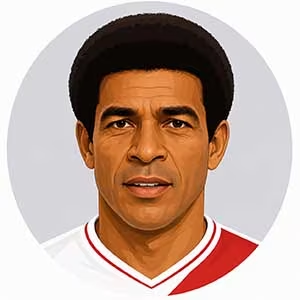
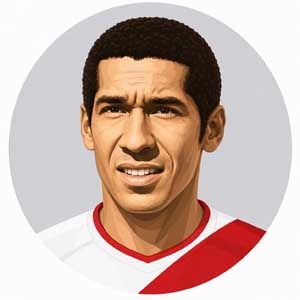
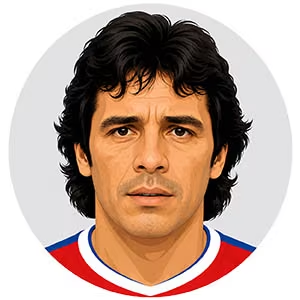
Peru - Centre-backChumpitaz, Héctor
Few leaders in the history of South American football commanded the backline with the moral weight and intellectual serenity of the defender from Cañete. Héctor Eduardo Chumpitaz González, revered across the continent as El Capitán de América, served as the unbreakable tactical spine of Peru's greatest generation. Deployed as a sweeping líbero or central stopper, Chumpitaz transformed defending into an exercise of anticipatory precision: reading attacking passing lanes two steps ahead, dispossessing forwards with surgical standing tackles, and immediately stepping out to launch 40-yard diagonal passes with his precise right foot. At club level, he collected eight Peruvian league titles split between Universitario and Sporting Cristal, while anchoring Universitario to the 1972 Copa Libertadores final. For Peru, across 105 caps and three World Cup campaigns (1970, 1974 qualifiers, and 1978), his defining masterclass arrived in the 1975 Copa América, captaining La Blanquirroja to continental supremacy over Colombia in the final play-off in Caracas.
Nevertheless, Chumpitaz's defensive game had clear physical boundaries. Standing just five-foot-seven, he was noticeably undersized for a classic center-half; against towering six-foot-three European target men who pinned him inside the six-yard box under relentless aerial bombardments, he had to rely entirely on body positioning and timing rather than vertical dominance. Furthermore, his lack of high-end recovery sprint speed made him vulnerable whenever his team played an aggressive high line and rapid opposing wingers broke into open-field footraces behind him.
Commanding, noble, and radiating a natural patriarch's authority, Chumpitaz governed matches without ever raising his voice in anger or resorting to crude violence. He was the definitive anti-cynic: he did not kick ankles off the ball or engage in psychological warfare, relying instead on clean, immaculate timing that demoralized opposing strikers through sheer competence. On the pitch, his presence settled team-wide panic; when stadiums turned hostile or opponents launched desperate late sieges, Chumpitaz remained ice-cold, organizing his backline with quiet, definitive hand gestures. Inside the locker room, his word was sacred law, uniting diverse egos with total respect and absolute dedication to the shirt. Referees viewed him as a model of professional dignity, cementing an immortal legacy as one of the most respected, intelligent, and legendary defensive captains South America has ever seen.