We use Google Analytics to understand how visitors use this site. Analytics cookies are only activated with your consent. For details, read our Privacy Policy.
Profile lensThe same player, read from a different angle.
Athletic84
Acceleration
77
Pace
75
Agility
77
Strength
82
Balance
86
Jumping
95
Stamina
86
Fitness
90
Technical83
Dribbling
78
Short Passing
82
Long Passing
86
Finishing
77
Shot Accuracy
77
Shot Power
90
Shooting Technique
72
Heading
90
Tackling
87
Crossing
79
Free Kick
91
Penalties
89
First Touch
82
Mental87
Composure
84
Aggression
91
Consistency
87
Creativity
75
Leadership
93
Work Rate
88
Tactical85
Vision
85
Off the Ball
75
Defensive Positioning
87
Teamwork
90
Anticipation
85
Marking
88
Player Traits
Attacking80
Crossing
79
Finishing
77
Heading Accuracy
90
Shot Accuracy
77
Off the Ball
75
Technique82
Dribbling
78
Free Kick
91
Short Passing
82
Long Passing
86
First Touch
82
Shot Technique
72
Movement79
Acceleration
77
Pace
75
Agility
77
Balance
86
Physicality89
Shot Power
90
Jumping
95
Stamina
86
Strength
82
Fitness
90
Defending87
Marking
88
Tackling
87
Def. Positioning
87
Mentality & Game Reading87
Aggression
91
Composure
84
Penalties
89
Vision
85
Leadership
93
Work Rate
88
Teamwork
90
Anticipation
85
Consistency
87
Creativity
75
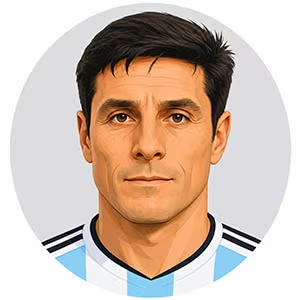
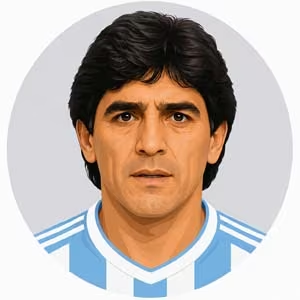
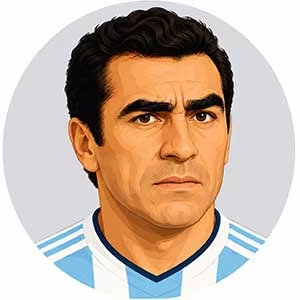
Argentina - SweeperPassarella, Daniel
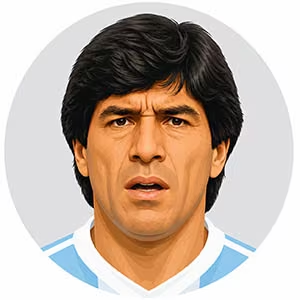
At the Monumental on 25 June 1978, Argentina entered the World Cup final against the Netherlands with Daniel Passarella wearing the captain’s armband at twenty-five. The match became increasingly physical and antagonistic, stretching into extra time before Argentina won 3–1. Passarella’s role extended beyond defending the penalty area. He organised the line, confronted opponents, assumed set pieces and functioned as the visible authority of a team playing under extraordinary home pressure. Earlier in the tournament he had scored the penalty against France that helped secure qualification from the first group stage. When the final ended, he became the first Argentine captain to lift the World Cup. The image fits his reputation, but it can also obscure the mechanism behind it. Passarella did not respond to pressure by reducing his footprint. Competitive tension tended to make him more interventionist: tighter marking, stronger communication, greater willingness to confront and an expanded claim over how the group should behave.
At approximately 1.73 metres, Passarella compensated for an extraordinary height disadvantage at centre-back through timing, leap, aggression and anticipation. He attacked aerial balls rather than waiting beneath them and defended forwards at close range, trying to prevent clean reception before size could become decisive. His left foot added an attacking dimension exceptional for the position. Passarella could distribute progressively, strike long-range passes, take penalties and free kicks and attack set pieces himself; his 134 goals in senior club football and 22 for Argentina reflect genuine scoring function rather than statistical accident. At River Plate he could operate as both stopper and defensive initiator, while spells with Fiorentina and Internazionale demonstrated that the combination survived in Serie A. His aggression was not purely destructive: stepping forward to intercept could immediately become the first attacking action. Later in his career, as physical margins narrowed, experience allowed him to defend with greater positional economy. He therefore combined traditional man-oriented severity with technical responsibilities normally associated with less confrontational defenders.
The same construction created substantial risk. Passarella’s aggressive marking and willingness to step into opponents could generate fouls, disciplinary exposure and spaces behind him when the intervention failed. His extraordinary leap compensated for height but did not eliminate the physical disadvantage in every aerial situation, particularly when forced to defend from a static position against much larger forwards. More importantly for simulation, his drive to impose order could cross the boundary between functional leadership and interpersonal control. Authority was not merely something Passarella exercised when invited; evidence from Argentina suggests he could regard discipline and hierarchy as conditions the group was expected to respect. That made him exceptionally valuable when teammates accepted the structure and potentially disruptive when they did not. This is a genuine degradation condition rather than an aesthetic criticism: a leadership mechanism designed to increase collective control can generate factional conflict when another player possesses enough status to reject that control.
Psychologically, Passarella is best defined by **hierarchical ownership combined with high confrontation readiness**. The conflict with Diego Maradona before the 1986 World Cup provides the clearest evidence. Passarella had captained Argentina to the 1978 title and remained accustomed to substantial authority within the national team, but Carlos Bilardo transferred the captaincy to Maradona. Their relationship deteriorated sharply. Maradona later accused Passarella of attempting to undermine him within the squad; Passarella disputed important elements of Maradona’s account and offered his own criticisms of the younger captain. The disputed allegations should not be treated as established fact. What is securely documented is the underlying struggle over leadership, discipline and legitimacy: the former captain and the new captain became competing centres of authority inside the same group. Passarella’s earlier behaviour makes that conflict more informative than a simple personality clash. He had long exercised leadership through direct instruction, confrontation and enforcement of standards; losing formal captaincy therefore altered not only status but the mechanism through which he had functioned. Yet even here status conflict and competitive withdrawal must remain separate. Passarella stayed with the 1986 squad despite losing the armband, although illness prevented him from appearing in the tournament, and Argentina won without him on the field. Evidence for confrontation with opponents is abundant, but physical/tactical aggression should not automatically become emotional instability; much of his contact was deliberately functional. The more precise conclusion is that **Passarella performed naturally when responsibility and hierarchy reinforced one another, while competing claims to authority could turn his leadership from a stabilising force into a source of internal friction**.