We use Google Analytics to understand how visitors use this site. Analytics cookies are only activated with your consent. For details, read our Privacy Policy.
Profile lensThe same player, read from a different angle.
Athletic79
Acceleration
72
Pace
74
Agility
74
Strength
85
Balance
78
Jumping
85
Stamina
84
Fitness
77
Technical81
Dribbling
77
Short Passing
82
Long Passing
85
Finishing
63
Shot Accuracy
66
Shot Power
85
Shooting Technique
70
Heading
85
Tackling
84
Crossing
79
Free Kick
78
Penalties
78
First Touch
80
Mental83
Composure
87
Aggression
88
Consistency
78
Creativity
71
Leadership
86
Work Rate
81
Tactical81
Vision
82
Off the Ball
68
Defensive Positioning
85
Teamwork
83
Anticipation
83
Marking
83
Player Traits
Attacking72
Crossing
79
Finishing
63
Heading Accuracy
85
Shot Accuracy
66
Off the Ball
68
Technique79
Dribbling
77
Free Kick
78
Short Passing
82
Long Passing
85
First Touch
80
Shot Technique
70
Movement75
Acceleration
72
Pace
74
Agility
74
Balance
78
Physicality83
Shot Power
85
Jumping
85
Stamina
84
Strength
85
Fitness
77
Defending84
Marking
83
Tackling
84
Def. Positioning
85
Mentality & Game Reading82
Aggression
88
Composure
87
Penalties
78
Vision
82
Leadership
86
Work Rate
81
Teamwork
83
Anticipation
83
Consistency
78
Creativity
71
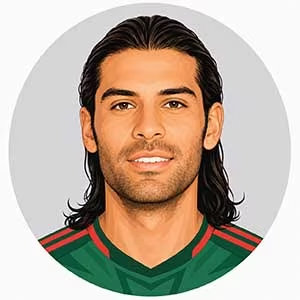
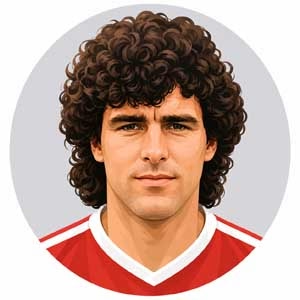
Mexico - SweeperMárquez, Rafael
Surgical spatial anticipation, laser-guided sixty-yard diagonal switches off either foot, and pristine tackling mechanics established Rafael Márquez Álvarez as one of the most intellectually refined central defenders in modern football history. Emerging from Atlas before winning the 1999–2000 Ligue 1 title with AS Monaco, El Káiser de Michoacán achieved European immortality at FC Barcelona under Frank Rijkaard and Pep Guardiola. Capable of operating with equal authority as a ball-playing center-back or a deep-lying defensive anchor (pivote), Márquez was the foundational blueprint for modern playmaking from the back: reading transitions two passes ahead, stepping out of the line to intercept with upright elegance, and spraying pinpoint passes into dynamic wide runners. In Catalonia, he became the first Mexican player to lift the UEFA Champions League, collecting two European crowns (2006, 2009), four La Liga titles, and the 2009 FIFA Club World Cup. For Mexico across 147 caps and 17 goals, his international pedigree was mythic: captaining El Tri at five consecutive World Cups (2002 through 2018), lifting the 1999 FIFA Confederations Cup, and winning three CONCACAF Gold Cups.
Tactically and physically, however, Márquez’s cerebral game had evident boundaries. He lacked explosive recovery sprint speed in wide-open expanses; when isolated against blisteringly fast forwards who turned him into dynamic footraces over thirty yards, he was vulnerable to being bypassed on the half-turn. Furthermore, a latent, combustible temperament occasionally surfaced under extreme tournament friction, leading to moments of undisciplined aggression—most infamously illustrated by his straight red card against the United States at the 2002 World Cup.
Authoritative, dignified, and radiating an imposing aura of natural hierarchy, Márquez led not through hysterical screaming, but through cold, unshakeable tactical command. On the pitch, his body language was imperious: he directed defensive lines with minimal, precise gestures, projecting total calm under suffocating high presses that settled the nerves of his entire back four. Inside the Barcelona and Mexican locker rooms, he was an untouchable alpha and moral leader, holding absolute respect from global megastars like Ronaldinho, Carles Puyol, and Lionel Messi for his tactical pedigree and fearless standard-setting. When physical center-forwards attempted to intimidate him, Márquez absorbed the duel with calculated body positioning, disarming opponents through pristine timing rather than crude violence. Match officials viewed him as an articulate, highly respected captain who managed the tempo of games with veteran mastery, cementing an eternal legacy as the greatest, most decorated, and tactically visionary defender in North American football history.