We use Google Analytics to understand how visitors use this site. Analytics cookies are only activated with your consent. For details, read our Privacy Policy.
Profile lensThe same player, read from a different angle.
Athletic83
Acceleration
85
Pace
77
Agility
77
Strength
84
Balance
78
Jumping
82
Stamina
87
Fitness
92
Technical82
Dribbling
83
Short Passing
84
Long Passing
85
Finishing
71
Shot Accuracy
62
Shot Power
77
Shooting Technique
73
Heading
77
Tackling
84
Crossing
81
Free Kick
68
Penalties
67
First Touch
82
Mental90
Composure
88
Aggression
87
Consistency
92
Creativity
79
Leadership
88
Work Rate
95
Tactical85
Vision
86
Off the Ball
77
Defensive Positioning
85
Teamwork
95
Anticipation
85
Marking
82
Player Traits
Attacking74
Crossing
81
Finishing
71
Heading Accuracy
77
Shot Accuracy
62
Off the Ball
77
Technique79
Dribbling
83
Free Kick
68
Short Passing
84
Long Passing
85
First Touch
82
Shot Technique
73
Movement79
Acceleration
85
Pace
77
Agility
77
Balance
78
Physicality84
Shot Power
77
Jumping
82
Stamina
87
Strength
84
Fitness
92
Defending84
Marking
82
Tackling
84
Def. Positioning
85
Mentality & Game Reading86
Aggression
87
Composure
88
Penalties
67
Vision
86
Leadership
88
Work Rate
95
Teamwork
95
Anticipation
85
Consistency
92
Creativity
79
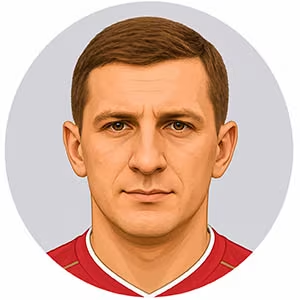
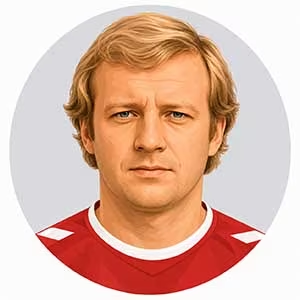
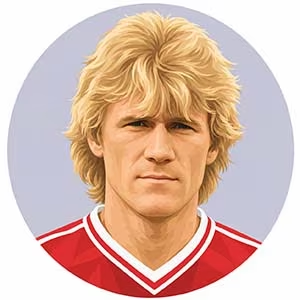
Denmark - SweeperOlsen, Morten
Pristine tactical geometry, total spatial economy, and a sweeping passing range from the back established Morten Per Olsen as the undisputed intellectual commander of the legendary "Danish Dynamite" sides of the 1980s. Developing as a deep central midfielder at B 1901 and Cercle Brugge before Sepp Piontek and Anderlecht converted him into a world-class sweeper in his early thirties, Olsen redefined the libero role for the modern era. He lacked explosive foot speed and physical brutality; instead, his game was a masterclass in anticipation and clean body shape. Stationed behind the defensive line, he read opposition attacking movements two phases ahead, stepping out to intercept through-balls before initiating immediate, line-breaking transitions with raking 40-yard passes off either foot. At RSC Anderlecht, he was the cerebral anchor behind three Belgian league titles and the 1982–83 UEFA Cup triumph over Benfica. Across 102 caps and four goals for Denmark, he captained the national side through their unforgettable, free-flowing campaigns at Euro 1984, the 1986 World Cup in Mexico, and Euro 1988, finishing his playing days with a rock-solid veteran stint at 1. FC Köln.
Authoritative, impeccably disciplined, and didactic to his core, Olsen was a natural manager on the pitch who directed his teammates with the precision of an orchestra conductor. He had zero tolerance for defensive laziness, tactical drift, or reckless individual adventurism, holding flamboyant stars like Preben Elkjær and Michael Laudrup to strict positional duties through sharp, uninterrupted vocal commands. On the pitch, his emotional pulse was remarkably low; whether navigating hostile Latin American cauldrons in 1986 or defending a slender lead in Brussels, he projected an aura of total security that prevented structural panic across the back four. Inside the dressing room, he was the essential cultural bridge between Piontek’s German discipline and the free-spirited, bohemian creativity of the Danish squad, commanding unconditional reverence through his impeccable professionalism and spotless lifestyle. When physical center-forwards attempted to turn duels into wrestling matches, Olsen refused to engage on their terms, using intelligent off-the-ball retreats and surgical slide-interceptions to win possession cleanly. Referees and opponents regarded him as a stern, aristocratic statesman—a defender who never resorted to dirty tricks, cementing an enduring reputation as one of the most intelligent, refined sweepers in European history.


 All Time DenmarkNT