We use Google Analytics to understand how visitors use this site. Analytics cookies are only activated with your consent. For details, read our Privacy Policy.
Profile lensThe same player, read from a different angle.
Athletic81
Acceleration
73
Pace
76
Agility
74
Strength
85
Balance
82
Jumping
82
Stamina
84
Fitness
90
Technical79
Dribbling
75
Short Passing
81
Long Passing
77
Finishing
52
Shot Accuracy
61
Shot Power
82
Shooting Technique
63
Heading
85
Tackling
85
Crossing
63
Free Kick
66
Penalties
68
First Touch
78
Mental87
Composure
87
Aggression
75
Consistency
87
Creativity
71
Leadership
91
Work Rate
85
Tactical80
Vision
76
Off the Ball
62
Defensive Positioning
87
Teamwork
82
Anticipation
86
Marking
83
Attacking65
Crossing
63
Finishing
52
Heading Accuracy
85
Shot Accuracy
61
Off the Ball
62
Technique73
Dribbling
75
Free Kick
66
Short Passing
81
Long Passing
77
First Touch
78
Shot Technique
63
Movement76
Acceleration
73
Pace
76
Agility
74
Balance
82
Physicality85
Shot Power
82
Jumping
82
Stamina
84
Strength
85
Fitness
90
Defending85
Marking
83
Tackling
85
Def. Positioning
87
Mentality & Game Reading81
Aggression
75
Composure
87
Penalties
68
Vision
76
Leadership
91
Work Rate
85
Teamwork
82
Anticipation
86
Consistency
87
Creativity
71
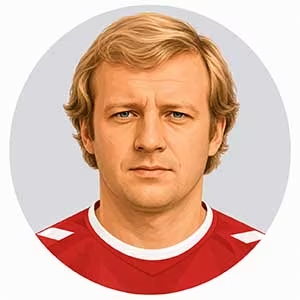
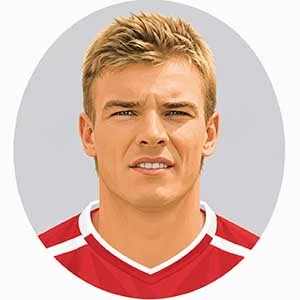
Denmark - SweeperOlsen, Lars
While the world was captivated by the romantic fairy tale of Denmark’s triumph at Euro 1992, the tactical architecture that made the miracle possible was anchored by the quiet, cerebral mastery of its sweeper and captain, Lars Christian Olsen. Operating at the heart of Brøndby IF’s dominant golden era under Morten Olsen and later showcasing his class abroad with Trabzonspor, RFC Seraing, and FC Basel, Olsen was the quintessential positional conductor. Never reliant on explosive physical speed or bone-shattering collisions, his game was elevated by an almost clairvoyant anticipation of opposing attacking passing lanes. Technically, he governed the backline with an upright posture, pristine slide-tackling timing without committing fouls, and a razor-sharp, low-trajectory vertical distribution that instantly transitioned defense into attack. Leading Brøndby to six Danish championships and an unforgettable run to the 1990–91 UEFA Cup semi-finals, Olsen was the undisputed defensive heartbeat of the national team across 84 caps, culminating in the immortal summer in Sweden where he hoisted the Henri Delaunay trophy as the captain of the European champions. Mentally and emotionally, Olsen was the absolute personification of stoic Nordic serenity, diplomatic intelligence, and ego-free authority. He led not through explosive screaming or theatrical gestures, but through an aura of profound, unshakeable calm that naturally stabilized those around him during high-friction tournament sieges. Inside the dressing room, he was the essential unifying glue and trusted bridge between coach Richard Møller Nielsen and a fiercely independent squad, managing explosive dressing-room dynamics with tact, maturity, and understated warmth. Under maximum international pressure—such as facing the relentless attacking barrage of the Netherlands and unified Germany in 1992—his heart rate appeared virtually unchanged, organizing Denmark’s defensive shell with mathematical clarity and refusing to allow panic to penetrate his backline. Toward match officials and physical opposing center-forwards, Olsen maintained an impeccably clean, gentlemanly standard: he avoided gamesmanship, never engaged in cynical off-the-ball antics, and asserted his dominance through tactical intelligence and immaculate sportsmanship, leaving an enduring legacy as one of the most respected and dignified captains in Scandinavian football history.


 All Time DenmarkNT