We use Google Analytics to understand how visitors use this site. Analytics cookies are only activated with your consent. For details, read our Privacy Policy.
Profile lensThe same player, read from a different angle.
Athletic79
Acceleration
77
Pace
76
Agility
75
Strength
82
Balance
78
Jumping
79
Stamina
85
Fitness
78
Technical75
Dribbling
74
Short Passing
75
Long Passing
77
Finishing
58
Shot Accuracy
62
Shot Power
76
Shooting Technique
67
Heading
81
Tackling
82
Crossing
74
Free Kick
62
Penalties
60
First Touch
72
Mental78
Composure
78
Aggression
78
Consistency
80
Creativity
68
Leadership
70
Work Rate
87
Tactical77
Vision
69
Off the Ball
68
Defensive Positioning
82
Teamwork
80
Anticipation
78
Marking
83
Attacking69
Crossing
74
Finishing
58
Heading Accuracy
81
Shot Accuracy
62
Off the Ball
68
Technique71
Dribbling
74
Free Kick
62
Short Passing
75
Long Passing
77
First Touch
72
Shot Technique
67
Movement77
Acceleration
77
Pace
76
Agility
75
Balance
78
Physicality80
Shot Power
76
Jumping
79
Stamina
85
Strength
82
Fitness
78
Defending82
Marking
83
Tackling
82
Def. Positioning
82
Mentality & Game Reading75
Aggression
78
Composure
78
Penalties
60
Vision
69
Leadership
70
Work Rate
87
Teamwork
80
Anticipation
78
Consistency
80
Creativity
68
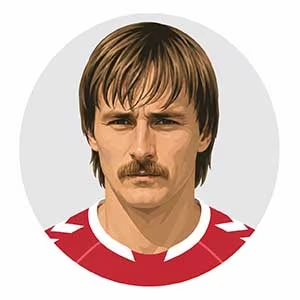
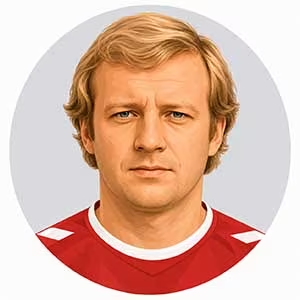
Denmark - Left BackHansen, Johnny
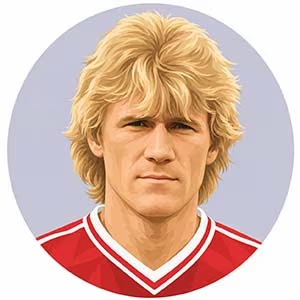
The defensive flank of Bayern Munich’s historic three-peat of European Cup victories in the mid-1970s was anchored by a durable, red-haired Danish full-back whose spotless tactical discipline made him one of the most reliable imports in early Bundesliga history. Johnny Terney Hansen was the quiet, uncompromising right-back and central defender who provided the positional balance and physical security behind Franz Beckenbauer’s sweeping adventures and Uli Hoeneß’s blistering forward runs.
Forged at Vejle Boldklub—where he won the 1967 Danish Footballer of the Year award—Hansen moved to Bayern Munich in 1970 under Udo Lattek. Across 214 matches and seven goals for the Bavarian giants between 1970 and 1976, he collected three consecutive Bundesliga titles (1972, 1973, 1974), the 1971 DFB-Pokal, and three consecutive European Cups (1974, 1975, 1976), famously scoring Bayern’s second goal in the 1976 Intercontinental Cup triumph over Cruzeiro in Munich. For Denmark, across 44 caps and three goals between 1965 and 1978, he was a foundational international leader during the era before professional players were fully integrated into the national setup.
Hansen’s game was rooted firmly in containment, physical tenacity, and low-risk distribution rather than spectacular attacking trickery. He was not a modern, dynamic wing-back who sprinted the length of the pitch to deliver curling crosses from the corner flag; his primary responsibility was to lock down his flank, win one-on-one defensive duels, and immediately cycle possession to Paul Breitner or Beckenbauer. When confronted by lightning-fast, elusive wingers who possessed sharp changes of direction, he had to rely strictly on body positioning and tackling timing rather than raw recovery pace.
Stoic, industrious, and carrying the understated professionalism of an old-school Nordic artisan, Hansen was the dream teammate who embraced the unglamorous defensive dirty work without chasing the spotlight. He never engaged in volatile outbursts, petulant fouls, or media controversies, earning the deep respect of Bayern’s volatile dressing room through pristine work ethic and total dependability in high-stakes continental finals. On the pitch, his presence was steady and unshakeable: marking wingers with relentless concentration, executing clean slide tackles without conceding fouls, and maintaining defensive compactness across ninety minutes. Inside the Olympic Stadium locker room, he was an indispensable, quietly celebrated soldier whose consistency helped forge one of the greatest dynasties in European club football history.


 All Time DenmarkNT