We use Google Analytics to understand how visitors use this site. Analytics cookies are only activated with your consent. For details, read our Privacy Policy.
Profile lensThe same player, read from a different angle.
Athletic83
Acceleration
85
Pace
82
Agility
85
Strength
76
Balance
78
Jumping
82
Stamina
92
Fitness
85
Technical79
Dribbling
79
Short Passing
78
Long Passing
83
Finishing
70
Shot Accuracy
70
Shot Power
78
Shooting Technique
72
Heading
76
Tackling
77
Crossing
82
Free Kick
70
Penalties
68
First Touch
80
Mental82
Composure
85
Aggression
82
Consistency
87
Creativity
72
Leadership
70
Work Rate
86
Tactical80
Vision
78
Off the Ball
73
Defensive Positioning
80
Teamwork
85
Anticipation
82
Marking
82
Player Traits
Attacking74
Crossing
82
Finishing
70
Heading Accuracy
76
Shot Accuracy
70
Off the Ball
73
Technique77
Dribbling
79
Free Kick
70
Short Passing
78
Long Passing
83
First Touch
80
Shot Technique
72
Movement83
Acceleration
85
Pace
82
Agility
85
Balance
78
Physicality83
Shot Power
78
Jumping
82
Stamina
92
Strength
76
Fitness
85
Defending80
Marking
82
Tackling
77
Def. Positioning
80
Mentality & Game Reading80
Aggression
82
Composure
85
Penalties
68
Vision
78
Leadership
70
Work Rate
86
Teamwork
85
Anticipation
82
Consistency
87
Creativity
72
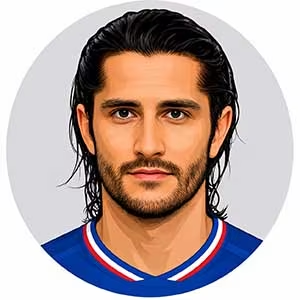
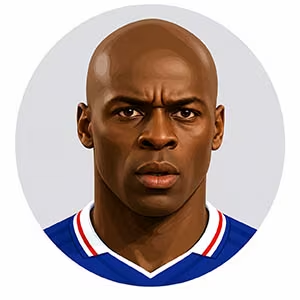
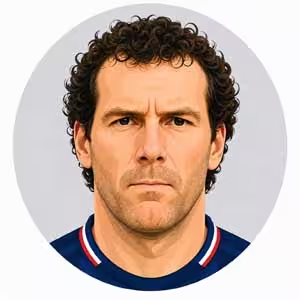
France - Left BackLizarazu, Bixente
The Basque coastline forged a relentless five-foot-seven athlete who transformed the left-back position into a tireless, two-way highway for club and country throughout the late 1990s and early 2000s. After anchoring Bordeaux’s historic run to the 1996 UEFA Cup final alongside Zinedine Zidane and a brief stint at Athletic Bilbao, Bixente Lizarazu moved to Bayern Munich in 1997 to establish himself as one of the most decorated full-backs of all time. Combining an elite cardiovascular engine with explosive recovery pace and pristine tackling fundamentals, he locked down his flank defensively while providing continuous overlapping width and laser-accurate low crosses. Over eight seasons in Bavaria across two spells, he won six Bundesliga titles, five DFB-Pokals, the 2001 UEFA Champions League, and the 2001 Intercontinental Cup. For France, across 97 caps and two goals, he was an irreplaceable pillar of Aimé Jacquet and Roger Lemerre’s historic golden generation, lifting the 1998 World Cup and Euro 2000 as an undisputed starter.
Naturally, his compact frame presented clear structural liabilities. Standing well under five-foot-eight, Lizarazu was a regular target for towering target men on diagonal switches and back-post aerial deliveries, requiring his left-sided center-back to provide constant aerial coverage. When forced into physical wrestling matches against bruising, heavy wide forwards, he had to rely on anticipation rather than brute force. Furthermore, muscular calf and thigh strains repeatedly disrupted his rhythm during congested autumn European campaigns.
Disciplined, fiercely proud, and trained in martial arts (later becoming a European Brazilian Jiu-Jitsu champion), Lizarazu carried the unyielding mindset of a combat athlete onto the football pitch. He feared no one: whether facing David Beckham, Luís Figo, or towering wingers, he neutralized threats through relentless spatial denial and aggressive, clean standing tackles. On the pitch, his body language was focused and professional; he did not engage in unnecessary theatrics, letting his extraordinary work rate and tactical discipline speak for him. Inside the French and Bayern locker rooms, he was a universally respected leader—calm, highly articulate, and an essential cultural bridge who earned the deep admiration of demanding captains like Oliver Kahn and Didier Deschamps. Referees admired his spotless sportsmanship, while opposing wingers universally dreaded the exhausting physical battle of facing him over ninety minutes, cementing an eternal legacy as one of the most complete, consistent, and decorated left-backs in modern football history.