We use Google Analytics to understand how visitors use this site. Analytics cookies are only activated with your consent. For details, read our Privacy Policy.
Profile lensThe same player, read from a different angle.
Athletic84
Acceleration
89
Pace
87
Agility
86
Strength
73
Balance
75
Jumping
83
Stamina
93
Fitness
88
Technical79
Dribbling
78
Short Passing
77
Long Passing
82
Finishing
66
Shot Accuracy
66
Shot Power
83
Shooting Technique
73
Heading
74
Tackling
79
Crossing
81
Free Kick
70
Penalties
68
First Touch
81
Mental85
Composure
85
Aggression
82
Consistency
91
Creativity
71
Leadership
82
Work Rate
85
Tactical80
Vision
76
Off the Ball
74
Defensive Positioning
77
Teamwork
84
Anticipation
83
Marking
85
Player Traits
Attacking72
Crossing
81
Finishing
66
Heading Accuracy
74
Shot Accuracy
66
Off the Ball
74
Technique77
Dribbling
78
Free Kick
70
Short Passing
77
Long Passing
82
First Touch
81
Shot Technique
73
Movement84
Acceleration
89
Pace
87
Agility
86
Balance
75
Physicality84
Shot Power
83
Jumping
83
Stamina
93
Strength
73
Fitness
88
Defending80
Marking
85
Tackling
79
Def. Positioning
77
Mentality & Game Reading81
Aggression
82
Composure
85
Penalties
68
Vision
76
Leadership
82
Work Rate
85
Teamwork
84
Anticipation
83
Consistency
91
Creativity
71
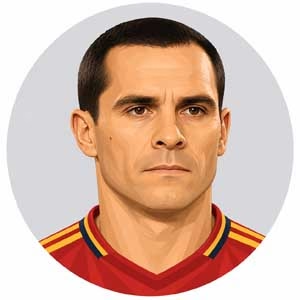
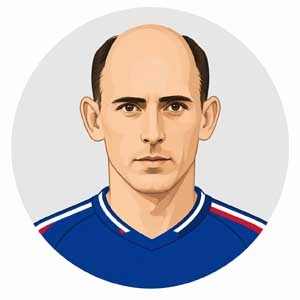
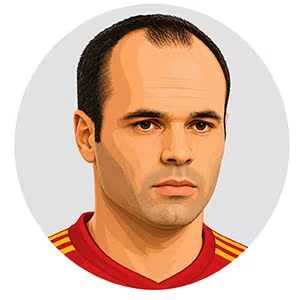
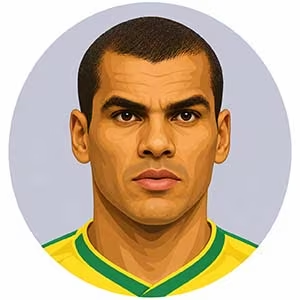
Spain - Left BackSergi
Johan Cruyff did not hesitate in late 1993 to pluck an unproven 21-year-old straight out of Barcelona B and drop him directly into a high-voltage Champions League clash against Galatasaray. Sergi Barjuán rewarded that gamble by seizing the left-back slot for nearly a decade, becoming the dynamic touchline locomotive of both the fading Dream Team and Louis van Gaal’s title-winning setups. Standing just five-foot-seven, Sergi compensated for his compact frame with electric short-burst acceleration, relentless cardiovascular stamina, and aggressive overlapping runs that dragged opposing defenders deep into their own corners. Across nearly four hundred appearances in the blaugrana shirt before concluding his top-flight career at Atlético Madrid, he amassed three La Liga titles (1994, 1998, 1999), two Copas del Rey, the 1997 UEFA Cup Winners' Cup, and the 1997 UEFA Super Cup. For Spain, he earned 56 caps, serving as the undisputed starting left-back at two World Cups (1994, 1998) and two European Championships (1996, 2000).
Naturally, such a hyper-aggressive wide profile left structural cracks at the back. Because he constantly positioned himself in the final third to offer crossing width, expansive spatial voids opened behind him during rapid counter-attacks. His aerial output was virtually non-existent when defending deep diagonal switches to the far post, and his delivery into the penalty box—while delivered at high velocity—frequently lacked nuanced flight and pinpoint accuracy.
Fiercely competitive, fiery, and playing with a permanent blue-collar urgency, Sergi was a relentless competitor who approached every match with aggressive intensity. He never backed down from a confrontation: when matched against taller, physically imposing wide forwards, he used low leverage, aggressive body checks, and sharp slide tackles to disrupt their stride before they could build momentum. On the pitch, his body language radiated non-stop motion, tracking back sixty yards to correct his own attacking over-commitments with desperate, sliding recoveries. Inside the Camp Nou and Spanish national team dressing rooms, he was an essential, low-maintenance teammate—vocal in match battles, deeply loyal to local Catalan veterans like Pep Guardiola and Albert Ferrer, and trusted implicitly by managers for his uncomplaining tactical self-sacrifice. Referees found him a combative, persistent figure who often tested the limits of touchline fouls, cementing his legacy as one of the most energetic, iconic, and decorated Spanish full-backs of the 1990s.