We use Google Analytics to understand how visitors use this site. Analytics cookies are only activated with your consent. For details, read our Privacy Policy.
Profile lensThe same player, read from a different angle.
Athletic83
Acceleration
81
Pace
85
Agility
78
Strength
81
Balance
78
Jumping
80
Stamina
90
Fitness
90
Technical78
Dribbling
79
Short Passing
76
Long Passing
82
Finishing
73
Shot Accuracy
69
Shot Power
85
Shooting Technique
72
Heading
72
Tackling
79
Crossing
79
Free Kick
73
Penalties
76
First Touch
78
Mental81
Composure
80
Aggression
85
Consistency
80
Creativity
71
Leadership
83
Work Rate
83
Tactical78
Vision
78
Off the Ball
77
Defensive Positioning
77
Teamwork
80
Anticipation
80
Marking
77
Attacking74
Crossing
79
Finishing
73
Heading Accuracy
72
Shot Accuracy
69
Off the Ball
77
Technique77
Dribbling
79
Free Kick
73
Short Passing
76
Long Passing
82
First Touch
78
Shot Technique
72
Movement81
Acceleration
81
Pace
85
Agility
78
Balance
78
Physicality85
Shot Power
85
Jumping
80
Stamina
90
Strength
81
Fitness
90
Defending78
Marking
77
Tackling
79
Def. Positioning
77
Mentality & Game Reading80
Aggression
85
Composure
80
Penalties
76
Vision
78
Leadership
83
Work Rate
83
Teamwork
80
Anticipation
80
Consistency
80
Creativity
71
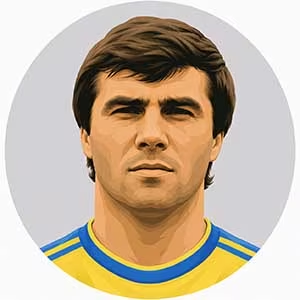
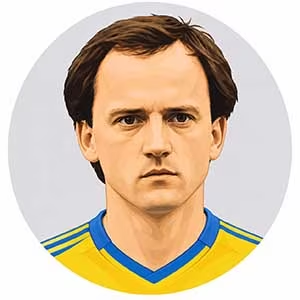
Ukraine - Left BackDemyanenko, Anatoliy
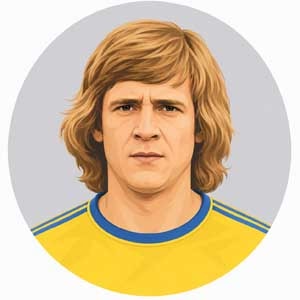
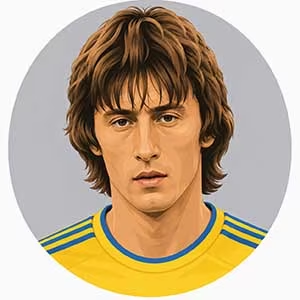
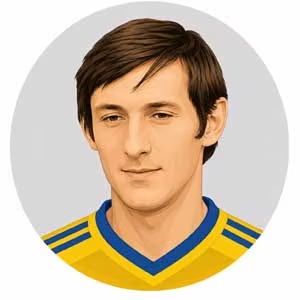
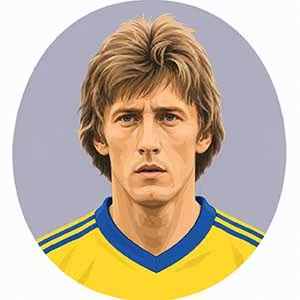
Demyanenko was primarily a left-back, although the position in Lobanovskyi’s Dynamo demanded considerably more than conventional flank defending. Around 1.80 metres tall, athletic and exceptionally durable, he combined acceleration and stamina with clean technique on his left foot. He defended proactively, stepping toward opponents and recovering quickly when the line moved, but his greatest tactical value came from repeated transitions between phases. He overlapped, carried possession through midfield, exchanged positions with teammates and appeared surprisingly high without abandoning his responsibility to recover. His passing was secure and purposeful rather than decorative, and he could strike powerfully when arriving outside the penalty area. The system demanded universal participation: defenders had to attack, attackers had to press, and distances between players had to remain coordinated. Demyanenko became one of its ideal interpreters. After emerging with Dnipro, he joined Dynamo Kyiv in 1979 and remained through the club’s dominant 1980s cycle, winning five Soviet league championships, four Soviet Cups and the 1986 Cup Winners’ Cup. He was named Soviet Footballer of the Year in 1985 and captained Dynamo during its European triumph. Late in his career he played briefly for Magdeburg and Widzew Łódź before returning to Dynamo. Internationally he accumulated 80 caps for the Soviet Union, captained the national side and appeared at the 1982, 1986 and 1990 World Cups as well as Euro 1988, where the USSR reached the final.
The physical and tactical demands that made Demyanenko valuable also defined his failure conditions. His forward movement depended on extraordinary running capacity and collective synchronisation; if possession was lost while teammates failed to cover, space could appear behind him. He was an excellent all-round footballer rather than an exceptional one-on-one creator, so against compact opponents who removed the possibility of overlapping he could contribute circulation without independently destabilising the defence. His proactive positioning also carried risk against fast counterattacks if the collective press was broken. Most importantly, his game was highly system-dependent. Lobanovskyi’s structure amplified his intelligence, endurance and versatility because teammates moved according to shared principles. In a disorganised side, the same willingness to advance could become exposure rather than advantage. As age reduced his athletic range, maintaining the enormous two-way workload inevitably became harder; his effectiveness depended more heavily on physical condition than that of a conservative full-back.
Psychologically, Demyanenko’s career provides unusually strong behavioural evidence for disciplined endurance. Lobanovskyi’s training environment was deliberately demanding, with workloads measured scientifically and players expected to repeat coordinated actions under fatigue. Demyanenko did not merely survive that regime: he remained central to it for more than a decade and eventually became captain, which implies that coaches trusted him not only to complete the work but to embody its standards for others. Former Dynamo players have described an environment in which individual preference was routinely subordinated to collective preparation. Demyanenko’s longevity within it shows little evidence of resistance to demanding authority when the demands were connected to a coherent footballing purpose. Yet obedience should not be mistaken for passivity. As captain he had to communicate positioning, maintain collective concentration and continue advancing from defence even when fatigue made conservatism personally safer. His leadership was therefore operational: credibility came from performing the same burdens he expected teammates to accept. Major occasions generally preserved that behaviour. He captained Dynamo through the 1986 European campaign and remained a starting defender when the Soviet Union reached the Euro 1988 final, suggesting that pressure did not substantially narrow his willingness to participate in both phases. There is little reliable evidence of habitual retaliation after fouls, prolonged disputes with referees or public conflict with coaches. Physical confrontation was absorbed into the task rather than converted into personal hostility. Failure also appears to have produced continuation rather than public blame. The Soviet Union’s disappointing World Cup outcomes, including elimination in 1986 after a tournament in which their football had initially looked dominant, did not lead Demyanenko to distance himself from the collective model; he continued under Lobanovskyi and captained the national side afterward. His later willingness to play abroad, after spending most of his prime inside a highly specific Soviet football culture, also indicates some environmental adaptability, although those late spells never reproduced his Dynamo importance. The defining psychological mechanism is therefore not emotional coldness but internalised structure. Demyanenko appears to have reduced uncertainty by trusting preparation, repetition and collective organisation. Under pressure he did not need to invent a different emotional response; he returned to the system he had trained to execute.