We use Google Analytics to understand how visitors use this site. Analytics cookies are only activated with your consent. For details, read our Privacy Policy.
Profile lensThe same player, read from a different angle.
Athletic82
Acceleration
84
Pace
86
Agility
81
Strength
75
Balance
80
Jumping
79
Stamina
92
Fitness
81
Technical79
Dribbling
85
Short Passing
79
Long Passing
85
Finishing
73
Shot Accuracy
66
Shot Power
80
Shooting Technique
71
Heading
74
Tackling
69
Crossing
84
Free Kick
74
Penalties
73
First Touch
77
Mental81
Composure
83
Aggression
84
Consistency
74
Creativity
72
Leadership
87
Work Rate
82
Tactical73
Vision
83
Off the Ball
77
Defensive Positioning
64
Teamwork
72
Anticipation
75
Marking
64
Player Traits
Attacking75
Crossing
84
Finishing
73
Heading Accuracy
74
Shot Accuracy
66
Off the Ball
77
Technique79
Dribbling
85
Free Kick
74
Short Passing
79
Long Passing
85
First Touch
77
Shot Technique
71
Movement83
Acceleration
84
Pace
86
Agility
81
Balance
80
Physicality81
Shot Power
80
Jumping
79
Stamina
92
Strength
75
Fitness
81
Defending66
Marking
64
Tackling
69
Def. Positioning
64
Mentality & Game Reading79
Aggression
84
Composure
83
Penalties
73
Vision
83
Leadership
87
Work Rate
82
Teamwork
72
Anticipation
75
Consistency
74
Creativity
72
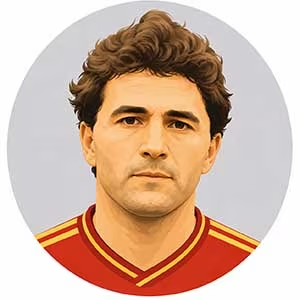
Spain - Left BackGordillo, Rafael
Socks rolled completely down to his ankles with no shin guards, bursting down the left touchline with his tongue hanging out and lungs burning at full tilt, Rafael Gordillo Vázquez provided the most electrifying visual trademark in Spanish football during the late 1970s and 1980s. Emerging as an iconic hometown hero at Real Betis—where he won the 1977 Copa del Rey and was crowned Spanish Player of the Year in 1979–80—the Almendralejo-born dynamo joined Real Madrid in 1985 to become the unstoppable left-sided locomotive of the Quinta del Buitre. Operating as an attacking left wing-back, traditional left-back, or wide midfielder, Gordillo combined terrifying linear pace with immense stamina and an exceptional left-footed crossing delivery on the full sprint. Over seven seasons at the Santiago Bernabéu across 254 matches, he swept five consecutive La Liga championships (1986–1990), the 1985–86 UEFA Cup, and the 1989 Copa del Rey (scoring the match-winning header in the final against Real Valladolid), before returning to his beloved Betis. For Spain, across 75 caps and three goals, he was a pivotal starter across two World Cups (1982, 1986) and three European Championships, spearheading the run to the Euro 1984 final in France.
Naturally, such a hyper-aggressive, direct style came with clear tactical boundaries. Gordillo was an open-field linear runner rather than an intricate, tight-space combinator; when forced into congested central corridors against ultra-compact defenses that denied him a sprinting runway down the touchline, his technical contribution was less effective. Furthermore, his relentless attacking surges frequently left expansive defensive territory behind him on the left flank, demanding disciplined covering from his left-sided center-half to prevent opposition counter-attacks.
Charismatic, passionately authentic, and universally adored across Spain for his joyful, unpretentious nature, Gordillo was the rare superstar who transcended fierce club rivalries. He played with an infectious, wild freedom that brought terraces to their feet, charging forward with a distinctive galloping stride that looked like organized chaos. On the pitch, his presence radiated pure kinetic energy: running until total exhaustion, delivering dangerous crosses, and bouncing back instantly from heavy fouls with an easy smile. Inside the Betis, Real Madrid, and Spanish dressing rooms, he was an indispensable cultural spirit—immensely funny, humble, and loved by teammates like Emilio Butragueño, Hugo Sánchez, and Camacho for his total absence of ego. Referees admired his honest, non-cynical sportsmanship, leaving behind an immortal legacy as one of the most dynamic, beloved, and iconic wide players in the history of Spanish football.


 All Time SpainNT