We use Google Analytics to understand how visitors use this site. Analytics cookies are only activated with your consent. For details, read our Privacy Policy.
Profile lensThe same player, read from a different angle.
Athletic83
Acceleration
93
Pace
91
Agility
89
Strength
72
Balance
78
Jumping
79
Stamina
80
Fitness
78
Technical81
Dribbling
85
Short Passing
74
Long Passing
74
Finishing
86
Shot Accuracy
82
Shot Power
86
Shooting Technique
72
Heading
77
Tackling
41
Crossing
67
Free Kick
72
Penalties
88
First Touch
78
Mental79
Composure
85
Aggression
88
Consistency
76
Creativity
75
Leadership
74
Work Rate
78
Tactical81
Vision
76
Off the Ball
86
Defensive Positioning
38
Teamwork
75
Anticipation
87
Marking
38
Player Traits
Attacking80
Crossing
67
Finishing
86
Heading Accuracy
77
Shot Accuracy
82
Off the Ball
86
Technique76
Dribbling
85
Free Kick
72
Short Passing
74
Long Passing
74
First Touch
78
Shot Technique
72
Movement88
Acceleration
93
Pace
91
Agility
89
Balance
78
Physicality79
Shot Power
86
Jumping
79
Stamina
80
Strength
72
Fitness
78
Defending39
Marking
38
Tackling
41
Def. Positioning
38
Mentality & Game Reading80
Aggression
88
Composure
85
Penalties
88
Vision
76
Leadership
74
Work Rate
78
Teamwork
75
Anticipation
87
Consistency
76
Creativity
75
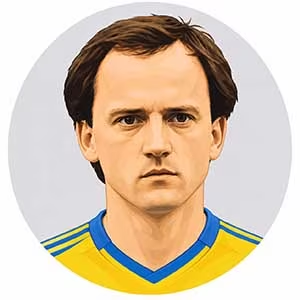
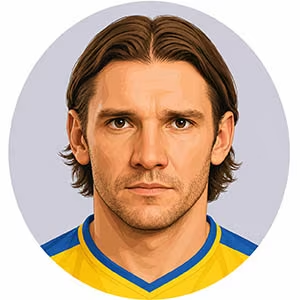
Ukraine - StrikerBelanov, Igor
Sprint-speed velocity clocked at under eleven seconds over one hundred meters, razor-sharp diagonal darts behind high defensive lines, and sudden laces-down shooting on the run made Igor Ivanovich Belanov the ultimate transition weapon of Valeriy Lobanovskyi’s scientific Dynamo Kyiv. Developed at SKA Odesa and Chornomorets before arriving in Kyiv in 1985, the Ukrainian striker became the dynamic tip of Europe’s most synchronized pressing machine. Standing five-foot-eight with explosive leg drive, low center of gravity, and relentless linear burst, Belanov was built specifically for sudden collective counter-thrusts: attacking open channels the instant possession was turned over, latching onto vertical service from Oleksandr Zavarov and Vasyl Rats, and striking cleanly off either foot without breaking stride. In 1986, he enjoyed a career-defining year, capturing the Soviet Top League, the European Cup Winners' Cup (scoring five goals throughout the tournament, including the final against Atlético Madrid), and the 1986 Ballon d'Or ahead of Gary Lineker. For the Soviet Union across 33 caps and eight goals, his international zenith arrived at the 1986 World Cup in Mexico, highlighted by a breathtaking hat-trick in the thrilling 4–3 round-of-sixteen clash against Belgium, followed by anchoring the USSR attack to the final of Euro 1988.
Yet Belanov’s hyper-specialized profile possessed unforgiving tactical and structural boundaries. He was a system-dependent forward who required space, collective synchronization, and forward passing momentum to thrive; when confronted by congested low blocks that denied him sprint space, his tight-space technical dribbling was rudimentary, his aerial presence was negligible, and his back-to-goal hold-up play was easily smothered by physical stoppers. His subsequent 1989 transfer to the Bundesliga with Borussia Mönchengladbach and later Eintracht Braunschweig ruthlessly exposed these limitations: stripped of Lobanovskyi’s rigorous physical conditioning and tactical scaffolding, he struggled to create chances independently in slower, static attacking structures. His international legacy was also marked by a critical tournament failure, seeing his central penalty saved by Hans van Breukelen in the Euro 1988 final.
Disciplined, unpretentious, and completely molded by the collectivist ethos of the Soviet sporting system, Belanov approached professional football as an exercise in high-intensity labor. He had zero interest in individual vanity or stylistic self-indulgence; his entire game was built on relentless physical sacrifice and total tactical obedience to the manager’s tactical blueprints. On the pitch, his body language was earnest and urgent: he pressed opposing center-backs tirelessly from the front, made repeated thirty-yard decoy runs without complaint, and never allowed physical fouling to disrupt his sprint patterns. Inside the Kyiv and Soviet locker rooms, he was an understated, low-maintenance teammate who integrated seamlessly among dominant figures like Oleg Blokhin and Rinat Dasayev, earning deep respect through his ferocious training habits. When marked by bruising stoppers who attempted to body-check him off his stride, Belanov absorbed the contact with balance, relying on his explosive acceleration to leave defenders trailing on the next transition. Referees found him honest and completely devoid of gamesmanship, leaving behind an enduring legacy as one of the most explosive, direct, and system-perfect counter-attacking forwards in European football history.