We use Google Analytics to understand how visitors use this site. Analytics cookies are only activated with your consent. For details, read our Privacy Policy.
Profile lensThe same player, read from a different angle.
Athletic86
Acceleration
96
Pace
94
Agility
84
Strength
85
Balance
77
Jumping
83
Stamina
82
Fitness
84
Technical90
Dribbling
93
Short Passing
85
Long Passing
82
Finishing
92
Shot Accuracy
97
Shot Power
85
Shooting Technique
92
Heading
70
Tackling
41
Crossing
83
Free Kick
85
Penalties
88
First Touch
94
Mental83
Composure
90
Aggression
73
Consistency
82
Creativity
92
Leadership
79
Work Rate
74
Tactical85
Vision
84
Off the Ball
91
Defensive Positioning
35
Teamwork
81
Anticipation
86
Marking
37
Player Traits
Attacking87
Crossing
83
Finishing
92
Heading Accuracy
70
Shot Accuracy
97
Off the Ball
91
Technique89
Dribbling
93
Free Kick
85
Short Passing
85
Long Passing
82
First Touch
94
Shot Technique
92
Movement88
Acceleration
96
Pace
94
Agility
84
Balance
77
Physicality84
Shot Power
85
Jumping
83
Stamina
82
Strength
85
Fitness
84
Defending38
Marking
37
Tackling
41
Def. Positioning
35
Mentality & Game Reading83
Aggression
73
Composure
90
Penalties
88
Vision
84
Leadership
79
Work Rate
74
Teamwork
81
Anticipation
86
Consistency
82
Creativity
92
Curated interpretation
Signature Moves
Role-defining patterns—not attributes, traits or Inner Game measures. Three ways Thierry Henry changes the meaning of the role around him.
01
Due North
His instinct points only one way: forward, in the straightest line the pitch allows.
02
Foreigner at Home
A Frenchman who becomes more Highbury than Highbury itself.
03
Poetry in Motion
An acceleration that looks less like effort and more like verse.
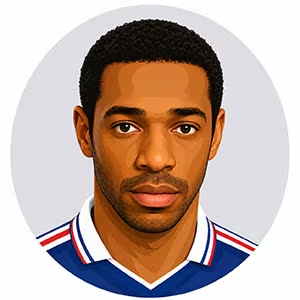
France - StrikerHenry, Thierry
Thierry Henry ran differently from almost every forward around him. His stride was long, loose and almost gazelle-like, the upper body appearing unusually relaxed while each extension of the leg consumed enormous ground. Defenders could seem correctly positioned when he began moving and already be chasing him two steps later. The geometry of his Arsenal game grew from that movement. Henry would drift towards the left rather than remain between the centre-backs, receive while facing forward and accelerate diagonally towards goal, using the open pitch to stretch his stride before the defender could convert the contest into contact. The trademark finish followed naturally: open the body and pass the ball with the inside of the right foot towards the far corner. What looked graceful was mechanically ruthless. Henry repeatedly created the same situation while defenders knew precisely what he wanted, because stopping it required controlling both the enormous space covered by his running and the technical decision available at the end of it.
Henry began as a wide forward and became a central striker without ever surrendering the instincts of a winger. Arsène Wenger’s conversion at Arsenal gave him the freedom to leave the centre, attack from the left and then re-enter scoring zones rather than occupy them permanently. His acceleration, close control at speed and exceptional balance made him devastating in transition, but his passing prevented defenders from treating every carry as a shot attempt. Henry could slow near the penalty area, draw a second opponent and release an overlapping runner or reverse the ball through the defensive line. He consequently became both Arsenal’s record scorer and an elite creator, including a Premier League-record 20 assists in 2002–03. His 2003–04 season embodied the complete version: 30 league goals while Arsenal completed the championship unbeaten. Later at Barcelona, physical dominance was less central and Henry accepted a more fixed left-sided role within a possession structure built around different attacking relationships. That adaptation produced another major peak with the 2008–09 treble.
There were genuine limitations behind the breadth. Despite being around 1.88 metres, Henry was never an aerially dominant centre-forward and generally preferred attacking space to prolonged wrestling with centre-backs. His movement towards the left could also leave the penalty area without its nominal striker if teammates failed to occupy the space he had vacated. When opponents defended deep enough to remove the runway required for his long acceleration, Henry remained technically dangerous but lost one of his most overwhelming advantages. Nor was his defensive work naturally suited to teams requiring the centre-forward to become a continuous physical pressing reference. Age and recurring physical problems eventually reduced the stride separation that had made his Arsenal version almost impossible to contain. Barcelona therefore required adjustment: more structured wide positioning, more selective acceleration and greater acceptance that possession would not revolve around him. His adaptation was successful, but it also demonstrates that the older Henry could not simply reproduce the autonomous attacking environment that had maximised him in London.
Psychologically, Henry is best defined by **standard externalisation**. His competitiveness did not remain entirely private: teammates have described how misplaced passes, poor decisions or insufficiently ambitious actions could produce immediate gestures, looks or verbal correction from him. Younger Arsenal players could find that scrutiny intimidating. This should not be flattened into arrogance or emotional instability. Henry applied demanding standards to himself as well, and his response to authority shows substantial capacity for adaptation: Wenger could transform his position completely, while at Barcelona Pep Guardiola demanded positional behaviours and collective subordination far removed from the freedom Henry had enjoyed as Arsenal’s attacking centre. He initially struggled with aspects of that transition but ultimately remained and contributed heavily to the treble. The more revealing distinction concerns teammates. Henry’s dissatisfaction could become **socially visible before it became tactically useful**: a gesture after a failed pass might communicate the expected solution, but could also increase pressure on the player who had failed to execute it. His leadership therefore contained both instructional and inhibitory potential. Major competitive pressure itself did not produce a consistent pattern of withdrawal; his career contains decisive performances alongside major finals in which his influence was reduced, making “big-game fearlessness” equally unjustified. Evidence for systematic referee obsession or retaliatory aggression is insufficient. The stronger pattern is that **Henry did not merely maintain an internal model of how the attack should function; when teammates fell below that model, they were often made immediately aware of it**.