We use Google Analytics to understand how visitors use this site. Analytics cookies are only activated with your consent. For details, read our Privacy Policy.
Profile lensThe same player, read from a different angle.
Athletic82
Acceleration
76
Pace
80
Agility
80
Strength
93
Balance
87
Jumping
78
Stamina
81
Fitness
82
Technical88
Dribbling
90
Short Passing
87
Long Passing
84
Finishing
87
Shot Accuracy
88
Shot Power
90
Shooting Technique
96
Heading
85
Tackling
48
Crossing
81
Free Kick
77
Penalties
89
First Touch
94
Mental84
Composure
92
Aggression
77
Consistency
77
Creativity
94
Leadership
86
Work Rate
78
Tactical84
Vision
86
Off the Ball
87
Defensive Positioning
42
Teamwork
85
Anticipation
84
Marking
41
Player Traits
Attacking86
Crossing
81
Finishing
87
Heading Accuracy
85
Shot Accuracy
88
Off the Ball
87
Technique88
Dribbling
90
Free Kick
77
Short Passing
87
Long Passing
84
First Touch
94
Shot Technique
96
Movement81
Acceleration
76
Pace
80
Agility
80
Balance
87
Physicality85
Shot Power
90
Jumping
78
Stamina
81
Strength
93
Fitness
82
Defending44
Marking
41
Tackling
48
Def. Positioning
42
Mentality & Game Reading85
Aggression
77
Composure
92
Penalties
89
Vision
86
Leadership
86
Work Rate
78
Teamwork
85
Anticipation
84
Consistency
77
Creativity
94
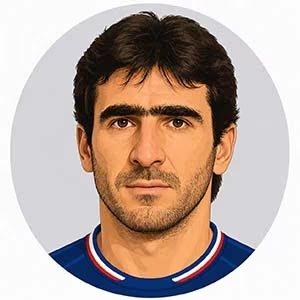
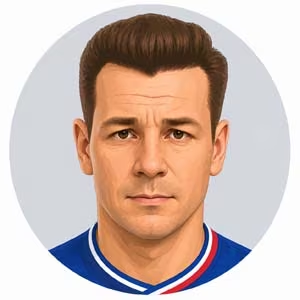
France - ForwardCantona, Eric
A theatrical colossus with an upturned collar, an aristocratic chest-out stride, and the incandescent charisma of an avant-garde philosopher, Éric Daniel Pierre Cantona did not merely play for Manchester United; he catalyzed an entire cultural and competitive revolution. Arriving at Old Trafford in November 1992 via Auxerre, Marseille, Nîmes, and a title-winning stint at Leeds United, The King became the missing tactical catalyst that ended United’s agonizing 26-year league title drought. Operating in the hole as an imperious second striker, Cantona turned the final third into his personal stage: executing delicate, cushioned first-time volleys, exquisite chipped finishes over stranded goalkeepers, and visionary, weighted through-balls that unlocked deep defensive blocks with royal nonchalance. Beyond his technical elegance, his physical strength allowed him to hold off aggressive English center-backs with his back to goal, creating the attacking runway for Sir Alex Ferguson’s emerging Class of '92. Sweeping four Premier League titles and two FA Cup doubles in just five seasons, he stood as the supreme talisman of the early Premier League era.
Psychologically, Cantona was a combustible genius powered by fierce individualism, artistic pride, and an absolute refusal to submit to institutional conformity. He saw himself not as an employee of a sporting corporation, but as an artist offering expressive beauty to the working-class masses in the stands. Inside the dressing room, his impact was transformative: he held an almost mythical reverence among young talents like Ryan Giggs, Paul Scholes, David Beckham, and Gary Neville, establishing a fanatical culture of post-training technical practice and unshakeable winning arrogance without ever uttering a single patronizing word. Under maximum pressure, his emotional posture was imperious and ice-cold; he lived for decisive, season-defining moments, routinely scoring clutch winners in FA Cup finals and crucial title run-ins. His volcanic temperament, however, remained an ever-present fault line, culminating in the infamous 1995 kung-fu kick at Selhurst Park—an explosive act of defiance against racist terrace abuse that brought an eight-month suspension, which he met with poetic, unapologetic stoicism. Toward match officials and physical markers who routinely sought to kick him out of matches, Cantona responded with a mixture of regal disdain, retaliatory fire, and devastating technical brilliance, leaving an eternal legacy as the ultimate antihero-king of modern British football.