We use Google Analytics to understand how visitors use this site. Analytics cookies are only activated with your consent. For details, read our Privacy Policy.
Profile lensThe same player, read from a different angle.
Athletic85
Acceleration
86
Pace
85
Agility
81
Strength
79
Balance
86
Jumping
73
Stamina
93
Fitness
93
Technical86
Dribbling
82
Short Passing
87
Long Passing
87
Finishing
87
Shot Accuracy
87
Shot Power
94
Shooting Technique
81
Heading
68
Tackling
71
Crossing
84
Free Kick
85
Penalties
83
First Touch
86
Mental87
Composure
83
Aggression
88
Consistency
91
Creativity
75
Leadership
91
Work Rate
88
Tactical88
Vision
88
Off the Ball
87
Defensive Positioning
63
Teamwork
90
Anticipation
88
Marking
64
Player Traits
Attacking83
Crossing
84
Finishing
87
Heading Accuracy
68
Shot Accuracy
87
Off the Ball
87
Technique85
Dribbling
82
Free Kick
85
Short Passing
87
Long Passing
87
First Touch
86
Shot Technique
81
Movement85
Acceleration
86
Pace
85
Agility
81
Balance
86
Physicality86
Shot Power
94
Jumping
73
Stamina
93
Strength
79
Fitness
93
Defending66
Marking
64
Tackling
71
Def. Positioning
63
Mentality & Game Reading87
Aggression
88
Composure
83
Penalties
83
Vision
88
Leadership
91
Work Rate
88
Teamwork
90
Anticipation
88
Consistency
91
Creativity
75
Curated interpretation
Signature Moves
Role-defining patterns—not attributes, traits or Inner Game measures. Three ways Bobby Charlton changes the meaning of the role around him.
01
Survivor
A survivor of the Munich air disaster, he becomes a symbol of Manchester United’s rebirth, his greatness inseparable from resilience built through immense loss.
02
Gentle Fury
Fierce intensity without theatrical aggression: energy, courage and competitiveness held inside the dignity of a great football gentleman.
03
Football Bloodline
Brother to Jack and part of the Milburn family, he carries professional football less like a vocation than a deep family inheritance.
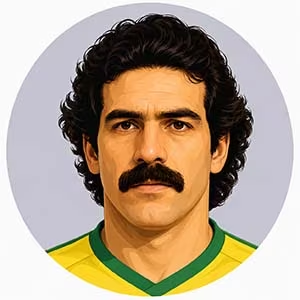
England - Attacking MidfielderCharlton, Robert
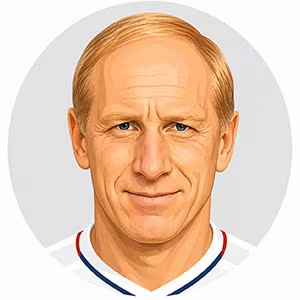
At Wembley on 26 July 1966, England were facing Portugal in a World Cup semi-final whose central tactical problem was how to attack without allowing Eusébio and Mário Coluna to control the match in transition. Bobby Charlton scored both English goals. The first came after a loose ball reached him outside the penalty area; he struck quickly before Portugal could reorganise. The second was more characteristic: Geoff Hurst laid the ball backwards and Charlton arrived from midfield to drive it first time beyond José Pereira. Four days later, against West Germany, his task changed. Franz Beckenbauer followed him closely and Charlton consequently spent much of the final farther from goal, while England’s other attackers exploited the space created around that duel. He did not score and did not need to manufacture involvement simply to preserve individual prominence. England won 4–2. The two matches show both sides of his attacking importance: Charlton could decide a game directly through violent forward execution, but could also remain tactically useful when an opponent devoted one of its most important players to removing that threat.
Charlton was an attacking midfielder and inside-forward whose game combined long-range acceleration, ball carrying and extraordinary striking from either foot. He could receive deeper than a conventional forward, turn into space and progress through midfield before releasing or finishing the attack. His shooting required remarkably little preparation: Charlton could strike while running and generate power from distances at which most players were still looking for the next pass. Yet describing him primarily as artillery understates his intelligence. He could distribute over distance, combine through midfield and alter his position according to the structure around him. Matt Busby used him across the forward line before his role increasingly settled into deeper attacking midfield, while Alf Ramsey exploited his capacity to provide progression and goals from inside the narrow structure of England’s 1966 side. Across 758 Manchester United appearances he scored 249 goals, winning three league championships, the FA Cup and the 1968 European Cup; for England he scored 49 times in 106 matches. His longevity at elite level depended partly on physical durability but also on a game that could shift from explosive carrying towards increasingly selective movement and distribution.
There were real boundaries. Charlton was not a specialist defensive midfielder and did not seek to control matches through tackling, physical intimidation or persistent close marking. His most dangerous actions required some possibility of receiving forward-facing possession; opponents capable of attaching an intelligent marker to him could reduce his direct attacking volume. Beckenbauer’s attention in the 1966 final is the obvious example, although describing the pair as simply “neutralising each other” overstates the symmetry: Ramsey later argued that Charlton’s positioning also prevented Beckenbauer from exerting his normal attacking influence. Charlton’s relative avoidance of physical confrontation could likewise leave more destructive defensive work to teammates. As he aged, acceleration and the frequency of long forward surges declined, reducing the attribute that had once allowed him to transform midfield possession into immediate territorial gain. None of this amounted to pressure degradation. His record includes decisive goals in a World Cup semi-final and two goals in the 1968 European Cup final. His limitations were principally functional: deny forward orientation, restrict shooting space and force the game towards repeated defensive confrontation, and more of his comparative advantage disappeared.
Psychologically, Charlton is best defined by **contained dissent rather than universal serenity**. His disciplinary record demonstrates unusually low behavioural escalation: across a career spanning more than two decades he was almost never sanctioned, despite playing through an era in which physical challenges were considerably less protected. That does not prove emotional detachment. Charlton could hold strong negative judgements about teammates, managers and behaviour around him while remaining reluctant to convert them into immediate public confrontation. The clearest contradiction emerged late at Manchester United. His relationship with George Best deteriorated as Charlton became increasingly disturbed by Best’s behaviour and its effect on the club, while tensions also developed around manager Frank O’Farrell. Charlton did not become an indiscriminate dressing-room enforcer; dissatisfaction accumulated more quietly and could produce distance rather than explosive confrontation. His relationship with his brother Jack similarly demonstrates that reserved public conduct did not mean absence of durable interpersonal grievance. Conversely, acute competitive pressure rarely produced visible behavioural disorganisation. After surviving the Munich air disaster in 1958, Charlton returned to football within weeks and eventually became central to rebuilding Manchester United, but the disaster should not be used to explain every subsequent trait or transformed into proof of permanent emotional invulnerability. Evidence supports continued functioning after extreme disruption; it does not allow us to quantify the private cost. His distinctive pattern is therefore narrower: **Charlton could experience disagreement, disappointment and relational fracture without needing immediate emotional discharge, while competitive responsibility remained available to him in situations of exceptional consequence**.


 All Time EnglandNT
 All Time UkClub
 All Time Manchester UnitedClub
 All-Time 1960s1960s
 All-Time EuropeEurope