We use Google Analytics to understand how visitors use this site. Analytics cookies are only activated with your consent. For details, read our Privacy Policy.
Profile lensThe same player, read from a different angle.
Athletic76
Acceleration
82
Pace
75
Agility
86
Strength
64
Balance
81
Jumping
66
Stamina
77
Fitness
76
Technical92
Dribbling
95
Short Passing
91
Long Passing
92
Finishing
87
Shot Accuracy
83
Shot Power
93
Shooting Technique
89
Heading
68
Tackling
48
Crossing
90
Free Kick
90
Penalties
90
First Touch
95
Mental82
Composure
87
Aggression
73
Consistency
74
Creativity
93
Leadership
84
Work Rate
78
Tactical84
Vision
91
Off the Ball
86
Defensive Positioning
52
Teamwork
85
Anticipation
74
Marking
38
Player Traits
Attacking83
Crossing
90
Finishing
87
Heading Accuracy
68
Shot Accuracy
83
Off the Ball
86
Technique92
Dribbling
95
Free Kick
90
Short Passing
91
Long Passing
92
First Touch
95
Shot Technique
89
Movement81
Acceleration
82
Pace
75
Agility
86
Balance
81
Physicality75
Shot Power
93
Jumping
66
Stamina
77
Strength
64
Fitness
76
Defending46
Marking
38
Tackling
48
Def. Positioning
52
Mentality & Game Reading83
Aggression
73
Composure
87
Penalties
90
Vision
91
Leadership
84
Work Rate
78
Teamwork
85
Anticipation
74
Consistency
74
Creativity
93
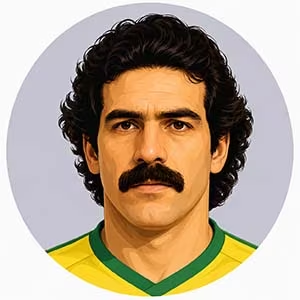
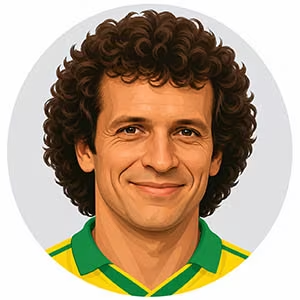
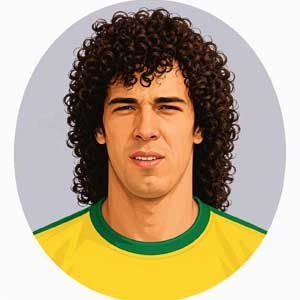
Brazil - Attacking MidfielderRivelino, Roberto
Rivelino’s left foot could change the scale of an attack in a single contact. From a position that appeared too distant for immediate danger, he could drive the ball towards goal, bend it around a wall or send a long diagonal towards a teammate before the defence had shifted. The violence of the strike contrasted with the softness of his close control. When a defender approached, Rivelino could move the ball across his body with the feint that became internationally associated with him as the elastico, showing one direction with the outside of the left foot before snapping the ball back inside with the same foot. The movement was learned and developed within the Brazilian street and futsal tradition rather than securely attributable to one inventor, but Rivelino became its great global transmitter. His football repeatedly joined those two scales: deception within centimetres followed immediately by a pass or shot travelling thirty metres.
Primarily a left-sided attacking midfielder or inside forward, Rivelino could begin wide and move centrally to organise possession, or start inside and drift towards the flank to create a better angle for his left foot. He was not dependent on dribbling alone. His passing range allowed him to switch play, combine at short distance and release forwards behind the line, while set pieces and long shooting made passive defending against him dangerous. With Brazil in 1970 he operated inside an attack containing several players accustomed to central creative responsibility, requiring positional compromise rather than individual ownership of the number-ten zone. Rivelino started all six matches and scored three times as Brazil won the World Cup. After Pelé’s international retirement, his function expanded. At the 1974 World Cup he became one of Brazil’s principal creative and scoring references, again producing three goals while carrying a much larger share of progression. His club career followed a different emotional geography: thirteen years at Corinthians without winning the major state title, followed by a successful period with Fluminense and later football in Saudi Arabia.
There were real limitations. Rivelino was physically robust enough to protect the ball more effectively than the description of him as “light” suggests, but he was not a high-volume defensive midfielder and his greatest value clearly emerged with possession. He could work inside a collective defensive structure, yet asking him to provide repeated recovery running or sustained pressing would consume the energy required for creation. His strong left-foot preference also shaped how opponents defended him: although technically capable with the right, his most dangerous passing, dribbling and shooting routes were constructed around opening the left side. Persistent close marking could therefore reduce the time available for those actions, particularly when Brazil no longer possessed the extraordinary distribution of creative responsibility seen in 1970. The later national-team version sometimes had to force progression because fewer teammates could assume the same burden. That did not make him tactically irresponsible; it increased the probability that possession would end with him because more attacks were required to pass through him.
Psychologically, Rivelino is best defined by **creative burden absorption rather than rebellious individualism**. The transition from 1970 to 1974 provides the clearest evidence. In Mexico he accepted a structure in which creative authority was distributed across several elite attackers and did not require the team to reorganise around him. Four years later, with Pelé gone and Brazil substantially changed, Rivelino accepted a far greater share of responsibility and remained one of the side’s strongest performers despite the collective decline. His relationship with Corinthians provides a different form of pressure. He spent more than a decade as the club’s principal idol while the team’s long title drought continued, then became an obvious target after the decisive defeat to Palmeiras in the 1974 Paulista championship. The criticism surrounding that loss contributed to an acrimonious departure for Fluminense. Rivelino later spoke openly about the hurt and sense of injustice attached to the episode, showing that public rejection affected him deeply; it did not, however, produce competitive withdrawal. He immediately became central to a successful Fluminense side. This separates emotional reaction from performance degradation. Evidence for systematic referee confrontation, retaliatory aggression or chronic conflict with coaches is insufficient to justify the old “hot-headed rebel” profile. The stronger pattern is that **Rivelino could absorb substantially more creative responsibility when the collective required it, while public rejection could wound his attachment to an institution without convincing him to reduce the ambition of his football**.