We use Google Analytics to understand how visitors use this site. Analytics cookies are only activated with your consent. For details, read our Privacy Policy.
Profile lensThe same player, read from a different angle.
Athletic84
Acceleration
93
Pace
86
Agility
85
Strength
75
Balance
86
Jumping
85
Stamina
84
Fitness
77
Technical91
Dribbling
96
Short Passing
90
Long Passing
88
Finishing
89
Shot Accuracy
92
Shot Power
77
Shooting Technique
94
Heading
72
Tackling
38
Crossing
85
Free Kick
84
Penalties
85
First Touch
95
Mental87
Composure
89
Aggression
79
Consistency
82
Creativity
93
Leadership
91
Work Rate
82
Tactical93
Vision
91
Off the Ball
94
Defensive Positioning
54
Teamwork
97
Anticipation
91
Marking
42
Player Traits
Attacking86
Crossing
85
Finishing
89
Heading Accuracy
72
Shot Accuracy
92
Off the Ball
94
Technique91
Dribbling
96
Free Kick
84
Short Passing
90
Long Passing
88
First Touch
95
Shot Technique
94
Movement88
Acceleration
93
Pace
86
Agility
85
Balance
86
Physicality80
Shot Power
77
Jumping
85
Stamina
84
Strength
75
Fitness
77
Defending45
Marking
42
Tackling
38
Def. Positioning
54
Mentality & Game Reading88
Aggression
79
Composure
89
Penalties
85
Vision
91
Leadership
91
Work Rate
82
Teamwork
97
Anticipation
91
Consistency
82
Creativity
93
Curated interpretation
Signature Moves
Role-defining patterns—not attributes, traits or Inner Game measures. Three ways Johan Cruyff changes the meaning of the role around him.
01
Bends Space
Orientation, movement, pauses and acceleration symbolically distort the geometry of the action, creating space where none appeared to exist.
02
Cruyff Turn
The defining feint: he sells one direction, draws the defender into it and escapes immediately through the other.
03
Fluid Identity
He changes role, height and position within the same action without surrendering his influence over it.
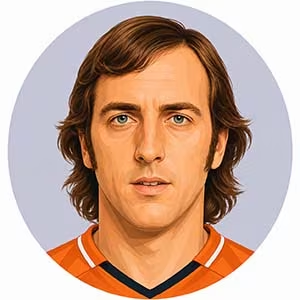
Netherlands - Attacking MidfielderCruyff, Johan
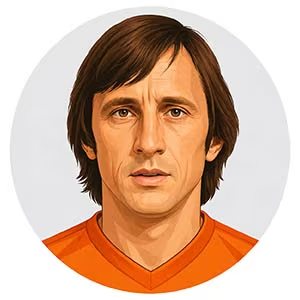
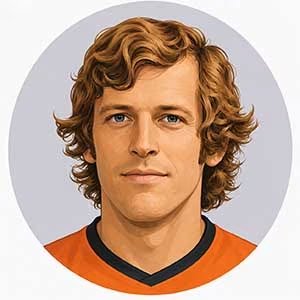
Reducing football to twenty-two players chasing a ball missed the entire point for a skinny kid from Betondorp who treated ninety minutes like kinetic architecture. Hendrik Johannes Cruijff did not merely play the sport; he dismantled its traditional, static geometry, turning the pitch into an elastic accordion of space and time as the on-field conductor and ideological prophet of Rinus Michels' Totaalvoetbal.
Nominally deployed as a centre-forward, Cruyff shattered orthodox tactical numbering by roaming wherever the game required: dropping thirty yards deep into his own half to collect from the centre-backs, drifting wide to the touchline to leave full-backs tackling thin air, or orchestrating triangular passing sequences on the run. Possessing explosive acceleration over the first ten yards, an uncanny ability to change direction at full sprint without losing balance, and the eponymous Cruyff Turn that sent Sweden's Jan Olsson into existential crisis, he weaponised spatial awareness like no one before him. Over an immortal spell at AFC Ajax he scored 257 goals in 329 matches, sweeping eight Eredivisie titles, five KNVB Cups, three consecutive European Cups (1971, 1972, 1973) and the 1972 Intercontinental Cup. His move to FC Barcelona in 1973 ignited a sociopolitical revolution, delivering the club's first La Liga title in fourteen years, before he concluded his playing days by firing Feyenoord to a domestic double at thirty-seven, in a move to Ajax's bitterest rivals made out of pure spite after his old club refused him a contract. Across 48 caps and 33 goals for the Netherlands he was the heartbeat of the 1974 World Cup side, collecting three Ballons d'Or (1971, 1973, 1974) as the defining European player of the twentieth century.
His footballing omnipotence, however, was fundamentally dependent on total collective harmony and dynamic runners around him. Cruyff was never a back-to-goal battering ram who could wrestle six-foot-four stoppers in congested six-yard boxes, nor did he possess brute physical size. When man-marked by hyper-cynical enforcers — like Berti Vogts in the 1974 final — who committed to relentless, suffocating physical contact and forced him away from central orchestrating channels, his scoring output could be blunted if his teammates failed to capitalise on the vacant space he created. He was also a heavy smoker throughout his playing career, and his slight frame carried the cumulative effect of the brutal treatment defenders were permitted to administer in that era.
Psychologically he possessed a supreme, unshakeable intellectual arrogance — a razor-sharp Dutch conviction that he understood the mechanics of the game better than anyone else in the stadium, including his managers, the club president and the referee. He was perpetually in motion, pointing, shouting instructions, and dictating where teammates should run while the ball was still thirty yards away; players at Ajax and Barcelona described the running commentary as relentless and, for younger squad members, genuinely intimidating. His rebelliousness was absolute: refusing Adidas's third stripe at the 1974 World Cup out of contractual loyalty to Puma, choosing the number 14 when starting shirts only went up to 11, and walking away from the 1978 World Cup on personal and security grounds after an attempted kidnapping at his Barcelona home. He argued with referees the way a barrister argues a point of law — analytically, at length, and with visible contempt rather than temper — and was sent off for dissent at the highest level, including in a Netherlands shirt.
That intransigence extended well beyond football. Cruyff fought protracted and public battles over money and control at every club he represented, organised his teammates against the Dutch federation over bonuses on the eve of a World Cup, and refused Michels' authority openly when the two disagreed on the pitch, in a relationship that was closer to a permanent negotiation between equals than to a hierarchy. He held grudges for decades and severed relationships with institutions he had defined, Ajax most painfully. Provocation from opponents did not draw a violent response — he retaliated verbally rather than physically and his aggression was almost entirely rhetorical — but sustained physical treatment did wear him down over ninety minutes, and matches in which he was dispossessed early and roughly could see him drift into peripheral, irritated participation, gesturing at teammates rather than solving the problem himself. Away from the pitch he was a family man, married to Danny Coster for over fifty years, cerebral, chain-smoking, and entirely uninterested in the conventional pieties of the profession; he later lost most of his fortune in a business fraud, an episode that hardened an already considerable suspicion of everyone handling his affairs. Visionary mentor and exhausting dogmatic autocrat in equal measure, Cruyff left an immortal legacy as the player-philosopher who fundamentally invented modern football and never, at any point, doubted that he had.