We use Google Analytics to understand how visitors use this site. Analytics cookies are only activated with your consent. For details, read our Privacy Policy.
Profile lensThe same player, read from a different angle.
Athletic84
Acceleration
83
Pace
86
Agility
78
Strength
84
Balance
79
Jumping
85
Stamina
88
Fitness
86
Technical82
Dribbling
80
Short Passing
81
Long Passing
84
Finishing
65
Shot Accuracy
70
Shot Power
85
Shooting Technique
74
Heading
79
Tackling
87
Crossing
87
Free Kick
81
Penalties
78
First Touch
82
Mental85
Composure
91
Aggression
80
Consistency
78
Creativity
77
Leadership
86
Work Rate
85
Tactical86
Vision
85
Off the Ball
72
Defensive Positioning
86
Teamwork
91
Anticipation
91
Marking
88
Player Traits
Attacking75
Crossing
87
Finishing
65
Heading Accuracy
79
Shot Accuracy
70
Off the Ball
72
Technique80
Dribbling
80
Free Kick
81
Short Passing
81
Long Passing
84
First Touch
82
Shot Technique
74
Movement82
Acceleration
83
Pace
86
Agility
78
Balance
79
Physicality86
Shot Power
85
Jumping
85
Stamina
88
Strength
84
Fitness
86
Defending87
Marking
88
Tackling
87
Def. Positioning
86
Mentality & Game Reading84
Aggression
80
Composure
91
Penalties
78
Vision
85
Leadership
86
Work Rate
85
Teamwork
91
Anticipation
91
Consistency
78
Creativity
77
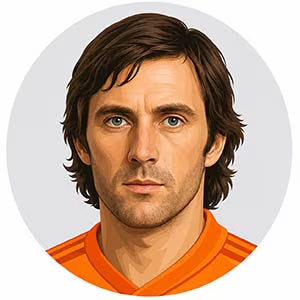
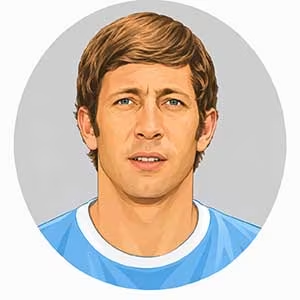
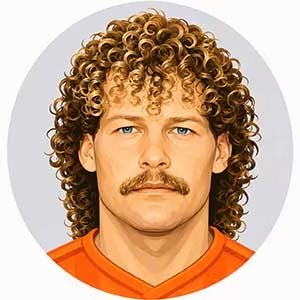
Netherlands - Left BackKrol, Ruud
Ruud Krol began primarily as a left-back but developed into one of the most positionally expansive defenders of his generation. Fast, strong and exceptionally comfortable on the ball, he could defend the flank, overlap, move inside to circulate possession and deliver accurately over distance. His right foot was sufficiently developed that opponents could not simply force him towards one predetermined exit. Within Ajax’s positional interchange he became both defensive security and an additional construction player, winning six league titles and three consecutive European Cups. With the Netherlands he operated from the left during the 1974 World Cup before progressively assuming more central responsibility and captaining the side to the 1978 final. The later move to Napoli exposed another version. Already past thirty, Krol increasingly played as a libero, where reduced dependence on repeated flank running allowed anticipation, passing and positional command to become the centre of his game. Italian journalists immediately recognised his influence, and he was voted Guerin Sportivo’s Serie A Player of the Year for 1980–81. His evolution therefore transferred value from athletic breadth towards structural interpretation rather than merely preserving the same role at lower speed.
There were limits beneath that completeness. Krol was an excellent defender but not primarily a specialist stopper whose greatest advantage emerged from remaining attached to one powerful centre-forward for ninety minutes. His game benefited from perspective: seeing the structure, choosing when to engage and retaining the possibility of becoming the next possession player. Systems that reduced him to permanent man-marking would therefore suppress part of his comparative value. His attacking ambition could also create risk if the compensating movement behind him failed; positional interchange only remained intelligent while somebody restored the space being vacated. Age eventually removed some of the recovery speed that had made those advances safer, which helps explain the increasingly central interpretation of his later years. Nor should his success at Napoli be exaggerated into literal domination of Serie A across his entire Italian period. His first seasons were outstanding, but physical decline eventually reduced his influence. Krol’s completeness was therefore conditional on a structure sophisticated enough to exploit his decision-making rather than simply celebrate his versatility.
Psychologically, Krol is best defined by structural autonomy combined with collective tactical ownership. His Ajax education under Rinus Michels demanded discipline, but not passive obedience: players were expected to recognise situations themselves and exchange functions without waiting for instructions from the touchline. Krol became one of the clearest embodiments of that responsibility. The 1978 Netherlands provide even stronger behavioural evidence. As captain, he later described a team in which senior players discussed tactical problems collectively and could challenge or modify aspects of Ernst Happel’s approach; Happel himself was sufficiently secure to allow experienced players substantial responsibility once the match began. This was not authority rebellion. Krol functioned successfully under extremely demanding coaches because autonomy operated inside shared principles rather than against them. His captaincy similarly did not depend on monopolising decisions: tactical intelligence was distributed across a group containing several strong personalities, and Krol’s role was partly to make that distributed intelligence coherent. The 1978 final also supplies evidence against simple pressure degradation. The Netherlands lost to Argentina after extra time, but Krol remained actively involved in construction and defensive organisation rather than withdrawing into conservative captaincy. Evidence for systematic referee confrontation, retaliatory aggression, teammate-directed blame or individual provocation is insufficient and should remain unknown. The stronger pattern is that Krol accepted structure most completely when structure trusted him to interpret it; responsibility meant knowing when the rule should be followed, when the position should be abandoned and how the collective shape had to change afterwards.