We use Google Analytics to understand how visitors use this site. Analytics cookies are only activated with your consent. For details, read our Privacy Policy.
Profile lensThe same player, read from a different angle.
Athletic86
Acceleration
83
Pace
87
Agility
74
Strength
91
Balance
89
Jumping
87
Stamina
93
Fitness
87
Technical78
Dribbling
81
Short Passing
74
Long Passing
79
Finishing
73
Shot Accuracy
70
Shot Power
87
Shooting Technique
69
Heading
82
Tackling
86
Crossing
77
Free Kick
72
Penalties
73
First Touch
74
Mental84
Composure
85
Aggression
86
Consistency
86
Creativity
68
Leadership
80
Work Rate
85
Tactical80
Vision
74
Off the Ball
73
Defensive Positioning
78
Teamwork
85
Anticipation
82
Marking
86
Player Traits
Attacking75
Crossing
77
Finishing
73
Heading Accuracy
82
Shot Accuracy
70
Off the Ball
73
Technique75
Dribbling
81
Free Kick
72
Short Passing
74
Long Passing
79
First Touch
74
Shot Technique
69
Movement83
Acceleration
83
Pace
87
Agility
74
Balance
89
Physicality89
Shot Power
87
Jumping
87
Stamina
93
Strength
91
Fitness
87
Defending83
Marking
86
Tackling
86
Def. Positioning
78
Mentality & Game Reading80
Aggression
86
Composure
85
Penalties
73
Vision
74
Leadership
80
Work Rate
85
Teamwork
85
Anticipation
82
Consistency
86
Creativity
68
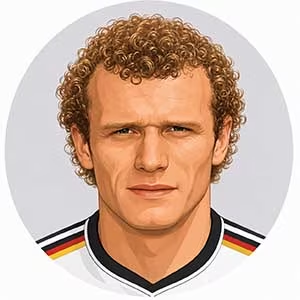
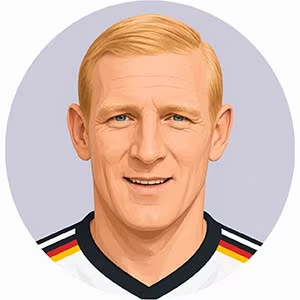
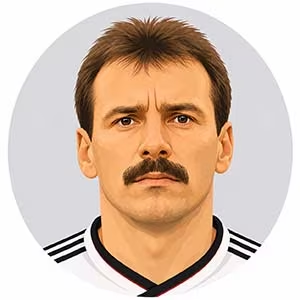
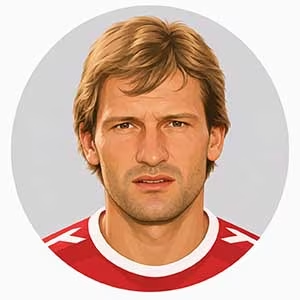
Germany - Left BackBriegel, Hans-Peter
road-shouldered athletic power, bone-crushing recovery challenges, and surging linear runs earned Hans-Peter Briegel the iconic moniker Die Walz aus der Pfalz (The Steamroller from the Palatinate), establishing him as one of the most fearsome physical forces in 1980s football. A former decathlete who did not enter formal competitive club football until the age of seventeen, Briegel brought unprecedented raw athletic parameters to 1. FC Kaiserslautern before making a seismic tactical impact in Serie A with Hellas Verona and Sampdoria. Standing six-foot-two, weighing over 85 kilograms of pure explosive muscle, and famously playing without shin guards with his socks rolled down to his ankles, he was a tactical hybrid capable of operating as an unstoppable left-back, a destructive central defensive midfielder, or a marauding box-to-box engine. His signature maneuver was the direct, freight-train charge: picking up the ball in his own defensive third, shrugging off two or three markers through upper-body torque, and driving 50 yards upfield to smash a venomous strike on goal or deliver a driven cut-back. At Verona under Osvaldo Bagnoli, he was the indisputable physical catalyst behind the club’s fairytale 1984–85 Scudetto triumph, later lifting the 1988 Coppa Italia with Sampdoria. For West Germany across 72 caps and four goals, he played in two World Cup finals (1982, 1986) and anchored the backline to the Euro 1980 championship in Rome.
However, Briegel’s late start in organized football left visible technical rough edges. His close-control dribbling was heavy, his passing range lacked nuanced vertical disguise when facing compact low blocks, and his aggressive, forward-surging momentum occasionally led to catastrophic positional over-commitments—most painfully exposed in the 1986 World Cup final when Jorge Burruchaga exploited the open space behind him to score Argentina’s winning goal.
Unflinching, hyper-combative, and driven by an indomitable work ethic, Briegel approached every ninety minutes as an extreme physical decathlon. He had no fear of any opponent on the planet; his sheer physical presence on the field was an active psychological deterrent that rattled creative wingers before a challenge was even made. On the pitch, his competitive motor was relentless and selfless: he threw his heavy frame into aerial collisions and 50-50 tackles with complete disregard for physical discomfort, rallying his teammates through raw kinetic energy when momentum stalled. Inside the Verona and Kaiserslautern dressing rooms, he was an adored, honest, and unpretentious leader who integrated seamlessly into squad hierarchies, bridging tactical systems through sheer sacrifice and unvarnished authenticity. When opposing markers attempted to foul or obstruct his linear runs, they routinely bounced off his broad torso while Briegel continued his sprint unchecked. Match officials respected his straightforward, hard-but-fair approach, cementing an enduring legacy as the ultimate athletic juggernaut and most powerful multi-functional full-back of his generation.