We use Google Analytics to understand how visitors use this site. Analytics cookies are only activated with your consent. For details, read our Privacy Policy.
Profile lensThe same player, read from a different angle.
Athletic84
Acceleration
87
Pace
86
Agility
80
Strength
83
Balance
86
Jumping
85
Stamina
85
Fitness
80
Technical86
Dribbling
87
Short Passing
79
Long Passing
75
Finishing
89
Shot Accuracy
88
Shot Power
86
Shooting Technique
78
Heading
85
Tackling
48
Crossing
68
Free Kick
68
Penalties
72
First Touch
86
Mental82
Composure
84
Aggression
87
Consistency
78
Creativity
74
Leadership
86
Work Rate
84
Tactical83
Vision
77
Off the Ball
90
Defensive Positioning
42
Teamwork
76
Anticipation
86
Marking
41
Player Traits
Attacking84
Crossing
68
Finishing
89
Heading Accuracy
85
Shot Accuracy
88
Off the Ball
90
Technique79
Dribbling
87
Free Kick
68
Short Passing
79
Long Passing
75
First Touch
86
Shot Technique
78
Movement85
Acceleration
87
Pace
86
Agility
80
Balance
86
Physicality84
Shot Power
86
Jumping
85
Stamina
85
Strength
83
Fitness
80
Defending44
Marking
41
Tackling
48
Def. Positioning
42
Mentality & Game Reading80
Aggression
87
Composure
84
Penalties
72
Vision
77
Leadership
86
Work Rate
84
Teamwork
76
Anticipation
86
Consistency
78
Creativity
74
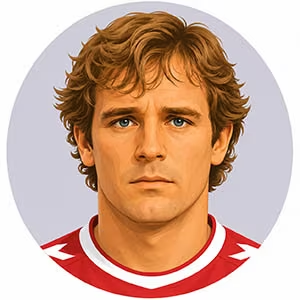
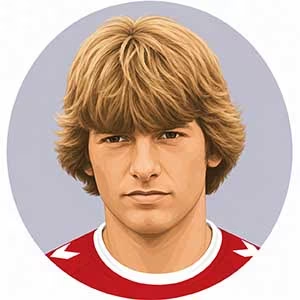
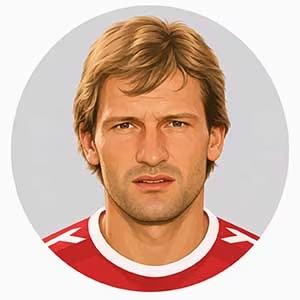
Denmark - StrikerElkjaer Larsen, Preben
An anarchic blend of explosive linear acceleration, upper-body brute force, and unapologetic vertical directness made Preben Elkjær Larsen the most terrifying, unpredictable striker of European football’s mid-1980s. Forged at Vanløse before refining his lethal counter-attacking instincts in Belgium with KSC Lokeren, the Danish forward reached the pinnacle of his club career in Italy under Osvaldo Bagnoli at Hellas Verona. Standing six feet tall with an irregular, galloping stride and extraordinary physical balance under contact, Elkjær was the ultimate transition weapon: capable of picking up loose balls forty yards out, barreling between two central defenders at terrifying speed, and unleashing violent, low-trajectory drives with either foot. His iconic moment arrived in October 1984 against Juventus, when, after losing his right boot in a challenge with a defender, he continued sprinting barefoot to slot the ball past Stefano Tacconi—a sequence that came to define Verona’s miraculous 1984–85 Scudetto triumph. For Denmark, across 69 caps and 38 goals, he was the untamed attacking spearhead of Sepp Piontek’s legendary Danish Dynamite side, lighting up Euro 1984 and the 1986 World Cup in Mexico, where his devastating hat-trick against Uruguay helped him finish third in the 1984 Ballon d'Or and second in 1985.
Tactically, however, Elkjær’s individualistic, high-octane style carried evident limitations: his short-passing synergy in tight, intricate combination play was erratic, his contribution to collective defensive pressing was virtually non-existent, and he struggled when forced to operate in crowded, static penalty boxes against ultra-deep low blocks where his long stride could not generate momentum.
Rebellious, hyper-confident, and wholly indifferent to conventional sporting dogma, Elkjær played the game with the wild joy of a street footballer who answered to no tactical master. He refused to be micromanaged; his game thrived on complete positional anarchy, drifting wide to the touchlines or deep into midfield before launching sudden, chaotic solo charges that paralyzed opposing tacticians. On the pitch, his body language projected untouchable swagger: he actively provoked elite Italian man-markers like Pietro Vierchowod and Claudio Gentile with cheeky smiles and direct challenges, using their aggression to fuel his adrenaline. Inside the Verona and Danish locker rooms, he was an adored, magnetic alpha whose infectious irreverence stripped away tournament tension and instilled an absolute belief that any giant could be slain. When markers kicked his ankles or pulled his jersey, Elkjær never complained or stayed down; he surged forward with greater fury on the next loose ball. Match officials found him difficult to contain due to his theatrical spirit, but opponents feared his raw, unstoppably direct brilliance, leaving an immortal legacy as one of the most explosive, charismatic, and electrifying cult forwards in modern football history.


 All Time DenmarkNT