We use Google Analytics to understand how visitors use this site. Analytics cookies are only activated with your consent. For details, read our Privacy Policy.
Profile lensThe same player, read from a different angle.
Athletic83
Acceleration
91
Pace
89
Agility
85
Strength
82
Balance
78
Jumping
77
Stamina
80
Fitness
81
Technical85
Dribbling
92
Short Passing
83
Long Passing
84
Finishing
85
Shot Accuracy
83
Shot Power
83
Shooting Technique
80
Heading
77
Tackling
44
Crossing
81
Free Kick
75
Penalties
83
First Touch
87
Mental79
Composure
83
Aggression
85
Consistency
75
Creativity
86
Leadership
76
Work Rate
78
Tactical79
Vision
82
Off the Ball
85
Defensive Positioning
44
Teamwork
78
Anticipation
76
Marking
43
Player Traits
Attacking82
Crossing
81
Finishing
85
Heading Accuracy
77
Shot Accuracy
83
Off the Ball
85
Technique84
Dribbling
92
Free Kick
75
Short Passing
83
Long Passing
84
First Touch
87
Shot Technique
80
Movement86
Acceleration
91
Pace
89
Agility
85
Balance
78
Physicality81
Shot Power
83
Jumping
77
Stamina
80
Strength
82
Fitness
81
Defending44
Marking
43
Tackling
44
Def. Positioning
44
Mentality & Game Reading80
Aggression
85
Composure
83
Penalties
83
Vision
82
Leadership
76
Work Rate
78
Teamwork
78
Anticipation
76
Consistency
75
Creativity
86
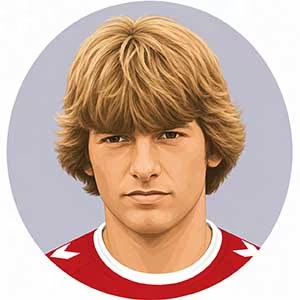
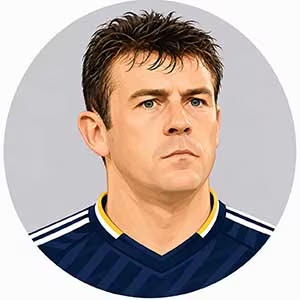
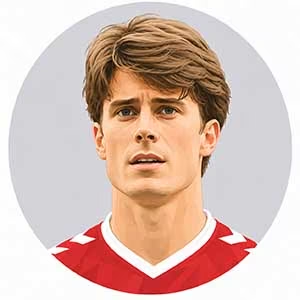
Denmark - ForwardLaudrup, Brian
Few dribblers in the modern era could shift balance at breakneck speed quite like Brian Laudrup, whose effortless hip swerves and outside-of-the-boot deliveries made him the dynamic attacking soul of Danish football throughout the 1990s. Stepping out of Brøndby before making his continental mark with Bayer Uerdingen, Bayern Munich, Fiorentina, and AC Milan, Laudrup found his true spiritual home in Scotland with Walter Smith’s Rangers. Operating as a free-roaming second striker, inside forward, or classic winger, he was practically uncatchable once he engaged his first three steps: receiving the ball wide, dropping his shoulder to wrong-foot full-backs, and accelerating horizontally across the edge of the penalty box. His technical execution was light, elegant, and devastatingly direct, yielding three Scottish Premier Division titles, two Scottish Cups, and two SFWA Footballer of the Year awards at Ibrox, alongside a 1998 UEFA Super Cup triumph with Chelsea. His international zenith arrived at Euro 1992: while his brother Michael sat out, Brian spearheaded Richard Møller Nielsen’s fairy-tale Danish side to the European Championship title through relentless counter-attacking carries. Over 64 caps and 21 goals for Denmark, his farewell masterclass came at the 1998 World Cup in France, authoring an iconic goal and horizontal-reclining celebration against Brazil in the quarter-finals.
An instinctive, sensitive artist who required genuine warmth and tactical trust from his manager to thrive, Laudrup withered in authoritarian, micromanaged environments like Fabio Capello’s Milan, but soared when granted complete creative liberty. He had no appetite for cynical gamesmanship, hard fouls, or locker-room politics, approaching matches with an almost childlike joy for pure technical expression. On the pitch, his competitive pride was sharp yet polite; when opponents tried to hack him down—a weekly occurrence on rough Scottish pitches—he simply got back on his feet, dusted off his knees, and attacked the exact same channel with even greater pace. Inside the Rangers and Denmark dressing rooms, he was a quiet, modest gentleman, universally adored for his generosity, quick wit, and total lack of arrogance. High-stakes tournament pressure never clouded his vision; against the suffocating defensive lines of France and Germany at Euro 92, his decision-making on the break remained crisp and unselfish. Toward referees and bruising full-backs, Laudrup remained a model of sporting nobility, leaving behind a legacy as one of the most aesthetically pleasing, balance-defying wingers European football has ever seen.


 All Time DenmarkNT