We use Google Analytics to understand how visitors use this site. Analytics cookies are only activated with your consent. For details, read our Privacy Policy.
Profile lensThe same player, read from a different angle.
Athletic77
Acceleration
66
Pace
67
Agility
74
Strength
83
Balance
82
Jumping
87
Stamina
66
Fitness
90
Technical45
Dribbling
51
Short Passing
55
Long Passing
58
Shot Accuracy
46
Shot Power
84
Shooting Technique
45
Heading
52
Free Kick
46
Penalties
46
First Touch
55
Mental84
Composure
84
Consistency
85
Leadership
84
Goalkeeping89
Reflexes
93
Positioning
88
Handling
88
Kicking
85
Goalkeeping89
Reflexes
93
Positioning
88
Handling
88
Kicking
85
Attacking49
Heading Accuracy
52
Shot Accuracy
46
Technique52
Dribbling
51
Free Kick
46
Short Passing
55
Long Passing
58
First Touch
55
Shot Technique
45
Physicality82
Shot Power
84
Jumping
87
Stamina
66
Strength
83
Fitness
90
Movement72
Acceleration
66
Pace
67
Agility
74
Balance
82
Mentality & Game Reading75
Composure
84
Penalties
46
Leadership
84
Consistency
85
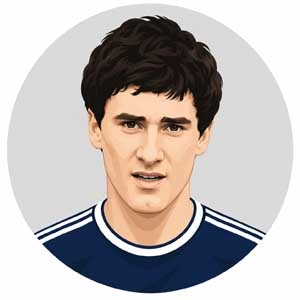
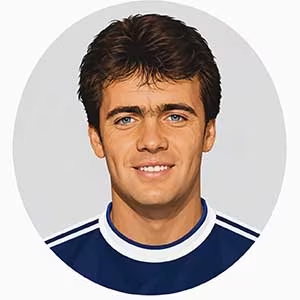
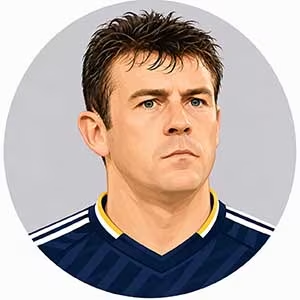
Scotland - GoalkeeperGoram, Andy
Rangers fans voted him the greatest goalkeeper in the club's history in two separate polls, a decade apart, which says something about how durable the affection was. But ask Andy Goram himself which sport meant more to him, and he never hesitated: cricket, he said, not football — not the Champions League nights, not fifty thousand people roaring in stadiums around the world, not even a loan spell in the Old Trafford goal under Alex Ferguson. Facing Allan Border and Merv Hughes at a packed cricket ground in Glasgow, he insisted, gave him no less pleasure than any of it.
Born in Bury, Lancashire, in 1964 to a Scottish father, Goram began at Oldham Athletic before establishing himself at Hibernian and then moving to Rangers in 1991 for a fee that made him Walter Smith's first major signing as manager. He was an athletic, physically imposing goalkeeper — nicknamed both The Goalie, a title so complete it functioned as a name, and The Flying Pig, for a build that belied his remarkable agility — and across seven trophy-laden seasons at Ibrox he won five league titles as part of the club's celebrated nine-in-a-row run, three Scottish Cups and two League Cups, and was voted Scotland's Player of the Year in the 1992–93 season widely regarded as Rangers' strongest campaign. For Scotland he won 43 caps, playing at the 1990 World Cup and the European Championships of 1992 and 1996, and remained the country's first-choice goalkeeper through both tournaments. He was also, remarkably, a genuine dual international: as a left-handed batter and medium-pace bowler, he played first-class cricket for Scotland in 1989 and 1991, including a match against a touring Australian side, before Smith ordered him to abandon the summer game entirely and focus on football — making Goram, to this day, the last man to represent Scotland at both sports.
His limitations were connected early in his Rangers career to confidence rather than raw ability — a difficult start under the weight of expectation following his big-money transfer saw his form dip badly enough that the club brought in goalkeeping coach Alan Hodgkinson specifically at Goram's own request, a mentor he later described in terms close to a father figure. His playing style, built on instinct and physical commitment rather than positional caution, occasionally left him exposed against genuinely well-placed finishes, though this was a minor cost relative to his overall standing among his generation's finest.
Temperamentally he was, by every account, a genuinely larger-than-life figure — whole-hearted in every pursuit he took seriously, from goalkeeping to cricket to the company he kept, and entirely without pretension about which of his talents he valued most. He treated football and cricket as equally serious commitments rather than ranking one above the other for status, an attitude that ran against the grain of a football culture that expected total, singular devotion from its stars. He remained a familiar, welcomed presence around Ibrox for years after retiring, still drawing crowds for legends matches, and his life away from the pitch was, by his own later account in a 2009 autobiography, considerably more complicated than his public reputation as a beloved club icon suggested — married and divorced multiple times, and open in his later years about the private struggles that accompanied his fame. He died in 2022, at fifty-eight, of oesophageal cancer, having spoken publicly and directly about his terminal diagnosis in the months before his death. Physically fearless, genuinely devoted to two sports at the highest level rather than one, and beloved by supporters who voted him the best they had ever seen, Goram built a public identity that was, by every measure available, exactly as vivid and unguarded as his nickname suggested.


 All Time ScotlandNT