We use Google Analytics to understand how visitors use this site. Analytics cookies are only activated with your consent. For details, read our Privacy Policy.
Profile lensThe same player, read from a different angle.
Athletic79
Acceleration
71
Pace
73
Agility
85
Strength
82
Balance
77
Jumping
92
Stamina
64
Fitness
88
Technical44
Dribbling
45
Short Passing
50
Long Passing
59
Shot Accuracy
42
Shot Power
82
Shooting Technique
41
Heading
44
Free Kick
40
Penalties
40
First Touch
57
Mental81
Composure
82
Consistency
78
Leadership
89
Goalkeeping88
Reflexes
90
Positioning
89
Handling
87
Kicking
86
Goalkeeping88
Reflexes
90
Positioning
89
Handling
87
Kicking
86
Attacking43
Heading Accuracy
44
Shot Accuracy
42
Technique49
Dribbling
45
Free Kick
40
Short Passing
50
Long Passing
59
First Touch
57
Shot Technique
41
Physicality82
Shot Power
82
Jumping
92
Stamina
64
Strength
82
Fitness
88
Movement77
Acceleration
71
Pace
73
Agility
85
Balance
77
Mentality & Game Reading72
Composure
82
Penalties
40
Leadership
89
Consistency
78
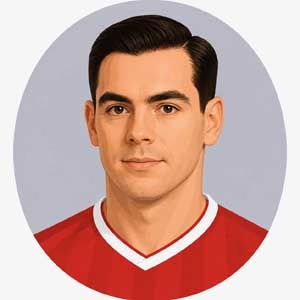
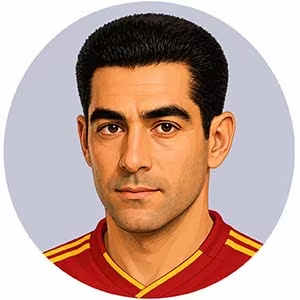
Spain - GoalkeeperRamallets, Antoni
On 29 June 1950, Spain faced Chile at the Maracanã needing another result to continue their unexpectedly strong World Cup. Antoni Ramallets had started the tournament as a reserve but was now in goal. Spain won 2–0, and the Brazilian press responded to his performance by giving him the name that would follow him for the rest of his life: the Cat of the Maracanã. The nickname came from the speed and elasticity of his saves, but the more important detail was how quickly he had accepted the stage. Ramallets had entered the tournament without established international status and emerged from its largest stadium looking as though the pressure belonged there with him.
Ramallets was an agile, technically refined goalkeeper whose style combined spectacular reflexes with a strong preference for simplicity when the situation allowed it. Barcelona’s own description emphasises intelligence above everything else: he could make the dramatic save, but he understood that positioning often made drama unnecessary. He was quick across his line, decisive when leaving goal and unusually secure on both high and low balls for a goalkeeper of his era. He played without gloves, relying on handling technique and strong hands rather than equipment that later generations would consider essential. After developing with Europa and spending time on loan at Valladolid, Ramallets became Barcelona’s regular goalkeeper after Velasco’s injury opened the position in 1949. His rise coincided with one of the club’s richest periods. He was part of the famous Five Cups side of 1951–52 and ultimately won six Spanish league titles, five Spanish Cups, two Latin Cups and two Inter-Cities Fairs Cups. Barcelona’s statistical archive credits him with 388 official appearances and 549 matches when unofficial fixtures are included. He won the Zamora Trophy five times, a record later equalled but not surpassed for decades. Internationally, the 1950 World Cup established him as Spain’s first-choice goalkeeper as the team finished fourth, its best World Cup position until 2010. He earned 35 senior caps. His Barcelona career lasted until 1961, and the following year the Camp Nou gave him a formal farewell tribute.
His greatest weakness was that the same confidence in judgement that made him decisive could become costly when the information available to him was wrong. Ramallets was aggressive enough in his positioning and exits that hesitation or a misread trajectory could leave little margin for recovery. The most painful example came in the 1961 European Cup final against Benfica in Bern. With Barcelona having already struck the woodwork repeatedly, a redirected ball dropped awkwardly toward his goal and ended as an own goal credited to Ramallets, helping Benfica take a 2–1 lead before eventually winning 3–2. Ramallets later called Bern the memory he most wanted to erase, and official Barcelona accounts identify it as probably the worst moment of his career. His athletic style also depended heavily on mobility and reflexes, making age progressively more relevant than it would have been for a goalkeeper who survived principally through reach and conservative positioning.
Psychologically, Ramallets appears to have possessed strong situational confidence without emotional indifference. When asked many years later for the best advice he had received as a professional, his answer was simply to believe in himself. That belief was tested repeatedly. At the 1950 World Cup he moved from reserve status into the side and immediately performed well enough in front of enormous Brazilian crowds to acquire a national reputation. The same tournament later included Spain’s 6–1 defeat to Brazil before more than 150,000 spectators, yet there is no evidence that the humiliation destabilised his club career; he returned to Barcelona and remained first choice for another decade. Pressure therefore did not appear to create avoidance. His goalkeeping itself required the opposite: leaving the line decisively, committing to the ball and accepting that a public error would be impossible to hide. Former teammate Josep Seguer remembered him specifically for elegance and security rather than emotional theatrics. His public personality appears similarly restrained. The Spanish federation’s obituary emphasised modesty and humility alongside his athletic qualities, and surviving interviews show little appetite for self-mythologising despite his status at Barcelona. That should not be mistaken for rapid emotional recovery from failure. Bern remained different. Decades later, when asked for a memory to forget, Ramallets immediately named the 1961 final and described the match through its repeated misfortune: Barcelona kept hitting the posts while Benfica converted almost every serious opportunity. The defeat had not become emotionally neutral with time. Importantly, however, he did not build the recollection around blaming teammates or officials. The grievance remained attached to the event rather than redirected toward other people. His response to mistakes therefore appears internalising rather than confrontational. There is similarly little evidence of habitual disputes with referees, retaliation after contact or attempts to intimidate opponents psychologically. Ramallets dealt with pressure primarily by narrowing attention toward the save itself. When that mechanism worked, enormous crowds and high stakes could elevate his reputation; when it failed catastrophically, the consequence stayed with him for years. His composure was therefore behavioural rather than emotionally empty: he could remain functional while feeling the significance very deeply.


 All Time BarcelonaClub