We use Google Analytics to understand how visitors use this site. Analytics cookies are only activated with your consent. For details, read our Privacy Policy.
Profile lensThe same player, read from a different angle.
Athletic77
Acceleration
68
Pace
67
Agility
84
Strength
81
Balance
80
Jumping
96
Stamina
63
Fitness
80
Technical44
Dribbling
52
Short Passing
55
Long Passing
57
Shot Accuracy
45
Shot Power
79
Shooting Technique
43
Heading
52
Free Kick
44
Penalties
44
First Touch
53
Mental84
Composure
87
Consistency
80
Leadership
85
Goalkeeping92
Reflexes
97
Positioning
93
Handling
92
Kicking
86
Goalkeeping92
Reflexes
97
Positioning
93
Handling
92
Kicking
86
Attacking49
Heading Accuracy
52
Shot Accuracy
45
Technique51
Dribbling
52
Free Kick
44
Short Passing
55
Long Passing
57
First Touch
53
Shot Technique
43
Physicality80
Shot Power
79
Jumping
96
Stamina
63
Strength
81
Fitness
80
Movement75
Acceleration
68
Pace
67
Agility
84
Balance
80
Mentality & Game Reading74
Composure
87
Penalties
44
Leadership
85
Consistency
80
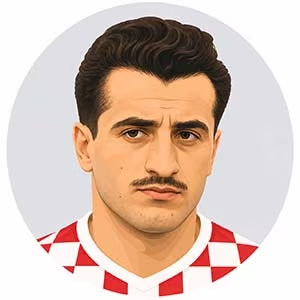
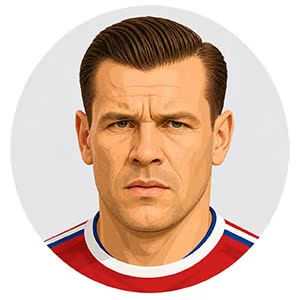
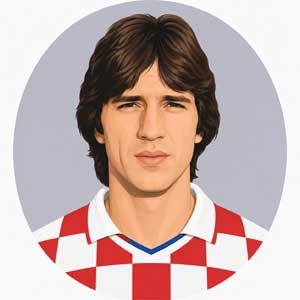
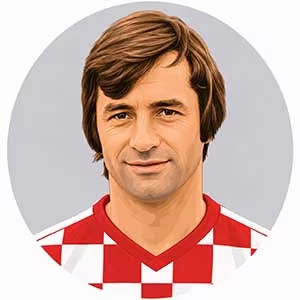
Croatia - GoalkeeperBeara, Vladimir
Lev Yashin, when handed the Ballon d’Or in 1963, stepped up to the European press corps and promptly pointed south toward Split, declaring that the true greatest goalkeeper on the planet had rubber in his knees and steel in his fingers. Vladimir Beara—celebrated nationwide as Veliki Vladimir (Big Vladimir) or The Ballerina with Steel Fists—was an acrobatic phenomenon whose early classical ballet training transformed shot-stopping into pure kinetic grace.
Operating between the posts for Hajduk Split and later Red Star Belgrade, Beara revolutionized the position through unprecedented elasticity, explosive lateral spring, and an uncanny ability to catch ferocious shots cleanly out of mid-air without spilling rebounds. During his decade at Hajduk (1947–1955), he anchored the Dalmatian side to three Yugoslav First League championships (1950, 1952, 1955), famously going through the 1950 season undefeated. His sensational, politically seismic transfer to Red Star Belgrade in 1955 yielded four further league titles and two Yugoslav Cups, as well as reaching the 1957–58 European Cup semi-finals against Manchester United. For Yugoslavia, across 59 caps between 1950 and 1959, he was the insurmountable last line of the legendary Olympic Team, capturing the Silver Medal at Helsinki 1952—where he famously saved a Ferenc Puskás penalty in the final—and starring across three World Cups (1950, 1954, 1958).
His daring, hyper-athletic style, however, carried inherent physical risks that tested his longevity. Beara was an instinctive, high-flying sweeper-keeper who launched himself head-first into flying studs and concrete goalposts to smother breakaways, resulting in a staggering litany of severe concussions, dislocated shoulders, and fractured fingers throughout his prime. Furthermore, in an era where referees rarely protected goalkeepers from physical body-checks on aerial set pieces, his preference for catching rather than punching occasionally left him exposed to brute-force collisions inside a crowded six-yard area.
Quiet, intensely proud, and marked by a deep, introspective dignity, Beara carried an almost melancholic gravitas throughout his career. Traumatized by the vicious public backlash and state-sponsored ostracization that followed his move from Split to Belgrade, he retreated into an unshakeable stoicism, letting his superhuman leaps do all the talking. On the pitch, his posture was upright, poised, and utterly fearless: standing completely still on his line before exploding into breathtaking, horizontal dives that defied gravity. Inside the dressing rooms of Hajduk, Red Star, and the national team, he was an untouchable, revered monument of concentration whose quiet courage and unmatched aerial beauty made him an immortal titan of European goalkeeping.