We use Google Analytics to understand how visitors use this site. Analytics cookies are only activated with your consent. For details, read our Privacy Policy.
Profile lensThe same player, read from a different angle.
Athletic79
Acceleration
75
Pace
73
Agility
84
Strength
82
Balance
77
Jumping
88
Stamina
67
Fitness
83
Technical45
Dribbling
50
Short Passing
68
Long Passing
64
Shot Accuracy
44
Shot Power
82
Shooting Technique
44
Heading
47
Free Kick
42
Penalties
44
First Touch
53
Mental85
Composure
89
Consistency
78
Leadership
86
Goalkeeping91
Reflexes
94
Positioning
93
Handling
91
Kicking
87
Goalkeeping91
Reflexes
94
Positioning
93
Handling
91
Kicking
87
Attacking46
Heading Accuracy
47
Shot Accuracy
44
Technique54
Dribbling
50
Free Kick
42
Short Passing
68
Long Passing
64
First Touch
53
Shot Technique
44
Physicality80
Shot Power
82
Jumping
88
Stamina
67
Strength
82
Fitness
83
Movement77
Acceleration
75
Pace
73
Agility
84
Balance
77
Mentality & Game Reading74
Composure
89
Penalties
44
Leadership
86
Consistency
78
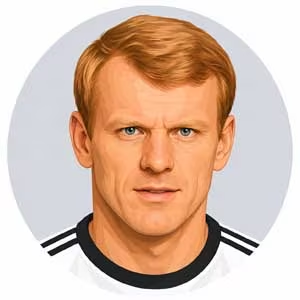
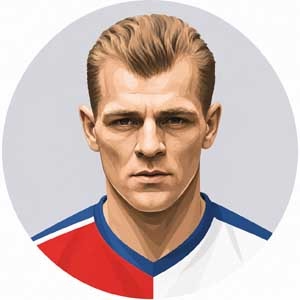
Czech Republic - GoalkeeperViktor, Ivo
Belgrade on June 20, 1976, was immortalized by Antonín Panenka’s chipped penalty, but Czechoslovakia’s historic European championship was built upon the miraculous, cat-like reflexes of a 34-year-old goalkeeper who shut down West Germany and the Netherlands across 210 brutal minutes of knockout football. Ivo Viktor was the agile, acrobatic guardian and undisputed leader of Dukla Prague and Czechoslovak football throughout the 1960s and 1970s. Standing five-foot-eleven, Viktor compensated for his modest height with explosive vertical spring, razor-sharp anticipation on low driven shots, and immaculate handling in wet, muddy conditions. Over a legendary club career spanning 316 league appearances for Dukla Prague, he claimed three Czechoslovak First League titles (1964, 1966, 1977) and three domestic cups, being voted Czechoslovak Footballer of the Year five times. For Czechoslovakia, across 63 caps between 1966 and 1977, his international zenith arrived at Euro 1976, where his masterclass performances against Johan Cruyff's Netherlands and Helmut Schön's West Germany earned him third place in the 1976 Ballon d'Or voting—a staggering achievement for a goalkeeper behind Franz Beckenbauer and Rob Rensenbrink.
Naturally, his smaller physical stature brought unavoidable tactical vulnerabilities against aerial assaults. When confronted by towering, physical British or German target men who crowded his six-yard box on set pieces, Viktor had to rely entirely on timing, boxing clearances, and spatial agility rather than brute physical height to claim high balls. A severe, chronic spinal disc injury sustained shortly after Euro 1976 abruptly ended his top-flight career at the age of 35.
Quiet, intellectual, and deeply humble, Viktor approached the goalkeeper's craft with analytical focus and exceptional concentration. He never engaged in flashy theatrics for the cameras; every dive, parry, and catch was calculated purely for maximum efficiency and defensive stability. On the pitch, his presence radiated serene confidence: reading attacking plays seconds before they developed, organizing his defensive markers with quick, sharp gestures, and bouncing back up instantly after making double-saves. Inside the Dukla Prague and Czechoslovak national team dressing rooms, he was an untouchable moral compass and respected captain whose tactical insight and modesty united a golden generation, cementing an eternal legacy as the greatest goalkeeper in Czech and Slovak football history.