We use Google Analytics to understand how visitors use this site. Analytics cookies are only activated with your consent. For details, read our Privacy Policy.
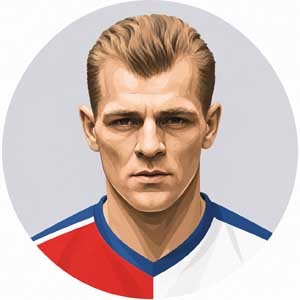
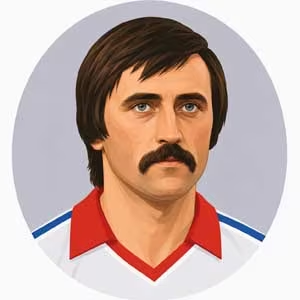
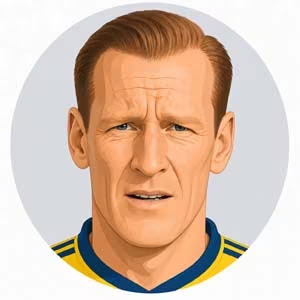
The brutal midfield trenches of the 1962 World Cup in Chile belonged to an unyielding defensive soldier from Zlín who formed the tactical platform for Czechoslovakia’s march to the final against Pelé’s Brazil. Svatopluk Pluskal was the indefatigable physical anchor and defensive half-back of Dukla Prague’s dominant golden generation, forging an almost telepathic central partnership alongside the legendary Josef Masopust. Operating as a destructive half-back, man-marking stopper, or sweeping center-half, Pluskal was a master of the clean turnover: suffocating elite playmakers through relentless cardiovascular stamina, timing sliding tackles with surgical accuracy, and dominating the airspace through an extraordinary vertical leap. Across sixteen seasons at Dukla Prague spanning nearly 300 league matches, he collected eight Czechoslovak First League championships and three domestic cups, later reaching the semi-finals of the 1966–67 European Cup. For Czechoslovakia, across 56 caps and one goal, he featured across three consecutive World Cups (1954, 1958, 1962), playing every single minute of their historic 1962 campaign and earning selection for the FIFA World XI in 1963 alongside Pelé, Alfredo Di Stéfano, and Lev Yashin at Wembley Stadium.
Yet Pluskal’s game was strictly utilitarian and structurally defensive. He possessed limited creative passing range when tasked with building possession against deep, compact low blocks; his technical distribution was limited to short, low-risk lay-offs to Masopust, and his dribbling in tight central channels was rudimentary. Furthermore, against hyper-agile, low-gravity forwards in isolated footraces over large distances, his heavy, muscular frame could be tested if his initial physical contact failed to dispossess his man.
Stoic, modest, and possessing an unbreakable Central European work ethic, Pluskal was the quintessential selfless warrior. He embraced the unglamorous defensive dirty work without complaint so that Masopust could roam forward and create, measuring his personal success entirely by the total neutralization of the opposition's primary playmaker. On the pitch, his body language was disciplined and resolute: absorbing physical collisions without showing pain, executing spotless standing challenges without cynical malice, and keeping his defensive structure organized under suffocating pressure. Inside the Dukla Prague and Czechoslovak national team locker rooms, he was an indispensable moral bedrock—universally admired for his loyalty, humility, and extraordinary physical bravery under fire, leaving behind an immortal legacy as one of the finest, most disciplined, and decorated defensive half-backs in 20th-century football history.