We use Google Analytics to understand how visitors use this site. Analytics cookies are only activated with your consent. For details, read our Privacy Policy.
Profile lensThe same player, read from a different angle.
Athletic81
Acceleration
76
Pace
75
Agility
77
Strength
78
Balance
80
Jumping
77
Stamina
91
Fitness
92
Technical82
Dribbling
82
Short Passing
84
Long Passing
84
Finishing
78
Shot Accuracy
71
Shot Power
78
Shooting Technique
78
Heading
81
Tackling
86
Crossing
80
Free Kick
77
Penalties
71
First Touch
82
Mental87
Composure
85
Aggression
91
Consistency
91
Creativity
73
Leadership
85
Work Rate
87
Tactical86
Vision
85
Off the Ball
72
Defensive Positioning
86
Teamwork
93
Anticipation
87
Marking
87
Player Traits
Attacking76
Crossing
80
Finishing
78
Heading Accuracy
81
Shot Accuracy
71
Off the Ball
72
Technique81
Dribbling
82
Free Kick
77
Short Passing
84
Long Passing
84
First Touch
82
Shot Technique
78
Movement77
Acceleration
76
Pace
75
Agility
77
Balance
80
Physicality83
Shot Power
78
Jumping
77
Stamina
91
Strength
78
Fitness
92
Defending86
Marking
87
Tackling
86
Def. Positioning
86
Mentality & Game Reading85
Aggression
91
Composure
85
Penalties
71
Vision
85
Leadership
85
Work Rate
87
Teamwork
93
Anticipation
87
Consistency
91
Creativity
73
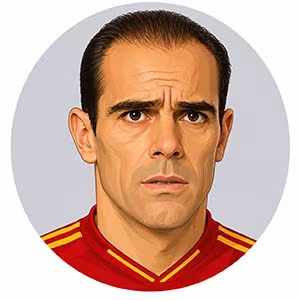
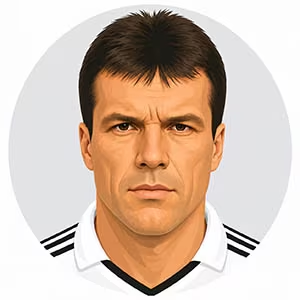
Argentina - Defensive MidfielderCambiasso, Esteban
Tactical geometry, spatial anticipation, and an encyclopedic understanding of phase transitions made Esteban Matías Cambiasso Delshaux the definitive midfield conductor of modern Argentine football. Emerging through Argentinos Juniors and River Plate after an early developmental detour in Real Madrid’s youth system, Cambiasso arrived at Inter Milan on a free transfer in 2004, turning that move into one of the greatest market bargains in Serie A history. Operating primarily as a deep-lying midfield anchor, El Cuchu was never a physically imposing enforcer or a blistering athlete; instead, he dominated through cerebral positioning and an instantaneous reading of the opponent's passing lanes. His left foot functioned as a clean, low-friction metronome, recycling possession with sharp first-time passes, while his signature offensive move was the late, unmarked arrival into the penalty area—a trait immortalized by his 24-pass team goal for Argentina against Serbia and Montenegro at the 2006 World Cup. Over a decade at San Siro spanning more than 430 matches, he served as the on-field brain of José Mourinho’s 2009–10 Treble-winning machine, securing five consecutive Serie A titles, four Coppa Italia trophies, and the UEFA Champions League, before pulling off a legendary twilight escape from relegation with Leicester City in 2015 and concluding his journey with Olympiacos.
Mentally and emotionally, Cambiasso was an authentic on-pitch manager whose competitive drive was entirely subordinate to collective structure and tactical discipline. He possessed an innate authority that required no shouting; his leadership was analytical, constant, and instructive, constantly pointing, organizing the pressing triggers, and covering the defensive holes vacated by attacking full-backs like Maicon. Inside the dressing room, he was an articulate, serious, and deeply respected tactical heavyweight, capable of bridging cultural divides between South American and European contingents while providing managers with an indispensable tactical dialogue during halftime adjustments. Under the suffocating pressure of knockout finals against teams like Barcelona and Bayern Munich, his mental clarity never slipped; he navigated high-friction moments with ice-cold discipline, maintaining structural compactness even when his team was reduced to ten men. Toward referees and aggressive opponents, Cambiasso was streetwise yet fundamentally professional: he utilized tactical obstruction and subtle shirt pulls to break up dangerous counters, but he avoided reckless malice or petulant outbursts, leaving an enduring legacy as one of the most intelligent, decorated, and tactically complete central midfielders of his era.