We use Google Analytics to understand how visitors use this site. Analytics cookies are only activated with your consent. For details, read our Privacy Policy.
Profile lensThe same player, read from a different angle.
Athletic83
Acceleration
77
Pace
77
Agility
81
Strength
80
Balance
86
Jumping
82
Stamina
90
Fitness
90
Technical81
Dribbling
79
Short Passing
84
Long Passing
77
Finishing
73
Shot Accuracy
75
Shot Power
88
Shooting Technique
78
Heading
82
Tackling
87
Crossing
72
Free Kick
66
Penalties
68
First Touch
82
Mental87
Composure
74
Aggression
90
Consistency
95
Creativity
70
Leadership
91
Work Rate
95
Tactical83
Vision
80
Off the Ball
75
Defensive Positioning
82
Teamwork
91
Anticipation
83
Marking
82
Player Traits
Attacking75
Crossing
72
Finishing
73
Heading Accuracy
82
Shot Accuracy
75
Off the Ball
75
Technique78
Dribbling
79
Free Kick
66
Short Passing
84
Long Passing
77
First Touch
82
Shot Technique
78
Movement80
Acceleration
77
Pace
77
Agility
81
Balance
86
Physicality86
Shot Power
88
Jumping
82
Stamina
90
Strength
80
Fitness
90
Defending84
Marking
82
Tackling
87
Def. Positioning
82
Mentality & Game Reading84
Aggression
90
Composure
74
Penalties
68
Vision
80
Leadership
91
Work Rate
95
Teamwork
91
Anticipation
83
Consistency
95
Creativity
70
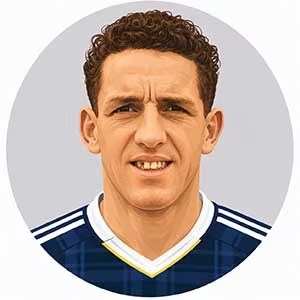
Scotland - Defensive MidfielderMackay, Dave
At Wembley on 2 May 1964, Tottenham were playing Manchester United when Dave Mackay challenged Noel Cantwell and fractured his left leg. He spent months recovering, returned the following season and, in his ninth match back, broke the same leg again against Shrewsbury Town. The second injury was psychologically different because recovery no longer offered proof that recovery was possible; the first comeback had just failed. Mackay nevertheless reconstructed himself again and returned to Tottenham’s midfield. Years later, when Brian Clough wanted the thirty-three-year-old at Derby County, Mackay initially assumed he had been recruited to organise the defence. Clough instead moved him into a deeper role where physical decline mattered less and judgement mattered more. Derby won promotion, Mackay was jointly named Footballer of the Year in 1969, and the player whose leg had twice fractured became the controlling senior figure of another successful side. His career therefore contains an unusually concrete form of resilience: not emotional invulnerability, but repeated acceptance that the previous version of his game had disappeared and another one had to be constructed.
At his peak Mackay was a left-half combining ball-winning force with considerably more technical ability than his intimidating reputation suggests. He could tackle with enormous commitment, carry the ball forward, pass accurately and strike powerfully from distance. At Hearts he captained the side to the 1957–58 Scottish championship before moving to Tottenham, where he became one of the foundations of Bill Nicholson’s double-winning team of 1960–61. Spurs subsequently retained the FA Cup and won the 1963 European Cup Winners’ Cup. Mackay’s defensive aggression was not merely destructive: he could receive after winning possession and begin the next phase rather than treating recovery as the end of his responsibility. At Derby, Clough and Peter Taylor exploited precisely that intelligence by using him as a sweeper, allowing anticipation, distribution and authority to replace some of the mobility lost through age and injury. The reinvention matters tactically and psychologically. Mackay did not preserve his career by pretending his physical capacities were unchanged; he accepted a different spatial relationship with the game and became elite again within it.
His limitations are clearest when separated from the mythology of toughness. Mackay’s confrontational tackling carried obvious physical and disciplinary risk, and his game at left-half depended heavily on mobility before the double leg fracture. After those injuries he could not simply reproduce the same covering range. The later sweeper role reduced that requirement and allowed him to defend through reading and positioning. His physical aggression also created situations in which functional intimidation could approach emotional confrontation. The famous photograph of Mackay grabbing Billy Bremner by the shirt has often been presented as the essence of his personality, but Mackay himself disliked the image because he believed it portrayed him as a bully. He explained that Bremner had targeted the leg he had broken twice and that his reaction came from anger at that specific challenge. The distinction is critical: the photograph documents a genuine emotional reaction to individual provocation, but it does not justify treating every hard tackle Mackay made as emotional aggression. Much of his physicality was tactical and habitual; this particular confrontation was retaliatory and personal.
Psychologically, Mackay is best defined by **protective enforcement combined with unusually strong reconstruction after physical loss**. Teammates consistently remembered a player who demanded effort and competitive seriousness, but his authority was not based merely on shouting or intimidation. Mackay regarded standards as collective obligations and was prepared to confront behaviour he believed threatened them. His response to Bremner supplies the more personal boundary: after two fractures of the same leg, a challenge directed at that vulnerability provoked immediate physical confrontation. That is documented provocation sensitivity, not generalized emotional instability. More revealing still is what happened after the injuries themselves. Mackay did not respond by reducing responsibility permanently. He endured two rehabilitation cycles, returned to Tottenham and later accepted Clough’s reinterpretation of him at Derby, where he became captain and a central influence. This distinguishes persistence from denial. Unlike a player who insists on reproducing the old role regardless of physical evidence, Mackay eventually allowed the function to change while preserving the competitive standard he expected from himself. His relationship with authority similarly resists a simple rebellious archetype: Nicholson commanded enormous respect, while Mackay accepted Clough’s radical positional reassignment despite initially being surprised by it. Evidence for systematic referee conflict, hostile-crowd degradation or habitual blame of teammates after mistakes is insufficient and should remain unknown. The defensible pattern is more specific: **Mackay reacted fiercely when a boundary he considered competitively illegitimate was crossed, but adversity that could not be confronted directly—age, injury, lost mobility—was met through reconstruction rather than grievance**.


 All Time ScotlandNT