We use Google Analytics to understand how visitors use this site. Analytics cookies are only activated with your consent. For details, read our Privacy Policy.
Profile lensThe same player, read from a different angle.
Athletic79
Acceleration
83
Pace
75
Agility
81
Strength
66
Balance
80
Jumping
70
Stamina
90
Fitness
90
Technical83
Dribbling
84
Short Passing
87
Long Passing
86
Finishing
83
Shot Accuracy
74
Shot Power
80
Shooting Technique
79
Heading
70
Tackling
77
Crossing
83
Free Kick
72
Penalties
70
First Touch
85
Mental84
Composure
77
Aggression
86
Consistency
85
Creativity
76
Leadership
87
Work Rate
95
Tactical82
Vision
86
Off the Ball
78
Defensive Positioning
74
Teamwork
87
Anticipation
78
Marking
80
Player Traits
Attacking78
Crossing
83
Finishing
83
Heading Accuracy
70
Shot Accuracy
74
Off the Ball
78
Technique82
Dribbling
84
Free Kick
72
Short Passing
87
Long Passing
86
First Touch
85
Shot Technique
79
Movement80
Acceleration
83
Pace
75
Agility
81
Balance
80
Physicality79
Shot Power
80
Jumping
70
Stamina
90
Strength
66
Fitness
90
Defending77
Marking
80
Tackling
77
Def. Positioning
74
Mentality & Game Reading83
Aggression
86
Composure
77
Penalties
70
Vision
86
Leadership
87
Work Rate
95
Teamwork
87
Anticipation
78
Consistency
85
Creativity
76
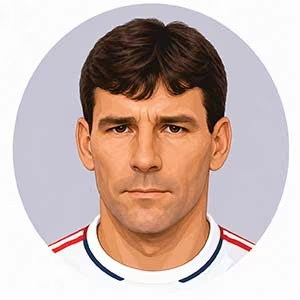
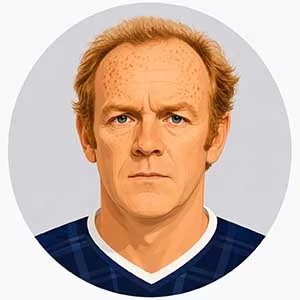
Scotland - Centre MidfielderBremner, Billy
Wembley, August 1974, the Charity Shield, televised live to a country still deciding what it thought about football violence. Billy Bremner and Kevin Keegan traded blows, were sent off, and both pulled their shirts off as they walked, an image that ran on the front pages for days and earned Bremner an eleven-match ban. He was thirty-one, he had captained Leeds United to almost everything English football could offer, and he had just been recorded doing in a showpiece fixture what he had done quietly for a decade. He never expressed much regret about it. Protecting his team was not, in his understanding, a discretionary activity.
Born in Stirling in 1942 into a working-class Scottish family, Bremner was rejected by Chelsea and Arsenal for being too small — he stood 1.70m and weighed under seventy kilos for most of his career — and signed for Leeds United at fifteen. He spent seventeen years there and became the greatest player in the club's history. As a central midfielder he was a genuine all-rounder disguised as a destroyer: an outstanding passer over both short and long distances, a tireless runner with exceptional stamina, a surprisingly effective header of the ball for his height, and a scorer of important goals, particularly in cup semi-finals. What he added was a competitive ferocity that turned Don Revie's Leeds into the most feared and most disliked side in Britain. He captained the team to two First Division titles (1969, 1974), the FA Cup in 1972, the League Cup in 1968, two Inter-Cities Fairs Cups (1968, 1971) and the 1975 European Cup final, alongside a punishing collection of near-misses that defined the era. He won 54 caps for Scotland, captained the side at the 1974 World Cup where they went out unbeaten on goal difference, and came within inches of scoring against Brazil in a match that would have changed his country's history.
His flaws were the direct cost of his virtues. Bremner's discipline record was extensive: sendings-off, suspensions, running feuds with individual opponents, and a willingness to escalate physically that repeatedly reduced Leeds to ten men in matches they were controlling. He was also drawn into off-pitch controversy, most damagingly a bribery allegation he spent years and considerable money contesting in court, and which he ultimately won. Against sides that stayed calm and let him provoke himself, his intensity could tip from asset into liability inside a few minutes.
Within his own dressing room, however, he was adored. Bremner led by fierce, almost familial loyalty — he fought for teammates rather than at them, confronted anyone who fouled a Leeds player, and reserved his hostility for opponents, referees and the press rather than his own. He talked constantly on the pitch, drove the team forward by visible example, and raised his level in exactly the matches that mattered most, feeding on hostile away grounds and the widespread dislike of Leeds as fuel rather than pressure. Revie treated him as an extension of his own authority, and the players followed him without reservation. He was superstitious, emotionally transparent, quick to anger and quick to laugh, and he took defeats hard for days. Away from football he was a family man from a modest background who never lost the accent or the outlook, well liked in the game once the shirt was off, and he later returned to manage Leeds without ever recapturing what he had built as a player. He died of a heart attack in 1997, a week before his fifty-fifth birthday. Small, combustible and utterly fearless, Bremner was the definitive captain of a team that won by refusing to be intimidated by anyone.


 All Time ScotlandNT