We use Google Analytics to understand how visitors use this site. Analytics cookies are only activated with your consent. For details, read our Privacy Policy.
Profile lensThe same player, read from a different angle.
Athletic82
Acceleration
77
Pace
76
Agility
77
Strength
85
Balance
78
Jumping
85
Stamina
93
Fitness
85
Technical83
Dribbling
81
Short Passing
85
Long Passing
85
Finishing
82
Shot Accuracy
77
Shot Power
90
Shooting Technique
78
Heading
86
Tackling
77
Crossing
82
Free Kick
81
Penalties
73
First Touch
82
Mental88
Composure
83
Aggression
91
Consistency
90
Creativity
74
Leadership
91
Work Rate
96
Tactical85
Vision
85
Off the Ball
81
Defensive Positioning
73
Teamwork
91
Anticipation
85
Marking
70
Player Traits
Attacking82
Crossing
82
Finishing
82
Heading Accuracy
86
Shot Accuracy
77
Off the Ball
81
Technique82
Dribbling
81
Free Kick
81
Short Passing
85
Long Passing
85
First Touch
82
Shot Technique
78
Movement77
Acceleration
77
Pace
76
Agility
77
Balance
78
Physicality88
Shot Power
90
Jumping
85
Stamina
93
Strength
85
Fitness
85
Defending73
Marking
70
Tackling
77
Def. Positioning
73
Mentality & Game Reading86
Aggression
91
Composure
83
Penalties
73
Vision
85
Leadership
91
Work Rate
96
Teamwork
91
Anticipation
85
Consistency
90
Creativity
74
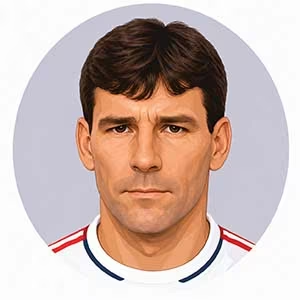
England - Centre MidfielderRobson, Bryan
Bandaged brows, heavily strapped shoulders that popped out of their sockets mid-match, and a torn jersey soaked in mud and blood became the indelible visual hallmarks of an all-action warrior from Chester-le-Street who carried club and country through an entire decade on sheer willpower. Bryan Robson OBE—canonized forever across Old Trafford and English football simply as Captain Marvel—was the definitive, heroic box-to-box midfielder, possessing a gladiatorial spirit that fused bone-crunching ball-winning tackles with panoramic passing and an unstoppable, late-arriving scoring threat inside the penalty box.
Operating with limitless stamina and an extraordinary sense of spatial timing, Robson was everywhere at once: sliding into challenges on the edge of his own box, dictating tempo with crisp distribution through the middle third, and launching himself head-first into flying boots to score crucial headers. Signed by Ron Atkinson for a then-British record fee of £1.5 million in 1981, he became the spiritual leader and longest-serving captain in Manchester United history across 461 appearances and 99 goals, lifting three FA Cups, the 1990–91 European Cup Winners' Cup against Barcelona in Rotterdam, and captaining Sir Alex Ferguson's breakthrough sides to back-to-back Premier League championships (1992–93, 1993–94). For England, across 90 caps (65 as captain) and 26 goals, he starred across three World Cups (1982, 1986, 1990)—famously scoring after just 27 seconds against France in 1982—and Euro 1988.
That supreme physical bravery, however, came at a staggering medical cost. Robson’s absolute refusal to pull out of 50-50 collisions or manage his own physical limits resulted in a relentless, agonizing succession of broken bones, dislocated shoulders, hamstring tears, and ankle surgeries that cruelly truncated his World Cup campaigns in both 1986 and 1990. Furthermore, because he played at such a ferocious, breakneck pace, his direct vertical drive could occasionally bypass patient, possession-based midfield circulation against cultured continental low blocks.
Fierce, immensely inspiring, and possessing a legendary, unshakeable courage, Robson was the ultimate leader of men. He felt the weight of the captain's armband not as a privilege, but as a sacred personal duty, playing through excruciating fractures and torn ligaments because he could not bear the thought of letting his teammates down. On the pitch, his presence was electric and commanding: lifting whole stadiums with a single crunching tackle, barking urgent encouragement to his backline, and diving into the mud to win loose balls. Inside the Old Trafford and England dressing rooms, his moral authority was absolute—an untouchable patriarch whose selfless valor, tactical completeness, and ferocious heart made him the defining English midfield icon of his era.


 All Time Manchester UnitedClub