We use Google Analytics to understand how visitors use this site. Analytics cookies are only activated with your consent. For details, read our Privacy Policy.
Profile lensThe same player, read from a different angle.
Athletic81
Acceleration
78
Pace
76
Agility
81
Strength
75
Balance
81
Jumping
79
Stamina
89
Fitness
90
Technical86
Dribbling
83
Short Passing
89
Long Passing
94
Finishing
80
Shot Accuracy
82
Shot Power
92
Shooting Technique
80
Heading
80
Tackling
68
Crossing
89
Free Kick
75
Penalties
77
First Touch
86
Mental85
Composure
90
Aggression
83
Consistency
91
Creativity
82
Leadership
71
Work Rate
82
Tactical85
Vision
93
Off the Ball
84
Defensive Positioning
64
Teamwork
94
Anticipation
77
Marking
63
Player Traits
Attacking83
Crossing
89
Finishing
80
Heading Accuracy
80
Shot Accuracy
82
Off the Ball
84
Technique85
Dribbling
83
Free Kick
75
Short Passing
89
Long Passing
94
First Touch
86
Shot Technique
80
Movement79
Acceleration
78
Pace
76
Agility
81
Balance
81
Physicality85
Shot Power
92
Jumping
79
Stamina
89
Strength
75
Fitness
90
Defending65
Marking
63
Tackling
68
Def. Positioning
64
Mentality & Game Reading84
Aggression
83
Composure
90
Penalties
77
Vision
93
Leadership
71
Work Rate
82
Teamwork
94
Anticipation
77
Consistency
91
Creativity
82
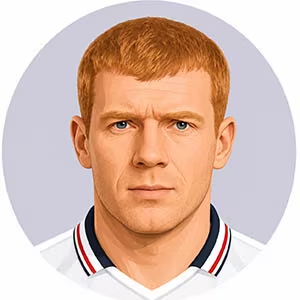
England - Centre MidfielderScholes, Paul
Pep Guardiola once declared him the finest central midfielder of his generation, while Zinedine Zidane famously admitted that his biggest regret was never playing alongside the quiet maestro from Salford. Paul Scholes stood as the pure, geometric brain and technical heartbeat of Sir Alex Ferguson’s Manchester United dynasty across nearly two decades. Emerging as an integral cornerstone of the Class of '92, Scholes began his career as an explosive, goalscoring second striker before transitioning into one of the most sophisticated deep-lying orchestrators in modern football history. He dictated match tempos with absolute metronomic mastery: executing 60-yard cross-field diagonal pings with pinpoint accuracy, turning out of pressure with delicate body feints, and unleashing thunderous, swerving volleys from 30 yards off cleared corners. Over 718 appearances and 155 goals for the Red Devils, he collected an astonishing eleven Premier League titles, three FA Cups, two League Cups, and two UEFA Champions League crowns (1999, 2008—scoring the iconic semi-final winner against Barcelona). For England, across 66 caps and 14 goals, he featured at two World Cups (1998, 2002) before walking away from international football in 2004 at just 29 years of age to preserve his club career and family life.
Yet this supreme technical perfection existed alongside famous mechanical deficiencies. Scholes was notoriously inept at the art of the physical tackle, racking up a massive collection of yellow and red cards throughout his career due to late, mistimed, and clumsy lunges that often looked like reckless frustration. Furthermore, his lack of high-end linear speed and physical height made him vulnerable in open-field transitional footraces if Manchester United lost possession high up the pitch without a dedicated defensive destroyer alongside him to cover ground.
Anti-celebrity, monastic, and completely immune to the circus of modern football fame, Scholes operated with zero ego. He avoided post-match interviews, arrived at training in modest clothes, and let his immaculate passing do the talking for twenty years. On the pitch, his presence was understated yet commanding: he never screamed or gestured wildly, controlling 80,000 people inside Old Trafford with a simple wave of his right boot and a casual turn of his hips. Inside the United dressing room, he was an untouchable, revered elder statesman whose supreme standard in training sessions left superstars like Cristiano Ronaldo and Wayne Rooney in awe. Referees treated his mistimed challenges with exasperation, but his fellow professionals held him in god-like reverence, cementing an immortal legacy as the purest, most vision-rich, and technically pristine English midfielder of the modern era.