We use Google Analytics to understand how visitors use this site. Analytics cookies are only activated with your consent. For details, read our Privacy Policy.
Profile lensThe same player, read from a different angle.
Athletic81
Acceleration
78
Pace
81
Agility
80
Strength
81
Balance
80
Jumping
73
Stamina
88
Fitness
87
Technical85
Dribbling
82
Short Passing
89
Long Passing
98
Finishing
80
Shot Accuracy
76
Shot Power
89
Shooting Technique
83
Heading
66
Tackling
58
Crossing
98
Free Kick
97
Penalties
83
First Touch
85
Mental87
Composure
91
Aggression
65
Consistency
84
Creativity
84
Leadership
87
Work Rate
85
Tactical85
Vision
96
Off the Ball
82
Defensive Positioning
54
Teamwork
87
Anticipation
80
Marking
48
Player Traits
Attacking80
Crossing
98
Finishing
80
Heading Accuracy
66
Shot Accuracy
76
Off the Ball
82
Technique89
Dribbling
82
Free Kick
97
Short Passing
89
Long Passing
98
First Touch
85
Shot Technique
83
Movement80
Acceleration
78
Pace
81
Agility
80
Balance
80
Physicality84
Shot Power
89
Jumping
73
Stamina
88
Strength
81
Fitness
87
Defending53
Marking
48
Tackling
58
Def. Positioning
54
Mentality & Game Reading84
Aggression
65
Composure
91
Penalties
83
Vision
96
Leadership
87
Work Rate
85
Teamwork
87
Anticipation
80
Consistency
84
Creativity
84
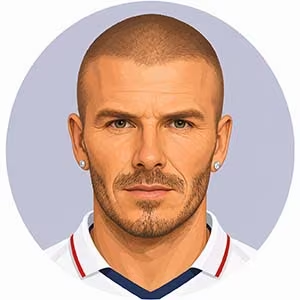
England - Right MidfielderBeckham, David
David Beckham could make a defender irrelevant without ever attempting to dribble past him. From the right side he opened his body, planted the left foot and wrapped the right around the ball with a contact that created extraordinary lateral curve without sacrificing pace. The delivery could begin from thirty metres away and still arrive behind the defensive line before a centre-back had adjusted his body towards his own goal. That mechanism shaped his entire career. Beckham did not need the touchline isolation normally associated with an elite winger; he could create from deeper territory, crossing early while the striker still had space to attack. The same mechanics transferred naturally to free kicks and long diagonal passing. His comparative advantage was therefore not separation from the immediate defender but the ability to make the ball travel through spaces faster and more accurately than the defence could reorganise around it.
Beckham was primarily a right midfielder whose technical specialisation was supported by exceptional running volume. At Manchester United he repeatedly covered the full flank, recovering into midfield before moving forward again to create from crossing positions. His first touch and passing allowed him to combine centrally when required, while long diagonals gave him influence from deeper areas as his career progressed. He was not dependent on reaching the byline: early crosses, switches and set pieces created attacking value without one-on-one superiority. Under Alex Ferguson this suited a highly structured 4-4-2 in which Beckham’s movement and delivery complemented rather than duplicated the forwards. At Real Madrid he increasingly operated centrally as well as from the right, while later periods in Los Angeles, Milan and Paris required further adaptation as pace declined. His career therefore outlasted the physical version of the traditional wide midfielder because the principal weapon—delivery based on technique and perception—aged more slowly than acceleration.
The limitations were nonetheless real. Beckham lacked elite top-end speed and could not repeatedly eliminate a full-back through dribbling, which made his effectiveness more dependent on movement around him than that of a winger capable of manufacturing separation alone. He was strongly right-foot dominant, although describing the left foot as functionally weak overstates the limitation. His agility was adequate rather than exceptional; pressure that prevented him from opening his body onto the right side could reduce the quality and ambition of his distribution. He was also not a natural defensive ball-winner despite enormous work rate. Running back into position and tackling effectiveness are separate attributes. Later central-midfield assignments exposed that distinction when opponents could attack around him at speed. His game therefore degraded most clearly when isolated into repeated one-on-one dribbling contests, denied the body orientation required for right-foot delivery or asked to provide defensive coverage through explosive lateral movement rather than endurance.
Psychologically, Beckham is best defined by **behavioural recalibration after public failure**. Against Argentina at the 1998 World Cup, after repeated physical interaction with Diego Simeone, Beckham reacted from the ground by kicking backwards towards him and was sent off. England were eliminated on penalties and Beckham became the target of extraordinary public hostility at home. The incident establishes genuine provocation-reactive aggression; it should not be softened into passion. What followed is more discriminating. Beckham did not reduce his exposure to high-responsibility actions. By 2001 he was England captain, and against Greece in the decisive World Cup qualifier he repeatedly assumed set pieces while England trailed. Deep into stoppage time he took another free kick and scored the goal that secured qualification. This was not simply redemption mythology: the behavioural change lies in continuing to place himself inside highly visible failure opportunities while avoiding the retaliatory mechanism that had damaged him in 1998. His Manchester United career provides another test. Ferguson could criticise him severely and eventually their relationship deteriorated, yet Beckham continued training and competing before leaving rather than becoming immediately unavailable. Evidence therefore supports neither emotional invulnerability nor permanent volatility. Individual provocation could breach his control, while sustained public hostility could be absorbed without comparable competitive withdrawal. **Beckham’s strongest psychological development was not learning to feel less pressure, but learning that pressure and provocation did not have to produce the same behaviour they once had.**