We use Google Analytics to understand how visitors use this site. Analytics cookies are only activated with your consent. For details, read our Privacy Policy.
Profile lensThe same player, read from a different angle.
Athletic83
Acceleration
85
Pace
85
Agility
86
Strength
81
Balance
76
Jumping
74
Stamina
87
Fitness
92
Technical86
Dribbling
87
Short Passing
85
Long Passing
92
Finishing
84
Shot Accuracy
82
Shot Power
85
Shooting Technique
81
Heading
77
Tackling
61
Crossing
92
Free Kick
91
Penalties
83
First Touch
89
Mental85
Composure
87
Aggression
76
Consistency
88
Creativity
82
Leadership
78
Work Rate
84
Tactical83
Vision
87
Off the Ball
81
Defensive Positioning
57
Teamwork
88
Anticipation
80
Marking
52
Player Traits
Attacking83
Crossing
92
Finishing
84
Heading Accuracy
77
Shot Accuracy
82
Off the Ball
81
Technique88
Dribbling
87
Free Kick
91
Short Passing
85
Long Passing
92
First Touch
89
Shot Technique
81
Movement83
Acceleration
85
Pace
85
Agility
86
Balance
76
Physicality84
Shot Power
85
Jumping
74
Stamina
87
Strength
81
Fitness
92
Defending57
Marking
52
Tackling
61
Def. Positioning
57
Mentality & Game Reading83
Aggression
76
Composure
87
Penalties
83
Vision
87
Leadership
78
Work Rate
84
Teamwork
88
Anticipation
80
Consistency
88
Creativity
82
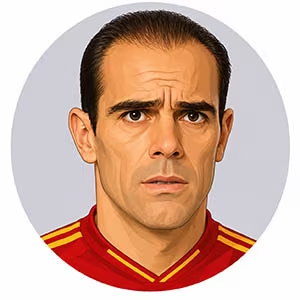
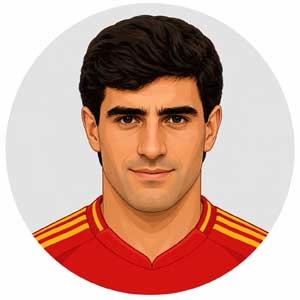
Spain - Right MidfielderMíchel
José Miguel González Martín del Campo—known across the footballing world simply as Míchel—was the exquisite, high-output outside-right and creative engine of Real Madrid’s legendary Quinta del Buitre, establishing the benchmark for wide play in the late 1980s.
Operating down the right flank or drifting centrally as an auxiliary playmaker, Míchel possessed clean first-touch control, deceptive shoulder drops, and an exceptional crossing repertoire: striking low, driven cutbacks across the penalty box, lofted diagonals to the far post, or vicious, bending deliveries at full sprint. A proud product of La Fábrica, he made 559 official appearances and scored 130 goals for Real Madrid between 1984 and 1996, forming an iconic core alongside Emilio Butragueño, Manolo Sanchís, Martín Vázquez, and Miguel Pardeza. During this golden era, he lifted six La Liga championships (including five consecutive titles from 1986 to 1990), two Copas del Rey, four Supercopas de España, and back-to-back UEFA Cups in 1985 and 1986. For Spain, across 66 caps and 21 goals, he featured across two World Cups (1986, 1990—where he scored an iconic hat-trick against South Korea) and Euro 1988, finishing as a prominent Ballon d'Or nominee in 1987.
Míchel’s specialized, line-hugging artistry, however, operated within clear physical boundaries. He was not an explosive, dynamic runner who relied on pure linear sprint speed or raw physical strength to knock defenders off balance; his game was anchored in spatial timing, body shape, and early ball-striking. When matched against aggressive, hyper-athletic full-backs who pressed him tightly and denied him half a yard to deliver crosses, his open-play impact could be contained. Furthermore, his defensive contributions were largely positional, offering minimal physical resistance when tracking opposing wingers deep into his own defensive third.
Polished, proud, and possessed of a theatrical, sharp-witted confidence that polarized Spanish terraces, Míchel embraced his role as Real Madrid’s glamorous aesthetic standard. He was fiercely protective of the Quinta's identity, taking immense pride in pure technical execution while displaying a combustible streak under provocation—most notoriously remembered for his infamous psychological distraction of Carlos Valderrama during a 1991 league match. On the pitch, his posture was upright, elegant, and demanding: gesturing for the ball with imperious certainty, surveying the box with a cool, calculating glance, and unleashing curling deliveries with effortless mechanics. Inside the Santiago Bernabéu and Spanish locker rooms, he was an influential, articulate pillar whose technical refinement and crossing precision left an indelible mark on European football history.


 All Time Real MadridClub