We use Google Analytics to understand how visitors use this site. Analytics cookies are only activated with your consent. For details, read our Privacy Policy.
Profile lensThe same player, read from a different angle.
Athletic74
Acceleration
68
Pace
72
Agility
73
Strength
80
Balance
70
Jumping
66
Stamina
85
Fitness
81
Technical85
Dribbling
90
Short Passing
92
Long Passing
85
Finishing
54
Shot Accuracy
64
Shot Power
72
Shooting Technique
82
Heading
68
Tackling
87
Crossing
77
Free Kick
68
Penalties
66
First Touch
90
Mental85
Composure
95
Aggression
66
Consistency
85
Creativity
85
Leadership
75
Work Rate
77
Tactical86
Vision
89
Off the Ball
72
Defensive Positioning
86
Teamwork
95
Anticipation
85
Marking
77
Player Traits
Attacking67
Crossing
77
Finishing
54
Heading Accuracy
68
Shot Accuracy
64
Off the Ball
72
Technique85
Dribbling
90
Free Kick
68
Short Passing
92
Long Passing
85
First Touch
90
Shot Technique
82
Movement71
Acceleration
68
Pace
72
Agility
73
Balance
70
Physicality77
Shot Power
72
Jumping
66
Stamina
85
Strength
80
Fitness
81
Defending83
Marking
77
Tackling
87
Def. Positioning
86
Mentality & Game Reading82
Aggression
66
Composure
95
Penalties
66
Vision
89
Leadership
75
Work Rate
77
Teamwork
95
Anticipation
85
Consistency
85
Creativity
85
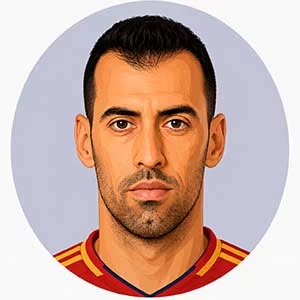
Spain - Defensive MidfielderBusquets, Sergio
Cerebral geometry, micro-pauses, and an uncanny panoramic vision allowed Sergio Busquets Burgos to dismantle opposing pressing schemes without ever relying on sprinting speed or heavy physical contact. Promoted directly from the Spanish fourth division by Pep Guardiola in the summer of 2008, the Catalan pivot became the tactical fulcrum around which Barcelona and the Spanish national team staged their multi-year continental hegemony. Standing at six-foot-two with a lean, gangly frame, Busquets operated with total technical minimalism: receiving possession on the half-turn with an open body shape, using subtle shoulder feints and dragging the ball with the sole of his boot (la pausa) to draw opponents in before slicing them open with sharp, ground-level passes through the central axis. His defensive value was equally sophisticated; rather than making sliding tackles in open channels, he cut off passing lanes through spatial anticipation and clamped down on counter-attacks within three yards of transition. Across 722 appearances for Barcelona, he secured nine La Liga titles, three UEFA Champions League trophies, and seven Copas del Rey, while anchoring Spain across 143 caps during their historic 2010 World Cup and Euro 2012 triumphs.
Psychologically, Busquets was an unshakeable zen master between the lines whose heart rate seemed completely unaffected by high-stakes pressure. Operating in the most congested, turnover-punishing zone on the pitch, he possessed a rare emotional detachment that allowed him to execute high-risk, one-touch escapes inches away from his own penalty area with icy clarity. On the pitch, his leadership was instructional, subtle, and continuous; he did not scream or beat his chest, communicating instead through precise hand gestures and subtle head movements that kept midfield partners like Xavi and Andrés Iniesta perfectly spaced. However, his competitive nature carried a distinct, street-smart cynicism: in his younger years, he occasionally leaned into theatrical gamesmanship and simulated contact to protect himself from heavy tackles or draw disciplinary action against opponents—most notoriously during the 2010 Champions League semi-final against Inter Milan. In the dressing room, he was a quiet, highly observant pillar of stability—completely devoid of individual vanity, universally respected across multiple generations of players, and serving as the calm cultural bridge between demanding tacticians and mercurial superstars. Toward referees and markers, Busquets was analytical and calculating, turning football into a game of chess where his supreme spatial intellect rendered pure physical athleticism largely obsolete.