We use Google Analytics to understand how visitors use this site. Analytics cookies are only activated with your consent. For details, read our Privacy Policy.
Profile lensThe same player, read from a different angle.
Athletic78
Acceleration
73
Pace
75
Agility
81
Strength
75
Balance
79
Jumping
72
Stamina
82
Fitness
84
Technical86
Dribbling
83
Short Passing
94
Long Passing
95
Finishing
74
Shot Accuracy
73
Shot Power
79
Shooting Technique
72
Heading
68
Tackling
71
Crossing
79
Free Kick
79
Penalties
75
First Touch
88
Mental85
Composure
87
Aggression
65
Consistency
82
Creativity
83
Leadership
85
Work Rate
84
Tactical81
Vision
91
Off the Ball
74
Defensive Positioning
69
Teamwork
95
Anticipation
80
Marking
66
Player Traits
Attacking74
Crossing
79
Finishing
74
Heading Accuracy
68
Shot Accuracy
73
Off the Ball
74
Technique85
Dribbling
83
Free Kick
79
Short Passing
94
Long Passing
95
First Touch
88
Shot Technique
72
Movement77
Acceleration
73
Pace
75
Agility
81
Balance
79
Physicality78
Shot Power
79
Jumping
72
Stamina
82
Strength
75
Fitness
84
Defending69
Marking
66
Tackling
71
Def. Positioning
69
Mentality & Game Reading83
Aggression
65
Composure
87
Penalties
75
Vision
91
Leadership
85
Work Rate
84
Teamwork
95
Anticipation
80
Consistency
82
Creativity
83
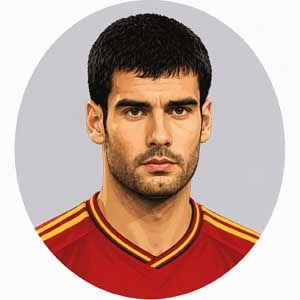
Spain - Defensive MidfielderGuardiola, Josep
A scrawny ball-boy perched by the Camp Nou dugout whom Johan Cruyff hauled onto the pitch with the strict instruction to never run more than necessary, because the ball moved faster than any human legs ever could, grew into the tactical architect of an entire European footballing philosophy. Josep "Pep" Guardiola Sala was the pure, distilled essence of the modern 4—the deep-lying pivot whose game was stripped of superfluous physical friction, defined instead by instantaneous spatial computation, head-up 360-degree vision, and an immaculate one-touch and two-touch passing cadence that dictated the heartbeat of Cruyff’s Dream Team.
Stationed at the base of Barcelona’s midfield triangle, Guardiola functioned as an on-pitch metronome. He did not run with the ball; he moved the opposition by receiving possession across his body, disguising his passing intent with subtle hip adjustments, and threading piercing ground balls between opposing lines into the feet of Laudrup, Stoichkov, or Bakero, or clipping forty-yard curved diagonals onto the chest of advancing wingers. A proud product of La Masia, he spent over a decade in the blaugrana first team between 1990 and 2001 across 384 official appearances and 12 goals, captaining the club through its most transformative era. His trophy haul was immense: six La Liga titles (including four consecutive championships from 1991 to 1994), two Copas del Rey, the 1991–92 European Cup at Wembley, the 1996–97 European Cup Winners' Cup, and two UEFA Super Cups. His later playing chapters took him to Serie A with Brescia (sharing the pitch with Roberto Baggio) and Roma, alongside spells in Qatar with Al-Ahli and Mexico with Dorados de Sinaloa under Juan Manuel Lillo. For Spain, across 47 caps and five goals, he was the gold-medal-winning captain of the 1992 Barcelona Olympics and the tactical conductor of the senior side across the 1994 World Cup and Euro 2000.
That supreme footballing intellect, however, existed alongside severe, glaring athletic vulnerabilities. Guardiola was notoriously slow over long distances, completely lacking dynamic recovery acceleration, top-end sprint speed, and explosive aerial spring; if caught in wide-open thirty-yard footraces against dynamic counter-attacking forwards when Barcelona’s offside trap malfunctioned, he was helpless. He was not a bone-crunching ball-winner, requiring combative, aggressive interior partners like José Mari Bakero, Guillermo Amor, or Miguel Ángel Nadal to handle the physical dirty work and press transitions. Furthermore, severe chronic injuries to his hamstrings and calf muscles severely disrupted his availability during his late twenties, accelerating his departure from peak European football.
Psychologically, Guardiola was an intense, hyper-analytical perfectionist whose passion for positional order bordered on obsessive-compulsive discipline. He experienced football not as a gladiatorial contest, but as an intellectual chess match of geometric angles and positional supremacy, displaying visible, agitated despair whenever a teammate played a lazy, imprecise pass or failed to occupy the correct zone on the pitch. Fiercely proud of his Catalan identity and bearing the heavy weight of the captain's armband with immense moral seriousness, he was an uncompromising dressing-room leader who demanded absolute tactical fidelity. On the pitch, his body language was a masterclass in cerebral command: standing upright, head constantly swiveling before the ball arrived, orchestrating teammates with frantic hand gestures, and striking crisp ground passes with pristine, minimalist mechanics. Inside the Camp Nou and Spanish national team locker rooms, his tactical wisdom was revered as gospel by teammates and managers alike—an untouchable maestro whose visionary playmaking as a player laid the indestructible intellectual foundation for the tactical revolution he would later unleash on the modern game.


 All Time SpainNT