We use Google Analytics to understand how visitors use this site. Analytics cookies are only activated with your consent. For details, read our Privacy Policy.
Profile lensThe same player, read from a different angle.
Athletic84
Acceleration
92
Pace
87
Agility
91
Strength
75
Balance
94
Jumping
77
Stamina
77
Fitness
81
Technical94
Dribbling
98
Short Passing
92
Long Passing
92
Finishing
97
Shot Accuracy
96
Shot Power
88
Shooting Technique
86
Heading
75
Tackling
36
Crossing
94
Free Kick
91
Penalties
84
First Touch
99
Mental82
Composure
88
Aggression
65
Consistency
88
Creativity
93
Leadership
72
Work Rate
73
Tactical89
Vision
94
Off the Ball
89
Defensive Positioning
38
Teamwork
92
Anticipation
88
Marking
30
Player Traits
Attacking90
Crossing
94
Finishing
97
Heading Accuracy
75
Shot Accuracy
96
Off the Ball
89
Technique93
Dribbling
98
Free Kick
91
Short Passing
92
Long Passing
92
First Touch
99
Shot Technique
86
Movement91
Acceleration
92
Pace
87
Agility
91
Balance
94
Physicality80
Shot Power
88
Jumping
77
Stamina
77
Strength
75
Fitness
81
Defending35
Marking
30
Tackling
36
Def. Positioning
38
Mentality & Game Reading84
Aggression
65
Composure
88
Penalties
84
Vision
94
Leadership
72
Work Rate
73
Teamwork
92
Anticipation
88
Consistency
88
Creativity
93
Curated interpretation
Signature Moves
Role-defining patterns—not attributes, traits or Inner Game measures. Three ways Lionel Messi changes the meaning of the role around him.
01
Shortest Path
He continually finds the shortest, most effective route from possession to danger, removing unnecessary passes and gestures from the action.
02
Scoreboard Glitch
He produces numbers so abnormal that they appear to violate the game’s normal statistical logic.
03
No Wasted Motion
Almost every control, touch, change of direction or acceleration serves a concrete, progressive purpose.
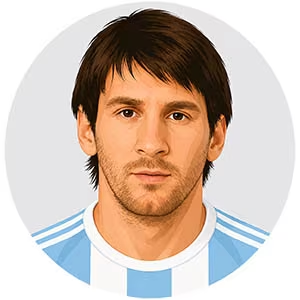
Argentina - ForwardMessi, Lionel
Qatar, 18 December 2022, the ninth minute of extra time in a World Cup final. Lionel Messi is thirty-five, has played every minute of the tournament, and pokes in a rebound from two yards to make it 3–2 — the least beautiful goal of his life and the only one anyone will remember him needing. Three hours later he lifted the trophy that had defined and tormented an entire career, and the argument that had run for twenty years quietly ended. He had never once raised his voice to win it.
Born in Rosario in 1987, diagnosed at ten with a growth hormone deficiency his family could not afford to treat, Messi arrived at Barcelona at thirteen on a contract famously drafted on a napkin. He established himself in the first team at seventeen and stayed for seventeen seasons, playing 778 matches and scoring 672 goals, both club records that will not be approached. His dribbling worked through changes of pace and timing rather than elaborate feints — he beat opponents by accelerating into a gap half a second before it appeared, at 1.70m and low to the ground, with the ball never more than a stride from his left foot. He was equally a passer, and the balance shifted across his career: a right winger cutting inside under Frank Rijkaard, a false nine under Pep Guardiola in the side that won the 2009 sextuple, and finally a deep-lying playmaker who created more chances than anyone in Europe while still scoring thirty a season. He won ten La Liga titles, four Champions Leagues and seven Copas del Rey with Barcelona, later Ligue 1 with Paris Saint-Germain and MLS Cup with Inter Miami. He holds eight Ballons d'Or, the record for goals in a calendar year at 91, and the La Liga scoring record. For Argentina, across more than 190 caps, he won the 2008 Olympic gold, the 2021 Copa América, the 2022 World Cup and the 2024 Copa América, after losing four major finals between 2007 and 2016.
The limitations were real even if they rarely mattered. Messi offered almost nothing defensively from his late twenties onward, walking through long phases of matches to conserve energy — a trade every coach accepted and which nonetheless left his teams pressing with ten. He was physically slight and could be roughed off the ball by defenders willing to foul persistently, and he was markedly less effective in cold, wet, attritional conditions than in controlled ones, a pattern visible in several away performances in England and in the earlier stages of his international career. His Barcelona sides became structurally dependent on him to a degree that flattered him and damaged them, and the collapses of the late 2010s exposed a team built around a single solution. He also carried, for a decade, a reputation for producing less for Argentina than for his club — unfair in the numbers, but not entirely invented, since the national side around him was frequently incoherent until Lionel Scaloni built one that fit.
He operated with an introverted, deeply internal emotional architecture, responding to high-stakes pressure not through vocal outbursts or physical intimidation but through a total, meditative focus that accelerated his decision-making in compressed moments. He led without speaking, through technical authority and results, maintaining a quiet, protective bond with a small inner circle of teammates while keeping his distance from media narratives and club politics. His discipline and routine were defined by meticulous consistency and by remarkable physical durability, playing nearly every minute of nearly every season for two decades. With referees and opponents he showed exceptional restraint: subjected to systematic fouling, shirt-pulling and tactical hacking throughout his career, he almost never retaliated, preferring to absorb the challenge, stay on his feet, and restart play immediately to exploit a displaced defensive block. Underneath the composure ran a competitiveness that occasionally surfaced without warning — the red card seconds into his Argentina debut, the confrontations with opponents in later years, the goading of a Dutch coach in 2022 — and a temper his teammates knew existed and outsiders rarely saw. Criticism, particularly from Argentina, wounded him deeply and privately: after losing the 2016 Copa América final he announced his international retirement in tears, spent months away, and returned without ever explaining himself. That pattern defined him more than any trophy — absorbing blame in silence, disappearing, and coming back — until the silence finally ran out in Qatar and the most reserved great player in the history of the sport spent a month leading, arguing, celebrating and confronting in public, having waited his entire life for permission.


 All Time BarcelonaClub
 All Time ArgentinaNT
 All-Time 2010s2010s
 All-Time South AmericaSouth America