We use Google Analytics to understand how visitors use this site. Analytics cookies are only activated with your consent. For details, read our Privacy Policy.
Profile lensThe same player, read from a different angle.
Athletic80
Acceleration
78
Pace
77
Agility
78
Strength
81
Balance
80
Jumping
74
Stamina
85
Fitness
84
Technical85
Dribbling
84
Short Passing
89
Long Passing
92
Finishing
74
Shot Accuracy
78
Shot Power
88
Shooting Technique
83
Heading
71
Tackling
69
Crossing
87
Free Kick
78
Penalties
78
First Touch
88
Mental86
Composure
93
Aggression
75
Consistency
85
Creativity
74
Leadership
80
Work Rate
83
Tactical85
Vision
93
Off the Ball
82
Defensive Positioning
64
Teamwork
93
Anticipation
78
Marking
61
Player Traits
Attacking78
Crossing
87
Finishing
74
Heading Accuracy
71
Shot Accuracy
78
Off the Ball
82
Technique86
Dribbling
84
Free Kick
78
Short Passing
89
Long Passing
92
First Touch
88
Shot Technique
83
Movement78
Acceleration
78
Pace
77
Agility
78
Balance
80
Physicality82
Shot Power
88
Jumping
74
Stamina
85
Strength
81
Fitness
84
Defending65
Marking
61
Tackling
69
Def. Positioning
64
Mentality & Game Reading83
Aggression
75
Composure
93
Penalties
78
Vision
93
Leadership
80
Work Rate
83
Teamwork
93
Anticipation
78
Consistency
85
Creativity
74
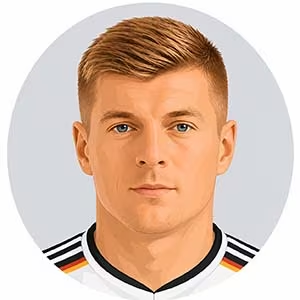
Germany - Centre MidfielderKroos, Toni
The center circle of the Santiago Bernabéu operated for a decade as the private, frictionless laboratory of an architect who dictated match tempos with cold, metronomic certainty. Recruited from Bayern Munich in the summer of 2014 fresh off lifting the World Cup with Germany, Toni Kroos established himself as the definitive deep-lying orchestrator (regista) of modern European football. Deployed on the left side of a legendary midfield trio alongside Luka Modrić and Casemiro, he transformed the simple act of distribution into an art of mathematical perfection: maintaining pass completion rates above 93% across entire seasons, executing laser-guided fifty-yard diagonal switches into wide channels, and creating passing angles through subtle, micro-second hip drops that completely bypassed high-pressing opposition lines. Across a glittering career spanning Bayern Munich and Real Madrid, Kroos captured an astonishing six UEFA Champions League titles (one with Bayern, five with Madrid), four Bundesliga titles, four La Liga championships, and six FIFA Club World Cups over more than eight hundred professional appearances. For Germany, across 114 caps and 17 goals, his international apex arrived at the 2014 World Cup in Brazil, where his masterclass in midfield orchestration—highlighted by two goals in the historic 7–1 semi-final rout of the hosts—anchored Die Mannschaft to global glory.
Yet this aristocratic, ultra-refined profile came with strict physical and defensive boundaries. Kroos was entirely dependent on tactical scaffolding around him; lacking dynamic linear sprint speed and vertical leap, he was easily bypassed in open-field transitions if forced to defend vast defensive expanses without a dedicated ball-winner like Casemiro beside him. His short-range tackling in isolated one-on-one duels was rudimentary, he offered negligible aerial resistance on defensive set pieces, and his goal output from open play was strictly limited to occasional, placed curlers from the edge of the box.
Detached, ice-cold, and governed by an absolute psychological immunity to external pressure, Kroos approached high-stakes Champions League finals with the exact same relaxed, emotionless composure as a routine training session. He played without fear or theatrical gestures: hostile away crowds, suffocating tactical presses, and aggressive midfield markers failed to raise his heart rate by a single beat. On the pitch, his body language was clean, upright, and unflappable; he directed the entire tempo of Real Madrid with minimal, decisive touches, refusing to rush his execution regardless of scoreboard pressure. Inside the Valdebebas locker room, he was a revered elder statesman who led purely by elite technical standard and quiet professionalism, avoiding media theatrics and retiring at the absolute peak of his powers on his own terms. Opponents found his composure infuriatingly impossible to disrupt, while match officials enjoyed a pristine working relationship with a player whose game was built entirely on clean, intellectual superiority, leaving an eternal legacy as one of the most precise, decorated, and cerebral midfield conductors in the history of the sport.