We use Google Analytics to understand how visitors use this site. Analytics cookies are only activated with your consent. For details, read our Privacy Policy.
Profile lensThe same player, read from a different angle.
Athletic75
Acceleration
75
Pace
72
Agility
77
Strength
70
Balance
77
Jumping
74
Stamina
83
Fitness
75
Technical86
Dribbling
83
Short Passing
90
Long Passing
95
Finishing
87
Shot Accuracy
77
Shot Power
87
Shooting Technique
85
Heading
74
Tackling
55
Crossing
90
Free Kick
82
Penalties
83
First Touch
89
Mental86
Composure
91
Aggression
70
Consistency
77
Creativity
85
Leadership
87
Work Rate
94
Tactical82
Vision
93
Off the Ball
82
Defensive Positioning
71
Teamwork
84
Anticipation
74
Marking
53
Player Traits
Attacking82
Crossing
90
Finishing
87
Heading Accuracy
74
Shot Accuracy
77
Off the Ball
82
Technique87
Dribbling
83
Free Kick
82
Short Passing
90
Long Passing
95
First Touch
89
Shot Technique
85
Movement75
Acceleration
75
Pace
72
Agility
77
Balance
77
Physicality78
Shot Power
87
Jumping
74
Stamina
83
Strength
70
Fitness
75
Defending60
Marking
53
Tackling
55
Def. Positioning
71
Mentality & Game Reading84
Aggression
70
Composure
91
Penalties
83
Vision
93
Leadership
87
Work Rate
94
Teamwork
84
Anticipation
74
Consistency
77
Creativity
85
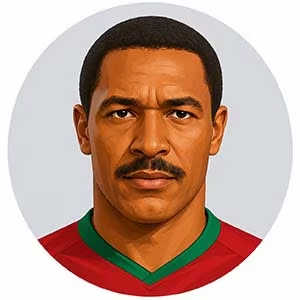
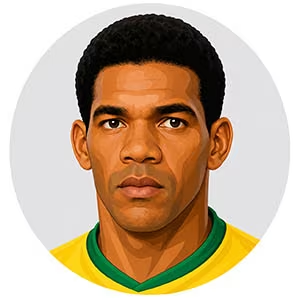
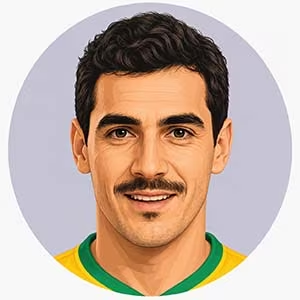
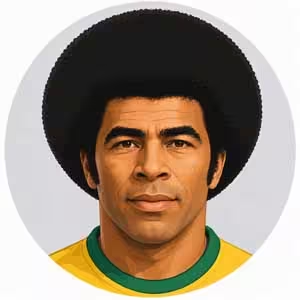
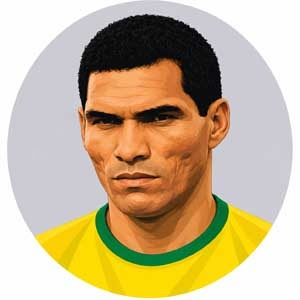
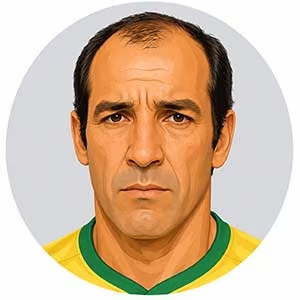
Brazil - Centre MidfielderGérson
The left boot of Gérson de Oliveira Nunes functioned as the ultimate launchpad for Brazil's greatest attacking side, dictating tempo with a level of passing geometry that earned him the moniker Canhotinha de Ouro (The Golden Left Foot). Emerging through Flamengo and Botafogo before starring for São Paulo and Fluminense, Gérson revolutionized the deep-lying playmaker role in South America during the 1960s and early 1970s. While he lacked explosive acceleration, he possessed an extraordinary visual field and a low center of gravity that allowed him to shield the ball under pressure with minimal body movements. Rather than relying on short, safe lateral recycling, his game was distinctively vertical: he could drop between the center-backs, look up, and deliver 50-yard diagonal passes that dropped over defensive lines straight into the stride of Jairzinho or Pelé. His finest tactical masterclass came in the 1970 World Cup Final against Italy, where he broke a 1–1 deadlock by dropping his shoulder to evade an Italian marker and driving a ferocious left-foot strike from distance into the bottom corner, before delivering the looping 40-yard pass that setup Pelé's headed assist for Jairzinho. Across 70 caps and 14 goals for the Seleção, he proved that passing speed and spatial anticipation always moved faster than pure physical running.
Psychologically, Gérson was a fiercely vocal, authoritarian floor general whose high footballing intelligence came packaged with an abrasive, uncompromising temperament. He possessed zero filter on the pitch; if a teammate mistimed a run, held the ball too long, or failed to track back, Gérson would berate them openly, regardless of their stature. This volatile intensity led to intense controversies off the pitch—most notoriously the 1979 cigarette advertising campaign that coined the "Lei de Gérson" (Gérson's Law), associating his name with ruthless opportunism, an episode he bitterly regretted for the rest of his life. Yet inside the dressing room of Mário Zagallo’s 1970 squad, his tactical authority was absolute; he acted as an on-field manager, rearranging Brazil's midfield structure on the fly when the game plan stalled. Under intense pressure, his mind worked with cold calculation; he never rushed his decisions, using his temper as fuel to demand the ball and impose his rhythm on chaotic matches. Toward referees and aggressive man-markers, Gérson was combative and cynical, using sharp elbows and tactical obstruction to protect himself while letting his surgical passing range dismantle opposing systems.


 All-Time 1960s1960s