We use Google Analytics to understand how visitors use this site. Analytics cookies are only activated with your consent. For details, read our Privacy Policy.
Profile lensThe same player, read from a different angle.
Athletic83
Acceleration
88
Pace
83
Agility
84
Strength
77
Balance
82
Jumping
86
Stamina
82
Fitness
81
Technical84
Dribbling
87
Short Passing
80
Long Passing
78
Finishing
87
Shot Accuracy
87
Shot Power
87
Shooting Technique
85
Heading
73
Tackling
44
Crossing
81
Free Kick
79
Penalties
82
First Touch
88
Mental79
Composure
85
Aggression
87
Consistency
77
Creativity
82
Leadership
76
Work Rate
75
Tactical79
Vision
81
Off the Ball
88
Defensive Positioning
39
Teamwork
73
Anticipation
85
Marking
36
Player Traits
Attacking83
Crossing
81
Finishing
87
Heading Accuracy
73
Shot Accuracy
87
Off the Ball
88
Technique83
Dribbling
87
Free Kick
79
Short Passing
80
Long Passing
78
First Touch
88
Shot Technique
85
Movement84
Acceleration
88
Pace
83
Agility
84
Balance
82
Physicality83
Shot Power
87
Jumping
86
Stamina
82
Strength
77
Fitness
81
Defending40
Marking
36
Tackling
44
Def. Positioning
39
Mentality & Game Reading80
Aggression
87
Composure
85
Penalties
82
Vision
81
Leadership
76
Work Rate
75
Teamwork
73
Anticipation
85
Consistency
77
Creativity
82
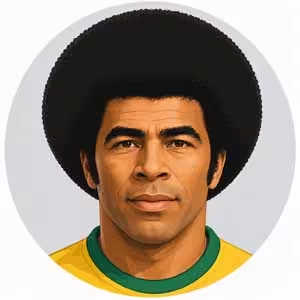
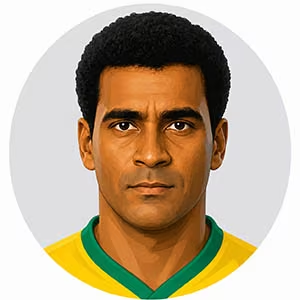
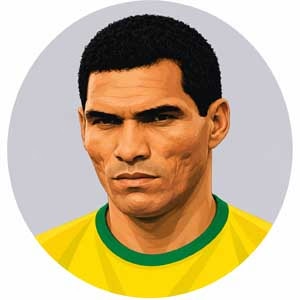
Brazil - Right WingerJairzinho
Charging down the right flank with an intoxicating blend of brute muscular force, rapid acceleration, and deceptive close control, Jair Ventura Filho—immortalized simply as Jairzinho—redefined the wide forward role in South American football throughout the late 1960s and 1970s. Inheriting the daunting mantle of Garrincha at Botafogo, Jairzinho was a fundamentally different tactical animal: less of an elusive, hip-swiveling trickster and far more of an explosive, direct power-winger. Possessing broad shoulders, a low center of gravity, and a devastating burst of pace over thirty yards, he specialized in riding heavy body checks, powering past full-backs along the touchline, and cutting inward to unleash venomous strikes with his right foot. He was the attacking motor of Botafogo's celebrated late-1960s side, capturing two Campeonato Carioca titles and the 1968 Taça Brasil, before later guiding Cruzeiro to the 1976 Copa Libertadores. Yet his definitive masterpiece remains the 1970 World Cup in Mexico: operating as the dynamic vertical spearhead of Mário Zagallo’s star-studded frontline, Jairzinho achieved the unprecedented feat of scoring in every single match of the tournament (seven goals in six games), earning the nickname O Furacão da Copa (The Hurricane of the World Cup) and cementing Brazil's permanent claim to the Jules Rimet trophy. Across 81 official caps and 33 goals for the Seleção, he featured across three consecutive World Cups (1966, 1970, 1974), remaining one of the most physically dominant wide attackers in international history. Psychologically, Jairzinho was an intensely proud, fiercely competitive, and emotionally expressive warrior who played with an infectious, street-forged swagger. Having grown up in the tough northern suburbs of Rio de Janeiro, he possessed an unshakeable inner resilience and refused to be intimidated by hostile crowds or brutal physical marking. On the pitch, his leadership was energetic, demonstrative, and demanding; he fed off the collective momentum of his team, celebrating goals with iconic, arm-flailing euphoria and constantly urging his teammates to maintain a suffocating attacking tempo. Inside the dressing room, he was a vibrant, charismatic, and unifying presence—warm-hearted, fiercely loyal to his peers, and capable of elevating the mood of the squad with his loud humor and natural confidence. Under the blistering heat and high-altitude pressure of Mexico 1970, his mental focus was razor-sharp; he never shrank alongside mythical figures like Pelé, Tostão, and Rivellino, instead demanding his share of attacking responsibility and finishing high-leverage chances with cold-blooded conviction. Toward referees and bruising full-backs who frequently hacked at him with cynical intent, Jairzinho responded with aggressive physical defiance: he used his formidable upper-body strength to push back, rarely stayed down after a challenge, and channeled any frustration directly into running over his marker on the subsequent play.