We use Google Analytics to understand how visitors use this site. Analytics cookies are only activated with your consent. For details, read our Privacy Policy.
Profile lensThe same player, read from a different angle.
Athletic83
Acceleration
93
Pace
88
Agility
86
Strength
73
Balance
82
Jumping
73
Stamina
88
Fitness
77
Technical85
Dribbling
92
Short Passing
85
Long Passing
88
Finishing
83
Shot Accuracy
77
Shot Power
86
Shooting Technique
87
Heading
63
Tackling
46
Crossing
90
Free Kick
77
Penalties
76
First Touch
90
Mental78
Composure
82
Aggression
85
Consistency
74
Creativity
90
Leadership
77
Work Rate
77
Tactical81
Vision
85
Off the Ball
84
Defensive Positioning
58
Teamwork
82
Anticipation
79
Marking
52
Player Traits
Attacking79
Crossing
90
Finishing
83
Heading Accuracy
63
Shot Accuracy
77
Off the Ball
84
Technique87
Dribbling
92
Free Kick
77
Short Passing
85
Long Passing
88
First Touch
90
Shot Technique
87
Movement87
Acceleration
93
Pace
88
Agility
86
Balance
82
Physicality79
Shot Power
86
Jumping
73
Stamina
88
Strength
73
Fitness
77
Defending52
Marking
52
Tackling
46
Def. Positioning
58
Mentality & Game Reading81
Aggression
85
Composure
82
Penalties
76
Vision
85
Leadership
77
Work Rate
77
Teamwork
82
Anticipation
79
Consistency
74
Creativity
90
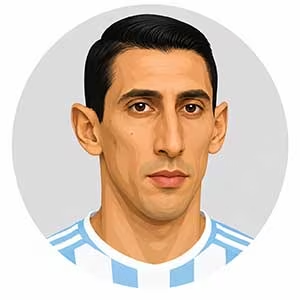
Argentina - Right WingerDi María, Ángel
Every final. That is the phrase that follows Ángel Di María, and it is close to literal: the winning goal in the 2008 Olympic final, the assist for the winner in the 2014 Champions League final, the goal in the 2021 Copa América final against Brazil, the goal in the 2022 Finalissima against Italy, and then the goal in the World Cup final in Lusail, the one that made it 2–0 and produced a substituted player weeping uncontrollably on the bench for a country that had spent a decade telling him he was not good enough. He was the most criticised member of that generation. He also decided, one way or another, almost every trophy it won.
Born in Rosario in 1988 into a family that ran a coal yard, where he worked as a child, Di María became one of the most productive wide players of his era through a physical profile nobody would have designed on purpose: 1.80m, extremely slight, and built for acceleration and repeated sprints rather than strength. He was two-footed in effect if not in preference, capable of playing on either flank or centrally, and his defining qualities were the ability to carry the ball at speed into space and a passing gift that made him one of the finest chance creators of his generation — cutbacks, chipped through-balls, and crosses struck with the outside of the left foot. He also possessed a hard, low shot from distance and a remarkable habit of scoring high-difficulty goals in high-stakes matches. Rosario Central and Benfica preceded a move to Real Madrid in 2010, where he won La Liga, two Copas del Rey and the 2014 Champions League, being named man of the match in the final before being sold that summer. An unhappy season at Manchester United followed, then seven years at Paris Saint-Germain — five Ligue 1 titles and the club's all-time assist record — and a final European chapter at Juventus and Benfica before returning to Rosario Central. For Argentina he passed 145 caps, won the 2021 Copa América, the 2022 World Cup, and the 2024 Copa América, retiring from international football with the trophies that had eluded the entire Messi generation.
His fragility was chronic and shaped his whole career. Di María suffered muscular injuries with unusual frequency, particularly in the periods immediately preceding major tournaments — he missed the 2014 World Cup final through a thigh tear sustained in the quarter-final — and his slender frame made him easy to knock off the ball by defenders who engaged him physically. His decision-making in the final third was inconsistent, shooting when a pass was available and forcing crosses into crowded areas, and his defensive contribution fluctuated by season and coach. Against compact low blocks that denied him space to run into, he could become wasteful rather than merely quiet.
The temperament underneath was unusually raw. Di María was emotionally transparent in a way elite football rarely permits: he cried openly and often, on pitches and in interviews, spoke publicly about how deeply the criticism from Argentine media and supporters wounded him, and never developed the protective indifference that most players in his position acquire. He carried grievances — about Real Madrid selling him, about being blamed for tournament failures — and expressed them plainly rather than diplomatically. On the pitch he was competitive and combustible, quick to protest, quick to retaliate against physical treatment, and capable of collecting cards in matches that did not require it. What made him valuable rather than fragile was that pressure activated him instead of suppressing him: the bigger the occasion, the more consistently he produced, and his record in finals is not statistical noise but the single most reliable pattern of his career. Away from football he was family-centred and low-key, devoted to his wife and daughters, and returned to the club where he had started despite security threats to his family in Rosario — a decision that summarised him more accurately than any of the finals. Wounded, sentimental and permanently underestimated, Di María spent fifteen years answering criticism by winning the matches nobody else could.


 All Time ArgentinaNT