We use Google Analytics to understand how visitors use this site. Analytics cookies are only activated with your consent. For details, read our Privacy Policy.
Profile lensThe same player, read from a different angle.
Athletic79
Acceleration
77
Pace
77
Agility
79
Strength
80
Balance
76
Jumping
74
Stamina
88
Fitness
81
Technical81
Dribbling
83
Short Passing
83
Long Passing
82
Finishing
68
Shot Accuracy
72
Shot Power
84
Shooting Technique
74
Heading
71
Tackling
82
Crossing
75
Free Kick
78
Penalties
74
First Touch
83
Mental80
Composure
86
Aggression
88
Consistency
78
Creativity
75
Leadership
75
Work Rate
83
Tactical81
Vision
82
Off the Ball
70
Defensive Positioning
80
Teamwork
83
Anticipation
84
Marking
81
Player Traits
Attacking71
Crossing
75
Finishing
68
Heading Accuracy
71
Shot Accuracy
72
Off the Ball
70
Technique81
Dribbling
83
Free Kick
78
Short Passing
83
Long Passing
82
First Touch
83
Shot Technique
74
Movement77
Acceleration
77
Pace
77
Agility
79
Balance
76
Physicality81
Shot Power
84
Jumping
74
Stamina
88
Strength
80
Fitness
81
Defending81
Marking
81
Tackling
82
Def. Positioning
80
Mentality & Game Reading81
Aggression
88
Composure
86
Penalties
74
Vision
82
Leadership
75
Work Rate
83
Teamwork
83
Anticipation
84
Consistency
78
Creativity
75
France - Defensive MidfielderFernández, Luis
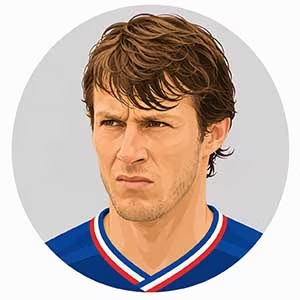
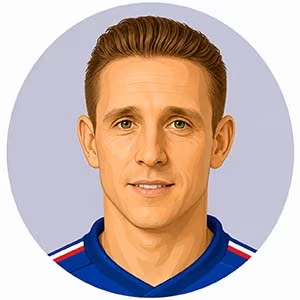
The decisive penalty in Guadalajara against Brazil on June 21, 1986, belonged to a snarling, combative destroyer who turned the middle of the pitch into an unremitting zone of attrition. Luis Miguel Fernández Toledo—born in Tarifa, Spain, before emigrating to France as a child—was the physical enforcer and defensive anchor of Michel Hidalgo’s legendary Carré Magique (Magic Square) alongside Platini, Giresse, and Tigana. Stationed at the base of the midfield, Fernandez was a ferocious ball-winner: breaking up opposing transitions with crunching tackles, tracking runners across thirty yards of open turf, and distributing crisp, low-risk passes to the playmakers ahead of him. Across 273 appearances for Paris Saint-Germain, he captained the club to their historic first Division 1 championship in 1985–86 and the 1982 and 1983 Coupes de France, later anchoring RC Paris and AS Cannes. For France, across 60 caps and six goals, he won Euro 1984 on home soil and claimed the bronze medal at the 1986 World Cup in Mexico.
Yet Fernandez’s hyper-combative edge walked a permanent tightrope with disciplinary disaster. His aggressive tackling style and fiery temperament earned him a relentless stream of bookings, occasionally leaving his side vulnerable to sudden dismissals during high-stakes tactical warfare. Technically, he was functional rather than creative: his passing range lacked long-range diagonal flight, his dribbling in tight channels was basic, and he contributed little offensive output inside the opponent's eighteen-yard box.
Combative, hyper-emotional, and playing with a permanent chip on his shoulder, Fernandez was the ultimate midfield warrior who relished hostile away atmospheres and physical dogfights. He fed off friction, using aggressive body checks and psychological intimidation to unbalance opposing playmakers before they could find their rhythm. On the pitch, his body language was explosive and demanding: waving his arms, barking pressing cues to his defensive line, and celebrating clean tackles with clenched fists. Inside the PSG and French national team locker rooms, he was an indispensable cultural glue and emotional sparkplug—taking on the defensive dirty work so that Platini and Giresse could create without anxiety. Referees faced a constant vocal adversary in him, cementing his eternal legacy as one of the most tenacious, passionate, and iconic defensive midfielders in French football history.