We use Google Analytics to understand how visitors use this site. Analytics cookies are only activated with your consent. For details, read our Privacy Policy.
Profile lensThe same player, read from a different angle.
Athletic86
Acceleration
78
Pace
85
Agility
76
Strength
93
Balance
88
Jumping
90
Stamina
91
Fitness
88
Technical86
Dribbling
83
Short Passing
87
Long Passing
87
Finishing
79
Shot Accuracy
78
Shot Power
88
Shooting Technique
82
Heading
88
Tackling
90
Crossing
83
Free Kick
77
Penalties
75
First Touch
86
Mental86
Composure
85
Aggression
87
Consistency
87
Creativity
78
Leadership
88
Work Rate
86
Tactical87
Vision
87
Off the Ball
79
Defensive Positioning
88
Teamwork
91
Anticipation
85
Marking
87
Player Traits
Attacking81
Crossing
83
Finishing
79
Heading Accuracy
88
Shot Accuracy
78
Off the Ball
79
Technique84
Dribbling
83
Free Kick
77
Short Passing
87
Long Passing
87
First Touch
86
Shot Technique
82
Movement82
Acceleration
78
Pace
85
Agility
76
Balance
88
Physicality90
Shot Power
88
Jumping
90
Stamina
91
Strength
93
Fitness
88
Defending88
Marking
87
Tackling
90
Def. Positioning
88
Mentality & Game Reading85
Aggression
87
Composure
85
Penalties
75
Vision
87
Leadership
88
Work Rate
86
Teamwork
91
Anticipation
85
Consistency
87
Creativity
78
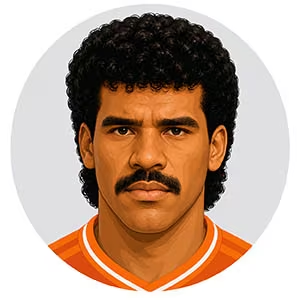
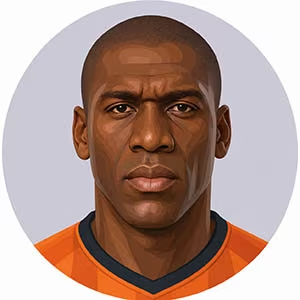
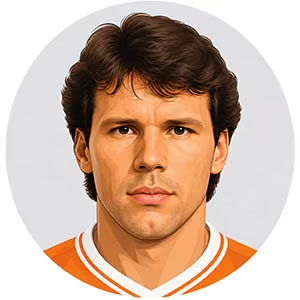
Netherlands - Defensive MidfielderRijkaard, Franklin
Milan, 1990: Marco van Basten was the artist, Ruud Gullit the icon, and Frank Rijkaard was the reason both of them could play. He was the third Dutchman, the one who did the parts of football that do not photograph well, and he did them with a physical authority and a technical ease that made him arguably the most complete midfielder of his era. He also scored the winning goal in a European Cup final, which tells you how little the description "defensive midfielder" ever covered him.
Born in Amsterdam in 1962 to a Surinamese father, Rijkaard came through the Ajax academy and debuted at seventeen under Leo Beenhakker. He was the ultimate tactical equalizer, functioning seamlessly as an elite centre-back and as a dominant defensive midfielder, combining a formidable frame with the touch of an attacking playmaker. His tackling range was exceptional, his aerial dominance almost total, and his capacity to break opposition pressing lines — with vertical passing or with powerful surges through the central axis — was the single most valuable thing about him. He won three Eredivisie titles and the 1987 Cup Winners' Cup with Ajax before a rupture with Johan Cruyff ended his first spell abruptly; he moved to Sporting CP and then Real Zaragoza before joining Milan in 1988. There, in Arrigo Sacchi's side, he won two Serie A titles and back-to-back European Cups in 1989 and 1990, scoring the only goal of the 1990 final against Benfica. He returned to Ajax in 1993 and won the 1995 Champions League at thirty-two, retiring immediately afterwards. For the Netherlands he won 73 caps and the 1988 European Championship.
His nonchalance had a cost. Rijkaard's relaxed style could tip into genuine languor, producing careless giveaways under light pressure and phases of tactical inattention, and his intensity dropped noticeably in matches that lacked stakes — he was a player who needed the occasion to be worth something. He was not quick over distance, and against sides that attacked into space behind a high midfield line he could be bypassed. His goal output was modest for a player of his technical range, since he rarely arrived in the box outside set pieces.
Emotionally he was a complex, highly reserved figure whose relaxed demeanour concealed a sharp temper when provoked. He usually projected cool authority and unruffled elegance, spoke quietly, and led through positional example rather than instruction, and teammates at three clubs described a man who was respected universally and known by very few. The exceptions were sudden and severe. In 1987, at twenty-five, he fell out with Cruyff — his manager and the figure he had grown up idolising — over selection and tactics, walked out of Ajax mid-season, and spent a year in exile abroad rather than back down, a rupture that took years to repair. Three years later came the confrontation with Rudi Völler in the 1990 World Cup, in which both men were sent off within minutes and Rijkaard spat at his opponent twice, an act he apologised for repeatedly and publicly for the rest of his life. Neither episode fitted the man his colleagues knew, which is precisely what made them notable: the volatility sat far beneath the surface and surfaced only under sustained provocation or a challenge to his own judgement. Away from football he was private, cultured, quietly political about race in Dutch society, and free of controversy in a long subsequent management career that included a Champions League with Barcelona. Serene, indispensable and occasionally combustible, Rijkaard was the balance in three of the greatest teams ever assembled and rarely received the credit for being it.