We use Google Analytics to understand how visitors use this site. Analytics cookies are only activated with your consent. For details, read our Privacy Policy.
Profile lensThe same player, read from a different angle.
Athletic82
Acceleration
75
Pace
77
Agility
76
Strength
87
Balance
87
Jumping
81
Stamina
90
Fitness
83
Technical82
Dribbling
80
Short Passing
82
Long Passing
85
Finishing
76
Shot Accuracy
74
Shot Power
97
Shooting Technique
73
Heading
78
Tackling
84
Crossing
79
Free Kick
84
Penalties
80
First Touch
82
Mental83
Composure
86
Aggression
82
Consistency
78
Creativity
77
Leadership
84
Work Rate
86
Tactical82
Vision
85
Off the Ball
76
Defensive Positioning
77
Teamwork
91
Anticipation
82
Marking
75
Player Traits
Attacking77
Crossing
79
Finishing
76
Heading Accuracy
78
Shot Accuracy
74
Off the Ball
76
Technique81
Dribbling
80
Free Kick
84
Short Passing
82
Long Passing
85
First Touch
82
Shot Technique
73
Movement79
Acceleration
75
Pace
77
Agility
76
Balance
87
Physicality88
Shot Power
97
Jumping
81
Stamina
90
Strength
87
Fitness
83
Defending79
Marking
75
Tackling
84
Def. Positioning
77
Mentality & Game Reading83
Aggression
82
Composure
86
Penalties
80
Vision
85
Leadership
84
Work Rate
86
Teamwork
91
Anticipation
82
Consistency
78
Creativity
77
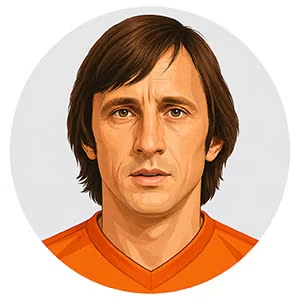
Netherlands - Defensive MidfielderHaan, Arie
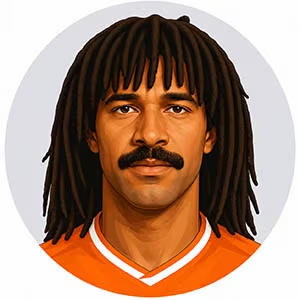
Ballistic long-range shooting and total positional flexibility turned Arend Haan into the ultimate tactical chameleon of Rinus Michels’ and Ernst Happel’s legendary Dutch sides. Graduating from the Ajax youth setup during the dawn of Totaalvoetbal, Haan initially established himself as a dynamic central midfielder before demonstrating his immense tactical intellect by shifting seamlessly into the sweeper role at the 1974 World Cup. Standing five-foot-eleven with a robust, muscular build, he combined disciplined spatial coverage with an extraordinary biomechanical striking technique; his ability to generate sudden, devastating velocity on dead balls and bouncing deliveries from 40 yards out earned him the nickname Torpedoman. Across a trophy-laden era at Ajax, he collected three consecutive European Cups (1971–1973) and three Eredivisie titles before moving to Belgium, where he became the tactical engine of Anderlecht's continental triumphs, capturing two European Cup Winners' Cups and two European Super Cups, alongside a later Belgian title with Standard Liège. Across 35 caps and six goals for the Netherlands, Haan featured as an immovable starter in back-to-back World Cup finals in 1974 and 1978, authoring two of the most iconic long-range missiles in tournament history against West Germany and Dino Zoff’s Italy during the 1978 campaign in Argentina.
Psychologically, Haan was a self-assured, cerebral pragmatist who approached football with a cold, almost scientific detachment. He possessed a high degree of tactical self-confidence, allowing him to absorb radical structural changes on the fly without suffering drops in concentration or positional anxiety. In high-leverage knockout environments, his emotional pulse was remarkably flat; while opposing defenses retreated into deep low blocks to protect the penalty box, Haan calmly surveyed the perimeter, backing his long-range technique to break the deadlock from distance when intricate passing patterns stalled. Inside the dressing room, he was an independent, articulate, and occasionally outspoken figure who refused to get dragged into the petty internal politics and financial feuds that frequently divided Dutch national squads. When facing aggressive man-marking or intense hostile atmospheres—such as the cauldron of the Estadio Monumental in 1978—he maintained a disciplined, unflappable demeanor, anchoring the backline and organizing transitions with quiet authority. Toward match officials and opponents, Haan carried himself with standard Northern European professional sobriety: avoiding theatrical simulation, competing firmly within the rules of the contest, and leaving an enduring legacy as one of the most intellectually gifted and dangerous long-distance shooters in European football history.



 All Time AjaxClub