We use Google Analytics to understand how visitors use this site. Analytics cookies are only activated with your consent. For details, read our Privacy Policy.
Profile lensThe same player, read from a different angle.
Athletic80
Acceleration
74
Pace
74
Agility
74
Strength
83
Balance
82
Jumping
82
Stamina
88
Fitness
80
Technical83
Dribbling
83
Short Passing
85
Long Passing
85
Finishing
71
Shot Accuracy
74
Shot Power
90
Shooting Technique
80
Heading
83
Tackling
78
Crossing
78
Free Kick
77
Penalties
74
First Touch
85
Mental82
Composure
84
Aggression
85
Consistency
80
Creativity
73
Leadership
85
Work Rate
81
Tactical82
Vision
84
Off the Ball
75
Defensive Positioning
78
Teamwork
91
Anticipation
81
Marking
72
Attacking76
Crossing
78
Finishing
71
Heading Accuracy
83
Shot Accuracy
74
Off the Ball
75
Technique83
Dribbling
83
Free Kick
77
Short Passing
85
Long Passing
85
First Touch
85
Shot Technique
80
Movement76
Acceleration
74
Pace
74
Agility
74
Balance
82
Physicality85
Shot Power
90
Jumping
82
Stamina
88
Strength
83
Fitness
80
Defending76
Marking
72
Tackling
78
Def. Positioning
78
Mentality & Game Reading82
Aggression
85
Composure
84
Penalties
74
Vision
84
Leadership
85
Work Rate
81
Teamwork
91
Anticipation
81
Consistency
80
Creativity
73
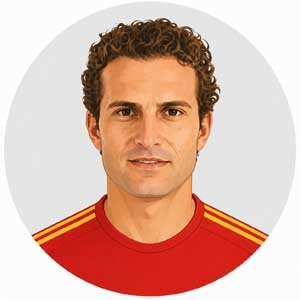
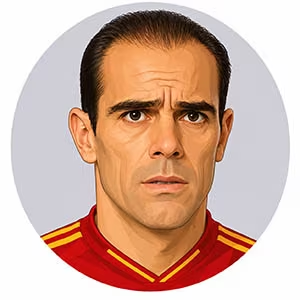
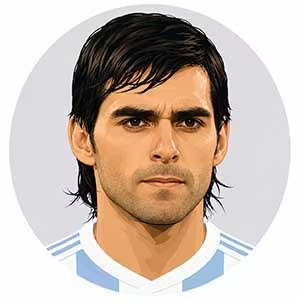
Spain - Defensive MidfielderBaraja, Rubén
Baraja was a complete central midfielder whose game combined defensive work, vertical passing and an unusually strong scoring threat from the second line. Tall, powerful and capable of sustaining repeated high-intensity runs, he could operate beside a holding midfielder or assume more responsibility for organising possession himself. He pressed aggressively, contested loose balls, protected central space and then moved forward once possession had been secured. His timing into the penalty area was exceptional for a midfielder: rather than remaining permanently advanced, he often arrived late beyond the forwards, making him difficult for defenders to track. He struck the ball cleanly from distance, attacked crosses well in the air and was reliable from set pieces. At Valladolid and then Atlético Madrid he established himself in the top flight, but his career changed after joining Valencia in 2000. Under Héctor Cúper and especially Rafael Benítez, his ability to combine intensity with tactical order became central to one of Europe’s strongest teams. Valencia reached the 2001 Champions League final, won LaLiga in 2001–02 and again in 2003–04, then added the UEFA Cup and European Super Cup in 2004. Baraja scored important goals throughout that cycle, including twice against Villarreal in a fierce 4–2 league comeback in 2004 and the opening goal against Porto in the European Super Cup. He remained at Valencia until retirement in 2010, winning the Copa del Rey in 2008 as well. For Spain he earned 43 caps, played every match of the 2002 World Cup campaign and appeared at Euro 2004.
His game demanded physical continuity, and this became its clearest vulnerability. Baraja himself linked his repeated muscular injuries to the intensity with which he played, and from the middle of the decade recurrent problems increasingly interrupted his rhythm. When he lacked full mobility, his ability to cover ground, press forward and still arrive in scoring positions diminished considerably. He was also more effective within a balanced midfield than as an isolated playmaker. His passing was intelligent and progressive, but he was not a specialist capable of controlling an entire match through possession alone. Similarly, his aggressive movement beyond the ball required positional insurance behind him; without it, spaces could open after turnovers. His temperament had another cost. Baraja later acknowledged that his abrasive manner had harmed his career prospects, and in unstable dressing-room environments his directness could make relationships harder rather than smoother. His standards increased collective intensity, but they did not always make him an easy personality to manage.
Baraja’s psychological profile is defined by a striking separation between what he felt and what he showed. During the long knee injury that disrupted the 2001–02 season, he later admitted that uncertainty over the diagnosis caused considerable anguish. His response was not to externalise it: he withdrew from interviews because he did not want others to see his state of mind and found greater calm by distancing himself temporarily from the football environment. When he returned, the emotional burden did not prevent immediate competitive involvement; the Espanyol match came near the end of that recovery and produced perhaps the most decisive individual contribution of Valencia’s title run. Similar patterns appeared later. After a 1–5 Champions League defeat to Inter in 2004, with teammates visibly shaken, Baraja publicly insisted that the team could not hide and had to face the next match at the Bernabéu wounded but standing. His leadership was therefore vocal, corrective and responsibility-oriented rather than reassuring. He did not pretend setbacks were painless, but he resisted allowing them to become excuses. This also applied inward. After repeated muscular injuries in 2006–07, he openly said that the relapses had been psychologically difficult and that being unable to help teammates frustrated him intensely, yet he also described the experience as having strengthened his self-esteem and repeatedly focused on recovering enough rhythm to contribute again. Toward coaches and institutions he was neither submissive nor habitually rebellious. He accepted demanding tactical authority when he believed in the project, but his own description of having an “arisco” — abrasive — character suggests low tolerance for artificial diplomacy. During Valencia’s internal upheavals he sometimes criticised decisions, but he also stated that if the club no longer wanted him he would simply leave rather than cling to status. Physical aggression did not appear to provoke emotional escalation; indeed, Baraja explicitly spoke before difficult matches about wanting football that was hard, physical and close-contact. He expected confrontation as part of competition. His disciplinary risk therefore came more from high-intensity involvement than from retaliation. Pressure itself generally increased his sense of responsibility. He wanted the ball, entered decisive areas and spoke publicly when the team was wounded. The cost was internal rather than theatrical: injury, exclusion and failure clearly affected him deeply, but his habitual strategy was containment first, action second.