We use Google Analytics to understand how visitors use this site. Analytics cookies are only activated with your consent. For details, read our Privacy Policy.
Profile lensThe same player, read from a different angle.
Athletic85
Acceleration
84
Pace
83
Agility
79
Strength
81
Balance
86
Jumping
85
Stamina
93
Fitness
89
Technical84
Dribbling
82
Short Passing
86
Long Passing
86
Finishing
84
Shot Accuracy
82
Shot Power
90
Shooting Technique
77
Heading
80
Tackling
76
Crossing
84
Free Kick
70
Penalties
86
First Touch
82
Mental86
Composure
82
Aggression
90
Consistency
86
Creativity
74
Leadership
89
Work Rate
91
Tactical87
Vision
88
Off the Ball
83
Defensive Positioning
71
Teamwork
93
Anticipation
89
Marking
71
Player Traits
Attacking83
Crossing
84
Finishing
84
Heading Accuracy
80
Shot Accuracy
82
Off the Ball
83
Technique81
Dribbling
82
Free Kick
70
Short Passing
86
Long Passing
86
First Touch
82
Shot Technique
77
Movement83
Acceleration
84
Pace
83
Agility
79
Balance
86
Physicality88
Shot Power
90
Jumping
85
Stamina
93
Strength
81
Fitness
89
Defending73
Marking
71
Tackling
76
Def. Positioning
71
Mentality & Game Reading87
Aggression
90
Composure
82
Penalties
86
Vision
88
Leadership
89
Work Rate
91
Teamwork
93
Anticipation
89
Consistency
86
Creativity
74
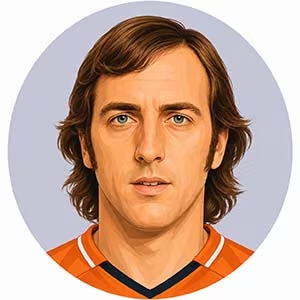
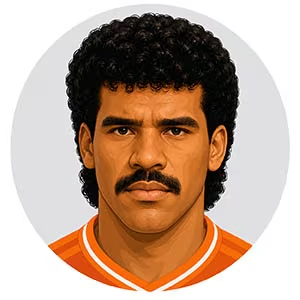
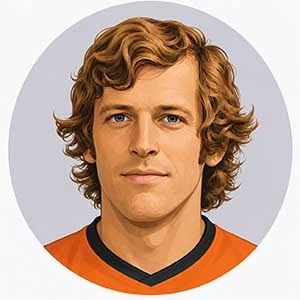
Netherlands - Centre MidfielderNeeskens, Johan
At the Olympiastadion in Munich on 7 July 1974, the World Cup final had barely begun when Johan Cruyff drove into the West German penalty area and was fouled by Uli Hoeneß. Johan Neeskens walked forward to take the penalty before a German player had touched the ball. He struck it hard through the centre as Sepp Maier moved away. The Netherlands led after roughly ninety seconds. Neeskens had already become one of the defining figures of their tournament through a combination of pressing, tackling, forward running and set-piece responsibility, but the opening of the final condensed his competitive profile into a single act. He did not require the match to settle before accepting its most exposed action. When the game produced a collision point—physical, tactical or psychological—Neeskens was unusually willing to become the player standing inside it.
Neeskens was a box-to-box midfielder whose technical quality was sometimes obscured by the violence of his running. He could press high, tackle aggressively, recover second balls and then continue the same action into the penalty area. At Ajax, positional interchange meant that his defensive work was not simply conventional midfield screening: he followed the movement of possession, stepped forward to compress space and helped prevent opponents from establishing controlled attacks after turnovers. Yet he could also pass cleanly, combine at speed and finish. His timing in the box produced goals with both feet and head, while penalties became another important source of output. He scored five times at the 1974 World Cup, including three penalties, and remained central when the Netherlands reached another final in 1978. At Ajax he won three consecutive European Cups before following Cruyff to Barcelona, where his physical and tactical range helped connect midfield aggression with attacking support. His value therefore came from phase continuity: he could begin an action as the ball-winner and finish it as an additional attacker.
The same structure created limits. Neeskens’s willingness to move aggressively towards the ball could become inefficient if the collective press failed around him; an intervention that was structurally correct inside Ajax’s coordinated pressure could become overextension in a less synchronised environment. His tackling also exposed him to disciplinary and physical cost, although describing him as chronically reckless would overstate the evidence. High-intensity engagement inevitably increased the frequency of contact and injury risk, and his game depended heavily on stamina and repeat acceleration. Once those athletic advantages declined, he had fewer mechanisms for dominating long stretches than a midfielder whose main value came from static distribution. Nor was he a deep orchestrator capable of controlling rhythm independently of movement. His passing was good, but his comparative advantage emerged through joining actions rather than standing outside them. Remove the possibility of pressing forward, contesting second balls and arriving late, and a significant portion of Neeskens’s influence disappeared.
Psychologically, Neeskens is best defined by **collision-seeking responsibility rather than generic fearlessness**. His role repeatedly placed him in actions where failure would be highly visible: penalties, front-foot pressing, physical duels and late runs into crowded areas. He did not merely tolerate those situations; his football gravitated towards them. The 1974 final penalty is the clearest high-pressure example, but the broader pattern is more important than one successful kick. Teammates and opponents remembered a player who set competitive intensity through action rather than through symbolic captaincy, using repeated physical engagement to establish what kind of match the team was willing to play. That should not be confused with emotional aggression in every confrontation. Much of Neeskens’s contact was functional and system-driven. Evidence for chronic referee argument, retaliatory fouling or loss of control after provocation is much weaker than the old “fiery temper” narrative suggests and should not be inflated. His later career also complicates the image of a player dependent on confrontation: he remained tactically useful after leaving the peak Ajax environment and adapted to different team structures without requiring permanent conflict to stay engaged. The stronger pattern is narrower: **when responsibility could be expressed by entering the hardest physical or tactical point of the action, Neeskens was unusually likely to volunteer himself for it**.