We use Google Analytics to understand how visitors use this site. Analytics cookies are only activated with your consent. For details, read our Privacy Policy.
Profile lensThe same player, read from a different angle.
Athletic82
Acceleration
88
Pace
89
Agility
87
Strength
76
Balance
78
Jumping
72
Stamina
84
Fitness
80
Technical84
Dribbling
87
Short Passing
85
Long Passing
85
Finishing
84
Shot Accuracy
82
Shot Power
85
Shooting Technique
84
Heading
72
Tackling
42
Crossing
84
Free Kick
81
Penalties
79
First Touch
86
Mental80
Composure
80
Aggression
78
Consistency
82
Creativity
82
Leadership
77
Work Rate
77
Tactical80
Vision
84
Off the Ball
83
Defensive Positioning
44
Teamwork
82
Anticipation
84
Marking
47
Attacking81
Crossing
84
Finishing
84
Heading Accuracy
72
Shot Accuracy
82
Off the Ball
83
Technique85
Dribbling
87
Free Kick
81
Short Passing
85
Long Passing
85
First Touch
86
Shot Technique
84
Movement86
Acceleration
88
Pace
89
Agility
87
Balance
78
Physicality79
Shot Power
85
Jumping
72
Stamina
84
Strength
76
Fitness
80
Defending44
Marking
47
Tackling
42
Def. Positioning
44
Mentality & Game Reading81
Aggression
78
Composure
80
Penalties
79
Vision
84
Leadership
77
Work Rate
77
Teamwork
82
Anticipation
84
Consistency
82
Creativity
82
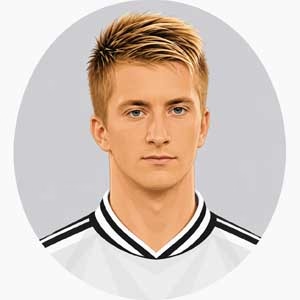
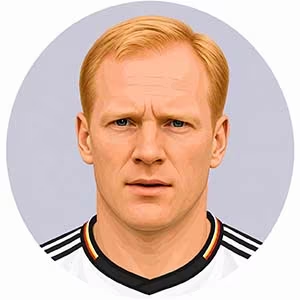
Germany - Right WingerReus, Marco
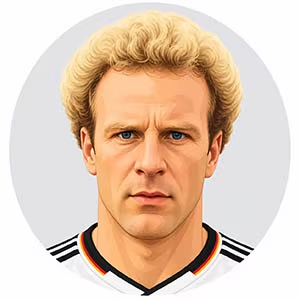
Few images in modern European football carry the bittersweet beauty of the blond-crested captain curling a sublime free-kick into the top corner at the Westfalenstadion, a moment of transcendent individual brilliance framed by a career perpetually interrupted by the cruelest medical setbacks. Marco Reus was the definitive attacking virtuoso of modern German football: an electrifying, intelligent second striker, attacking midfielder, and winger whose spatial awareness, one-touch combination play, and devastating finishing off either foot made him a world-class anomaly in transitional play.
Operating between the lines or attacking the channels from wide areas, Reus played with breathtaking speed of thought and execution. He combined rapid acceleration with an extraordinary ability to receive the ball at full sprint, link up through rapid-fire wall passes with teammates, and strike lethal, low-backlift finishes past advancing goalkeepers. Rising to prominence at Borussia Mönchengladbach—winning the 2012 German Footballer of the Year award—he returned to his boyhood club Borussia Dortmund in 2012 for €17 million. Over twelve seasons in black and yellow spanning 429 appearances and 170 goals, he became the spiritual heartbeat and long-serving captain of the club, lifting two DFB-Pokals (2016–17, 2020–21), three DFL-Supercups, and reaching two UEFA Champions League finals (2013 and 2024), while being named Bundesliga Player of the Season three times. For Germany, across 48 caps and 15 goals, his international pedigree was undeniable, starring at Euro 2012 and the 2018 World Cup, though his legacy was famously scarred by missing the triumphant 2014 World Cup and Euro 2016 due to devastating, ill-timed injuries on the eve of each tournament.
That sublime, fluid footballing brain, however, was constantly locked in an agonizing battle with physical fragility. A relentless cycle of syndesmosis tears, cruciate ligament ruptures, chronic adductor inflammation, and ankle trauma stripped away long stretches of his physical prime and forced him to adapt his game from an explosive winger into a more measured, central playmaker. Furthermore, in matches where physical enforcers targeted him with aggressive, repeated fouls to test his physical confidence on heavy pitches, his rhythm could be disrupted if his team lacked the structural muscle to protect him.
Introspective, intensely loyal, and carrying an unshakeable connection to the city of Dortmund, Reus rejected lucrative overtures from Europe's financial giants to remain the standard-bearer of his boyhood club through its most turbulent transitions. He met his staggering litany of heartbreaking tournament absences with profound emotional resilience, enduring grueling rehabilitation processes in silence and returning each time with the same graceful, selfless dedication to the pitch. On the field, his body language was a masterclass in kinetic elegance: drifting effortlessly into half-spaces, guiding attacking phases with subtle flicks, and celebrating iconic derby goals with passionate leaps toward the Südtribüne. Inside the Dortmund and German dressing rooms, his quiet dignity, technical generosity, and immense leadership under adversity made him an adored, iconic figure whose loyalty and talent earned him a legendary place in contemporary football lore.