We use Google Analytics to understand how visitors use this site. Analytics cookies are only activated with your consent. For details, read our Privacy Policy.
Profile lensThe same player, read from a different angle.
Athletic82
Acceleration
91
Pace
87
Agility
83
Strength
78
Balance
78
Jumping
77
Stamina
82
Fitness
79
Technical88
Dribbling
87
Short Passing
89
Long Passing
89
Finishing
85
Shot Accuracy
84
Shot Power
91
Shooting Technique
84
Heading
82
Tackling
48
Crossing
89
Free Kick
88
Penalties
85
First Touch
88
Mental79
Composure
83
Aggression
87
Consistency
76
Creativity
85
Leadership
81
Work Rate
74
Tactical83
Vision
87
Off the Ball
87
Defensive Positioning
44
Teamwork
82
Anticipation
76
Marking
42
Player Traits
Attacking85
Crossing
89
Finishing
85
Heading Accuracy
82
Shot Accuracy
84
Off the Ball
87
Technique88
Dribbling
87
Free Kick
88
Short Passing
89
Long Passing
89
First Touch
88
Shot Technique
84
Movement85
Acceleration
91
Pace
87
Agility
83
Balance
78
Physicality81
Shot Power
91
Jumping
77
Stamina
82
Strength
78
Fitness
79
Defending45
Marking
42
Tackling
48
Def. Positioning
44
Mentality & Game Reading82
Aggression
87
Composure
83
Penalties
85
Vision
87
Leadership
81
Work Rate
74
Teamwork
82
Anticipation
76
Consistency
76
Creativity
85
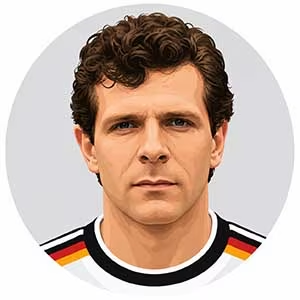
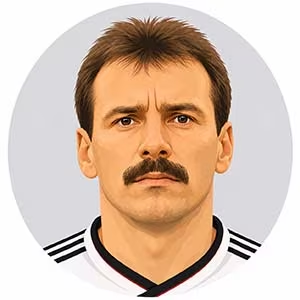
Germany - Attacking MidfielderMöller, Andreas
Old Trafford, June 1996, the semi-final of a European Championship England believed was theirs. Gareth Southgate had already missed. Andreas Möller placed the ball, took a short run, struck it high into the net, and then stopped in front of the England supporters with his chest inflated, hands on hips, chin raised — a pose held for several seconds and photographed from every angle in the stadium. It was arrogant, deliberate, entirely unnecessary, and completely in character. Möller understood better than almost any footballer of his era that being disliked was a cost he was prepared to pay.
Born in Frankfurt in 1967, he was one of the most technically gifted German attacking midfielders of the post-war period and one of the most consistently booed. At 1.75m he was slight and quick over short distances, with excellent close control, a hard and accurate shot from outside the box, and the specific gift of arriving late into the penalty area to finish moves he had started thirty yards earlier. He was a genuine number ten in a football culture that had never entirely trusted the position. His career moved between the German game's two poles: Eintracht Frankfurt, then Borussia Dortmund, then Juventus, then back to Dortmund, then Schalke 04 — a transfer that made him permanently unforgivable to the Dortmund support he had twice served. He won the Bundesliga twice with Dortmund (1995, 1996), the 1997 Champions League, Serie A and the 1993 UEFA Cup with Juventus, and the DFB-Pokal with Schalke. For Germany he collected 85 caps and 29 goals, won the 1990 World Cup as a squad member and the 1996 European Championship as a starter, and scored in both tournaments.
His reputation was not built solely on trophies. Möller went to ground with an ease that made him one of the most notorious divers in German football history, most famously in a 1995 match against Karlsruhe that earned a retrospective two-match ban and a public shaming rare for the era. He was physically avoidable, offered limited defensive work, and could be neutralised by aggressive man-marking. His form fluctuated with his mood, and in matches where the crowd turned on him early — which happened often, in almost every stadium in Germany including his own — he could retreat into peripheral, low-risk football rather than confront the hostility.
He was vain in a way German football had no vocabulary for. Möller was theatrical, image-conscious, quick to complain, and openly interested in his own status, and he made no effort to perform the modest professionalism his league expected. On the pitch he protested constantly, appealed for everything, and treated a physical foul as a personal grievance rather than an occupational hazard. Teammates generally found him a more agreeable figure than the public did, but he was never a leader and never sought to be one: his contribution was individual, and his relationship with a dressing room rarely extended past his own performance. The Schalke transfer confirmed a suspicion the country had held for a decade, that his loyalty was contractual rather than emotional, and he responded to the sustained abuse that followed with visible defiance rather than contrition. Away from football he lived a conventional, comfortable family life, and the arrogance was largely a competitive performance rather than a private one. Gifted, self-regarding and permanently jeered, Möller won almost everything the game offered while being loved by nobody outside his own contract.