We use Google Analytics to understand how visitors use this site. Analytics cookies are only activated with your consent. For details, read our Privacy Policy.
Profile lensThe same player, read from a different angle.
Athletic80
Acceleration
74
Pace
76
Agility
74
Strength
88
Balance
76
Jumping
85
Stamina
85
Fitness
78
Technical84
Dribbling
78
Short Passing
82
Long Passing
87
Finishing
70
Shot Accuracy
71
Shot Power
78
Shooting Technique
74
Heading
88
Tackling
89
Crossing
79
Free Kick
71
Penalties
68
First Touch
83
Mental84
Composure
88
Aggression
75
Consistency
78
Creativity
71
Leadership
87
Work Rate
85
Tactical86
Vision
82
Off the Ball
75
Defensive Positioning
89
Teamwork
88
Anticipation
88
Marking
86
Player Traits
Attacking77
Crossing
79
Finishing
70
Heading Accuracy
88
Shot Accuracy
71
Off the Ball
75
Technique79
Dribbling
78
Free Kick
71
Short Passing
82
Long Passing
87
First Touch
83
Shot Technique
74
Movement75
Acceleration
74
Pace
76
Agility
74
Balance
76
Physicality83
Shot Power
78
Jumping
85
Stamina
85
Strength
88
Fitness
78
Defending88
Marking
86
Tackling
89
Def. Positioning
89
Mentality & Game Reading81
Aggression
75
Composure
88
Penalties
68
Vision
82
Leadership
87
Work Rate
85
Teamwork
88
Anticipation
88
Consistency
78
Creativity
71
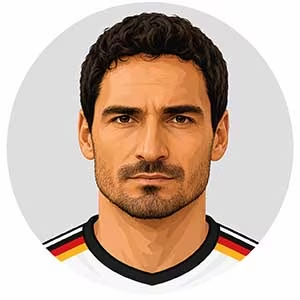
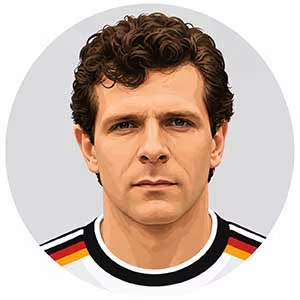
Germany - Centre-backHummels, Mats
Rio de Janeiro, July 2014: a corner, a leap, a header, and Germany were through to the semi-final against France. The goal itself was routine for him. What was less routine was the player scoring it — a centre-back who spent his career being told he was too slow, too casual and too fond of the difficult pass, and who kept answering by being right more often than anyone expected. Mats Hummels defended the way a chess player defends: several moves ahead, comfortable conceding a piece if the position improved, and entirely unbothered by how it looked while it was happening.
Born in Bergisch Gladbach in 1988 and raised in Munich, the son of a Bayern youth coach, Hummels came through the Bayern academy and was sent on loan to Borussia Dortmund in 2008, where the move became permanent and the career took shape. At 1.91m he was tall, strong in the air and genuinely uncomfortable in a footrace, and he built his defending on anticipation — stepping into passing lanes, intercepting rather than tackling, and reading the sequence before it developed. What separated him from his contemporaries was possession: he was among the finest passing defenders of his generation, capable of breaking two lines with a single diagonal and of carrying the ball out of defence when the press invited it. Under Jürgen Klopp he won two Bundesliga titles and the DFB-Pokal and reached the 2013 Champions League final; he returned to Bayern in 2016 for three more Bundesliga titles, then went back to Dortmund in 2019, where he stayed until 2024 and reached a second Champions League final at thirty-five. For Germany he collected 78 caps, won the 2014 World Cup, and was named in the tournament's team, before a difficult and public falling-out with Joachim Löw led to his exclusion in 2019 and a brief recall for Euro 2020.
His weaknesses were consistent and exploitable. Hummels was slow, and against forwards who ran in behind at pace he was in permanent danger, particularly in high defensive lines — a mismatch that produced some of the most costly individual errors of his career. His aggressive step-out sometimes vacated the space it was meant to close, and his willingness to attempt the ambitious pass in his own third occasionally handed opponents chances that a simpler player would never have offered. He was also injury-prone through his late twenties and, in his final Bayern seasons, visibly struggled with the intensity Pep Guardiola's system demanded.
His temperament was cool, articulate and faintly amused. Hummels was among the most intelligent and outspoken footballers of his era: he gave long, thoughtful interviews, discussed tactics with a precision most professionals avoid, criticised his own club and his own performances publicly, and used a dry, self-deprecating humour that made him popular with journalists and occasionally awkward for employers. He organised his defence verbally throughout matches, but his leadership was instructional rather than emotional — corrections delivered flatly, without theatre or anger, to teammates who described him as demanding but never abusive. He rarely argued at length with referees, fouled infrequently for a defender of his usage, and responded to provocation with visible indifference. Errors did not visibly destabilise him: he made high-profile mistakes in finals and tournaments, discussed them honestly afterwards rather than deflecting, and played the next match in exactly the same way. Away from football he was cultured and independent-minded, involved in fashion and social causes, and comfortable expressing political opinions in a profession that discourages them. Analytical, unhurried and quietly stubborn, Hummels defended with the calm of a man who had already accepted that being beaten occasionally was the price of controlling the game.