We use Google Analytics to understand how visitors use this site. Analytics cookies are only activated with your consent. For details, read our Privacy Policy.
Profile lensThe same player, read from a different angle.
Athletic80
Acceleration
75
Pace
76
Agility
75
Strength
82
Balance
76
Jumping
84
Stamina
83
Fitness
85
Technical79
Dribbling
77
Short Passing
79
Long Passing
75
Finishing
68
Shot Accuracy
74
Shot Power
84
Shooting Technique
73
Heading
81
Tackling
84
Crossing
68
Free Kick
73
Penalties
81
First Touch
78
Mental82
Composure
83
Aggression
76
Consistency
80
Creativity
68
Leadership
83
Work Rate
83
Tactical81
Vision
73
Off the Ball
68
Defensive Positioning
85
Teamwork
85
Anticipation
83
Marking
84
Attacking72
Crossing
68
Finishing
68
Heading Accuracy
81
Shot Accuracy
74
Off the Ball
68
Technique76
Dribbling
77
Free Kick
73
Short Passing
79
Long Passing
75
First Touch
78
Shot Technique
73
Movement76
Acceleration
75
Pace
76
Agility
75
Balance
76
Physicality84
Shot Power
84
Jumping
84
Stamina
83
Strength
82
Fitness
85
Defending84
Marking
84
Tackling
84
Def. Positioning
85
Mentality & Game Reading80
Aggression
76
Composure
83
Penalties
81
Vision
73
Leadership
83
Work Rate
83
Teamwork
85
Anticipation
83
Consistency
80
Creativity
68
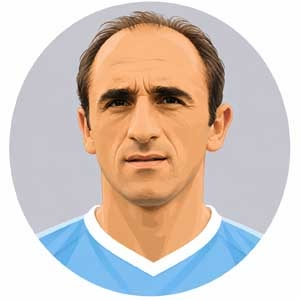
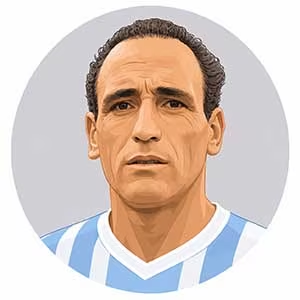
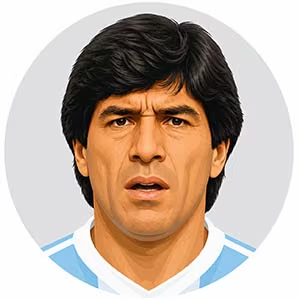
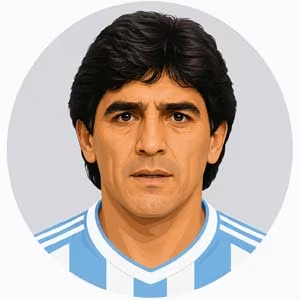
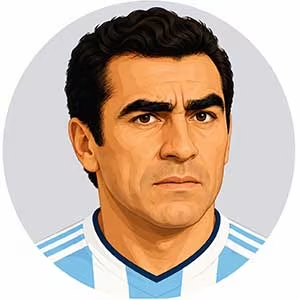
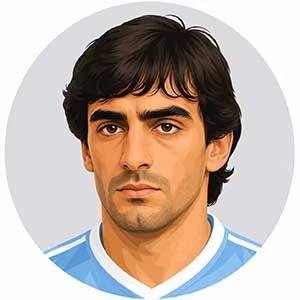
Uruguay - Centre-backMatosas, Roberto
Across the golden era of the 1960s, few sights in South American football matched the quiet majesty of a defender in yellow and black calmly killing a looping aerial clearance with his instep on the edge of his own penalty area, only to stride forward into the center circle with his head completely upright. Roberto Matosas Postiglione—born in Mercedes and raised in the fierce competitive furnace of River Plate and Peñarol—was the quintessential intellectual pioneer of the zaguero elegante: a commanding central defender and defensive midfielder who transformed Uruguay's traditional blood-and-guts defending into an art form of pristine spatial geometry, panoramic passing, and aristocratic composure.
Stationed as a cultured líbero, left-sided center-half, or deep-lying midfield distributor, Matosas dominated games through immaculate anticipation rather than desperate collisions. He read opposition passing lanes steps ahead of the play, intercepting transitional through-balls with soft, clean touches before initiating fluid counter-attacks with millimeter-precise forty-yard diagonal switches or incisive ground balls into the feet of attacking playmakers. Rising to prominence at CA Peñarol between 1958 and 1964, he was an indispensable tactical pillar of the legendary side that conquered South America, winning five consecutive Uruguayan Primera División titles (1958–1962), two Copa Libertadores (1960, 1961), and the 1961 Intercontinental Cup over Benfica. In 1964, River Plate shattered the international transfer market by paying an astronomical 33 million Argentine pesos to bring him to Buenos Aires; over five years at El Monumental spanning 165 matches and 19 goals, he anchored La Banda to the 1966 Copa Libertadores final and became one of the most revered defenders in Argentine football, before subsequent spells with Peñarol and Mexican sides San Luis and Toluca (where he lifted the 1974–75 Primera División title). For Uruguay, across 37 caps and one goal between 1960 and 1971, he was the defensive compass of two World Cups: starting every match at the 1966 tournament in England and orchestrating the backline during Uruguay's run to the semi-finals at the 1970 World Cup in Mexico, where they finished fourth.
That aristocratic, cerebral style, however, operated within specific athletic and situational limitations. Matosas was not a raw, explosive sprinter built to chase rapid, low-gravity wingers across wide-open thirty-yard channels; if an aggressive high press broke down and opponents bypassed his midfield with direct long balls behind his back, his recovery turning radius could be tested. Furthermore, because he possessed absolute supreme confidence in his ball control and spatial awareness, he occasionally took calculated risks when playing out of his own six-yard box under aggressive forward pressing, which could yield dangerous turnovers if teammates failed to show for the return pass.
Emotionally, Matosas was a figure of unshakeable inner tranquility, intellectual gravitas, and deep professional pride. He outright rejected the cynical, violent antics that characterized much of South American football in the late 1960s, demonstrating that authority could be established through moral dignity, spotless technique, and tactical superiority. He embraced immense pressure—such as the suffocating expectations of the world-record transfer fee at River Plate—with a cool, analytical perspective, treating football as an intellectual craft of angles, rhythm, and mutual respect. On the pitch, his body language was a masterclass in poise: head elevated, never rushing his clearances, directing teammates with calm, measured hand gestures, and stepping out of defense with effortless elegance. Inside the dressing rooms of Montevideo, Buenos Aires, and the Uruguayan national team, he was an untouchable patriarch and revered tactical mentor—an eternal symbol of Uruguayan football's aesthetic peak whose vision, composure, and technical mastery redefined the role of the modern South American defender.