We use Google Analytics to understand how visitors use this site. Analytics cookies are only activated with your consent. For details, read our Privacy Policy.
Profile lensThe same player, read from a different angle.
Athletic82
Acceleration
85
Pace
82
Agility
87
Strength
73
Balance
82
Jumping
78
Stamina
82
Fitness
83
Technical90
Dribbling
96
Short Passing
91
Long Passing
86
Finishing
88
Shot Accuracy
90
Shot Power
82
Shooting Technique
91
Heading
78
Tackling
44
Crossing
81
Free Kick
88
Penalties
88
First Touch
97
Mental84
Composure
88
Aggression
76
Consistency
85
Creativity
96
Leadership
83
Work Rate
75
Tactical86
Vision
88
Off the Ball
91
Defensive Positioning
42
Teamwork
85
Anticipation
84
Marking
38
Player Traits
Attacking86
Crossing
81
Finishing
88
Heading Accuracy
78
Shot Accuracy
90
Off the Ball
91
Technique92
Dribbling
96
Free Kick
88
Short Passing
91
Long Passing
86
First Touch
97
Shot Technique
91
Movement84
Acceleration
85
Pace
82
Agility
87
Balance
82
Physicality80
Shot Power
82
Jumping
78
Stamina
82
Strength
73
Fitness
83
Defending41
Marking
38
Tackling
44
Def. Positioning
42
Mentality & Game Reading85
Aggression
76
Composure
88
Penalties
88
Vision
88
Leadership
83
Work Rate
75
Teamwork
85
Anticipation
84
Consistency
85
Creativity
96
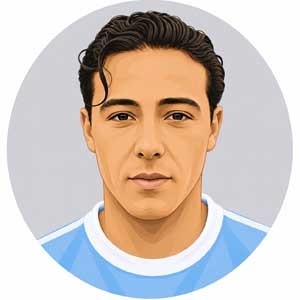
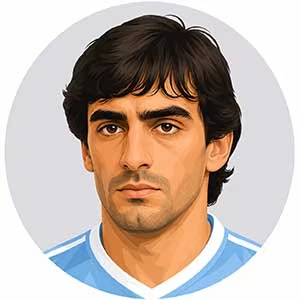
Uruguay - ForwardFrancescoli, Enzo
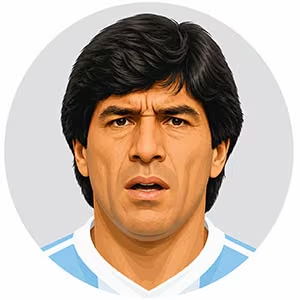
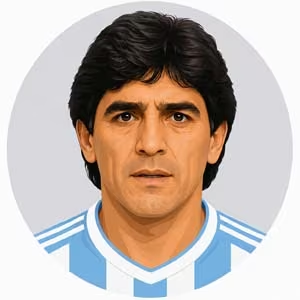
A teenage Zinedine Zidane sat transfixed in the stands of the Stade Vélodrome, absorbing the fluid body swerves and effortless velvet touches of a Uruguayan artist whose grace would compel the future French icon to name his firstborn son Enzo. Enzo Francescoli Uriarte—canonized across South America simply as El Príncipe (The Prince)—was the supreme aristocratic playmaker of his generation, blending the poetic vision of a classical number ten with the predatory, double-digit scoring instincts of a central forward.
Operating in the pocket behind the attack or gliding wide to orchestrate transitional triangles, Francescoli manipulated matches through posture, disguise, and immaculate balance. He was virtually uncatchable on the half-turn, utilizing sudden hip drops and a signature chest-control technique to cushion aerial diagonals before stroking finishes with either foot. Rising through Montevideo Wanderers, his mythical status was forged across two legendary eras at River Plate (1983–1986 and 1994–1997), scoring 137 goals in 237 matches, winning five Argentine Primera División titles, the 1996 Copa Libertadores as captain, and the 1997 Supercopa Sudamericana, alongside being twice named South American Footballer of the Year (1984, 1995). His European odyssey yielded the 1989–90 French Division 1 title with Marseille and cult stints in Serie A with Cagliari and Torino. For Uruguay, across 73 caps and 17 goals, he stands as an immortal national titan, lifting three Copas América (1983, 1987, 1995) and starring across two World Cups (1986, 1990).
Francescoli’s sublime elegance, however, operated within clear physical boundaries. Slender and upright, he avoided grinding physical wrestling matches against bruising stoppers in congested penalty boxes, relying entirely on spatial timing and quick give-and-goes rather than brute strength. When targeted by hyper-cynical man-markers on muddy pitches who hacked his ankles before he could face forward, his tempo-dictating rhythm could be disrupted if referees failed to penalize persistent fouling.
Noble, intensely dignified, and carrying the natural gravitas of a quiet leader, Francescoli commanded absolute reverence without ever shouting. He viewed football as an aesthetic and moral pursuit, playing with spotless sporting integrity and mentoring younger generations—including a young Marcelo Gallardo—with generous patience. On the pitch, his body language was all effortless serenity: gliding through midfield with an arched back, surveying passing runways with calm certainty, and celebrating triumphant goals with refined, princely smiles. Inside the River Plate, Marseille, and Uruguayan locker rooms, his moral authority was absolute—an untouchable patriarch whose technical mastery, humility, and timeless elegance made him the ultimate romantic icon of South American football.


 All Time UruguayNT