We use Google Analytics to understand how visitors use this site. Analytics cookies are only activated with your consent. For details, read our Privacy Policy.
Profile lensThe same player, read from a different angle.
Athletic79
Acceleration
82
Pace
77
Agility
83
Strength
76
Balance
81
Jumping
73
Stamina
77
Fitness
81
Technical87
Dribbling
91
Short Passing
89
Long Passing
90
Finishing
85
Shot Accuracy
85
Shot Power
83
Shooting Technique
87
Heading
73
Tackling
48
Crossing
85
Free Kick
79
Penalties
80
First Touch
94
Mental83
Composure
87
Aggression
75
Consistency
75
Creativity
93
Leadership
85
Work Rate
83
Tactical85
Vision
90
Off the Ball
87
Defensive Positioning
45
Teamwork
84
Anticipation
83
Marking
38
Attacking83
Crossing
85
Finishing
85
Heading Accuracy
73
Shot Accuracy
85
Off the Ball
87
Technique88
Dribbling
91
Free Kick
79
Short Passing
89
Long Passing
90
First Touch
94
Shot Technique
87
Movement81
Acceleration
82
Pace
77
Agility
83
Balance
81
Physicality78
Shot Power
83
Jumping
73
Stamina
77
Strength
76
Fitness
81
Defending44
Marking
38
Tackling
48
Def. Positioning
45
Mentality & Game Reading84
Aggression
75
Composure
87
Penalties
80
Vision
90
Leadership
85
Work Rate
83
Teamwork
84
Anticipation
83
Consistency
75
Creativity
93
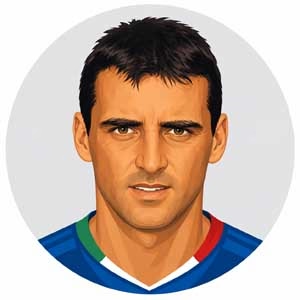
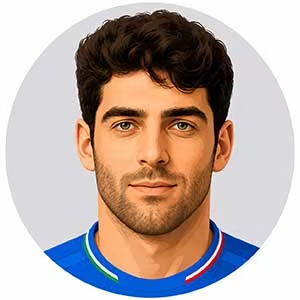
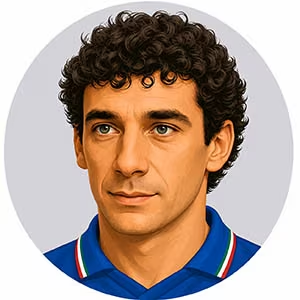
Italy - ForwardMancini, Roberto
Aristocratic vision, backheel flicks, and an astonishing technical precision on the half-volley turned Roberto Mancini into the ultimate creative dictator of Italian football across the 1980s and 1990s. Breaking through as a precocious teenager at Bologna before spending fifteen transformative seasons as the beating heart of Paolo Mantovani’s Sampdoria, Mancini operated as a classic fantasista and second striker who governed the offensive phase with complete authority. While he lacked blistering top-end sprint speed, his coordination and spatial balance were sublime: dropping between opposing midfield and defensive lines, absorbing physical pressure on the turn, and delivering disguised, reverse-angled through-balls into the path of his attacking partner Gianluca Vialli—forming the legendary I Gemelli del Gol (The Goal Twins). In front of goal, his execution was pure art, characterized by acrobatic mid-air volleys, outside-of-the-boot chips, and sudden backheel finishes at the near post. Mancini dragged Sampdoria to their historic 1990–91 Scudetto, four Coppa Italia titles, the 1990 European Cup Winners' Cup, and the 1992 European Cup final at Wembley, before following Sven-Göran Eriksson to Lazio in 1997 to secure another historic Scudetto (1999–2000), the 1999 Cup Winners' Cup, and two more domestic cups. Yet his international trajectory remained notoriously unfulfilled: despite 36 caps and four goals for the Azzurri, his stubborn refusal to accept tactical subordination or rotation under Azeglio Vicini and Arrigo Sacchi meant his genius was largely excluded from Italy’s World Cup campaigns. Psychologically, Mancini was a proud, hypersensitive perfectionist whose massive footballing intelligence came paired with an uncompromising, volcanic ego. He was an on-field prince who demanded absolute deference from everyone in his orbit; if a teammate ran into the wrong channel, misplaced a pass, or failed to match his creative rhythm, Mancini would openly lecture and gesticulate at them mid-match. This aristocratic petulance caused frequent friction with national team managers who refused to grant him the absolute tactical hegemony he enjoyed in Genoa and Rome. Inside the club locker room, however, his stature was mythical: at Sampdoria, he acted as a shadow technical director, advising Mantovani on transfers, helping design tactical set-pieces, and fiercely defending his teammates against external pressure. Under high-stakes pressure, his self-belief was unwavering; he relished the responsibility of the final ball, demanding possession in congested penalty boxes and executing high-risk artistic flicks with cold technical certainty. Toward referees and aggressive man-markers, Mancini was fiery, combative, and relentlessly vocal, constantly disputing calls and fighting for every foul, cementing a complex legacy as one of the most gifted, domineering, and artistically brilliant creators in Serie A history.